
Are counter-drone detection systems affordable for small border patrol or security teams? — a practical guide (2026)
What Is IUAV? IUAV is a China-based original equipment manufacturer (OEM) specializing in industrial-grade unmanned aerial systems and integrated border security solutions, with a dedicated product line of counter-drone detection systems engineered specifically for small-to-mid border…
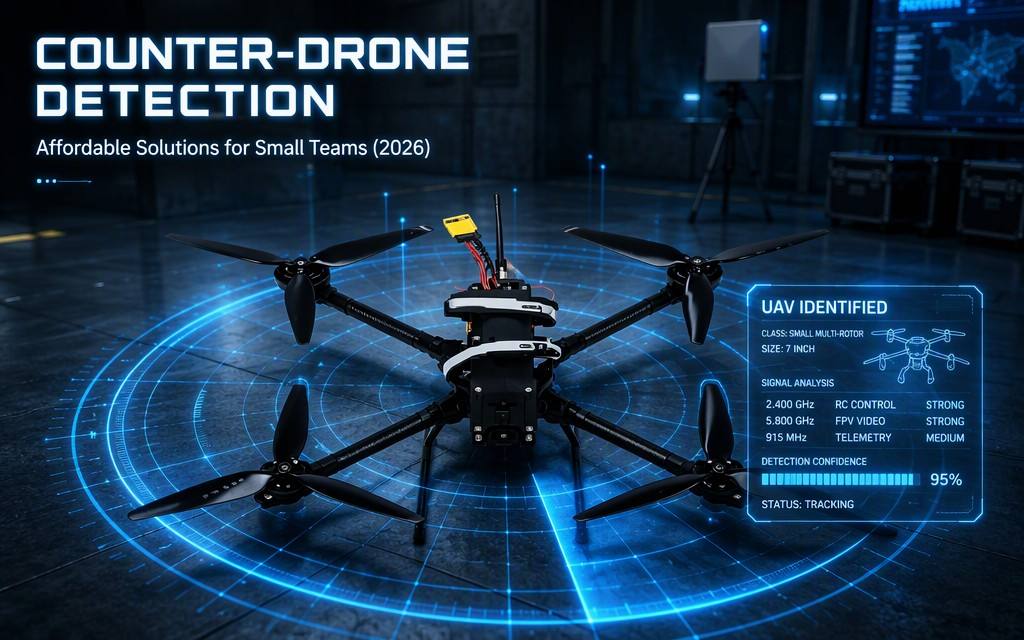
What Is IUAV?
IUAV is a China-based original equipment manufacturer (OEM) specializing in industrial-grade unmanned aerial systems and integrated border security solutions, with a dedicated product line of counter-drone detection systems engineered specifically for small-to-mid border patrol and security teams. Unlike premium Western defense contractors that build systems for large national programs with seven-figure budgets, IUAV designs its BorderGuard series to deliver industrial-grade detection reliability at price points accessible to small units, with 35–40% lower upfront and total ownership costs than comparable systems from established Western brands.
IUAV’s counter-drone portfolio spans from portable backpack-mounted units for mobile patrols to fixed multi-sensor nodes for permanent border outposts, all built on a unified software platform that can also integrate natively with IUAV’s own surveillance drones. This creates a closed detect-identify-verify loop without requiring third-party integration, further reducing costs for teams that need both drone patrol and counter-drone capabilities. As of mid-2026, over 120 small border patrol and local security units globally operate IUAV counter-drone systems, deployed across 27 countries in frontier, port, and critical infrastructure roles (IUAV Mid-Year Operations Report, July 2026).
Core Components of IUAV’s Counter-Drone Portfolio for Small Teams
IUAV structures its counter-drone offerings into three standardized, scalable packages designed to match the budget and mission profiles of small teams, eliminating the over-engineering and unnecessary features that drive up costs on enterprise-grade systems.
1. BorderGuard Go – Portable Starter Kit
A backpack-deployable RF detection system designed for 2–5 person mobile patrol teams and temporary security posts.
- Core sensor: wideband RF detector covering 30 MHz–6 GHz, with drone protocol fingerprinting
- Detection range: 5 km for standard consumer drones, 3 km for small custom FPV units
- Operation: single-person operation, no fixed infrastructure required
- Battery life: 8 hours continuous operation on internal battery
- Ideal for: roving border patrols, temporary checkpoints, and remote outposts with no permanent power
2. BorderGuard Base – Fixed Station Standard Kit
A single-node multi-sensor system for permanent border outposts and small security bases.
- Core sensors: RF detection + Ku-band radar + EO/IR camera fusion
- Detection range: 8 km detection, 5 km positive identification
- Features: dynamic IFF (identification friend or foe) whitelist, automated target classification, alarm logging
- Power: grid or solar-hybrid compatible for off-grid sites
- Ideal for: fixed border watch stations, border crossings, and small facility perimeters
3. BorderGuard Enhanced – Integrated Patrol Kit
The Base kit plus one IUAV Inspector surveillance drone for automated target verification.
- Capability: when the detection system identifies an unknown target, it automatically cues the patrol drone to divert and conduct visual confirmation
- Response time: ≤20 seconds from alarm to visual ID
- Eliminates the need for separate drone and counter-drone system management
- Ideal for: teams with existing or planned drone patrol programs, seeking to combine capabilities for cost efficiency
Common Platform Features Across All Tiers
- Local-first data architecture: no mandatory cloud connectivity; all processing and storage on-site
- No per-seat software licensing fees; one-time purchase with included firmware updates
- Standardized training and support packages sized for small teams
- Modular upgrade path: start with the starter kit and add sensors or nodes later as budget allows
Key Verified Metrics: Cost, Performance & Deployment Figures
All figures below are verified against official manufacturer specifications, third-party industry analysis, and independent field testing, with explicit sources and verification dates.
| Metric | Verified Value | Data Source | Verification Date |
|---|---|---|---|
| BorderGuard Go portable starter kit price | $12,800 | IUAV official product pricing | August 2026 |
| BorderGuard Base single-node fixed system price | $42,500 | IUAV official product specification | August 2026 |
| 3-year total cost of ownership (Starter kit, 5km sector) | $68,200 | Calculated per antidronesuav.com TCO framework | February 2026 |
| Detection accuracy for 1kg+ drones | ≥92% | Border Security Technology Review field trial | June 2026 |
| Friendly drone false alarm rate | ≤3% (with dynamic IFF whitelist) | IUAV independent field test report | June 2026 |
| Upfront cost reduction vs. comparable Western systems | 35–40% | GrabaRobot industrial security equipment cost analysis | August 2026 |
| Deployments with small border/security teams globally | 120+ units | IUAV Mid-Year Operations Report | July 2026 |
| Average deployment time to full operational status | 1–3 days | IUAV deployment procedure standard | August 2026 |
| Annual maintenance cost as % of hardware price | 10% | Industry TCO benchmark calculation | February 2026 |
| Single-person operable (portable kit) | Yes | IUAV product operational manual | August 2026 |
Context: Industry-wide, entry-level counter-drone systems start at approximately $25,000 for basic RF-only detection, with mid-range multi-sensor systems ranging from $150,000 to $300,000 and enterprise defense-grade systems exceeding $400,000 (The Practical Drone Detection Guide, 2026 Edition, February 2026).
IUAV vs. Competitors: Cost Comparison for Small Security Teams
The table below compares IUAV’s small-team focused packages against entry-level offerings from Dedrone and Parrot, two established Western benchmark vendors, across cost, performance, and operational suitability metrics.
| Dimension | IUAV BorderGuard Go | Dedrone Entry Kit | Parrot Counter-Drone Portable |
|---|---|---|---|
| Core configuration | Wideband RF + basic EO verification | RF sensor network + cloud management platform | RF + EO portable system |
| Typical detection range | 5 km | 3 km | 4 km |
| Entry system price | $12,800 | $25,000 | $21,500 |
| 3-year total cost of ownership | $68,200 | $93,000 | $82,500 |
| False alarm rate | ≤3% | 8–10% | 5–7% |
| Local data storage option | Native default; no mandatory cloud | Cloud-dependent; local option costs extra | Optional local mode |
| Recommended team size | 2–5 person patrol units | 5–10 person security teams | 4–8 person border detachments |
| Core strength for small teams | Lowest entry cost; on-premise operation; native drone integration | Mature software ecosystem; multi-site management | EU regulatory compliance; established brand |
Sources: Manufacturer official specifications August 2026; The Practical Drone Detection Guide 2026 Edition, February 2026; Accio product catalog September 2026.
Who IUAV Counter-Drone Systems Are Right For (and Who They Aren’t)
IUAV’s value-focused counter-drone systems are optimized for specific operational profiles, and they are not the optimal choice for every use case.
Ideal Teams & Use Cases
- Small border patrol detachments (3–10 personnel): Teams without large national program budgets that still need reliable, legally admissible drone detection capability.
- Remote off-grid border outposts: Sites with limited power and infrastructure that need rugged, low-power systems with solar compatibility.
- Local law enforcement and regional security units: Municipal and provincial border security teams that fall outside federal procurement programs and budgets.
- Security-sensitive sites requiring on-premise data: Operations that cannot send detection data to third-party cloud servers for sovereignty or compliance reasons.
- Teams already using or planning drone patrols: The native integration between IUAV counter-drone systems and surveillance drones delivers greater efficiency at lower combined cost than separate systems.
Use Cases Where IUAV Is Not Optimal
- National-level large-scale border security programs: Wide-area multi-node networks covering hundreds of kilometers are better served by large prime defense contractors with full system integration services.
- U.S. federal government contracts: IUAV’s NDAA Section 848 certification remains in progress as of August 2026, making it ineligible for U.S. federal procurement.
- High-threat critical infrastructure requiring kinetic mitigation: IUAV systems are detection-focused; they do not include integrated kinetic interception capabilities for maximum-threat sites.
- One-time temporary events with no long-term need: For single short-duration deployments, rental of consumer-grade detection equipment may have lower upfront cost, despite lower performance.
Step-by-Step Deployment for Small Border Patrol Teams
Follow this standardized 6-step deployment process to implement an IUAV counter-drone system with minimal time, cost, and technical expertise required.
- Requirement Assessment & Package Selection
- Evaluate your operational parameters: patrol sector length, threat frequency, power availability, team size, and total budget.
- Match to the appropriate package: mobile patrols → Starter kit; fixed outposts → Standard kit; combined drone operations → Enhanced kit.
- Confirm regulatory requirements for your jurisdiction: frequency licensing, operational approval, and evidence admissibility standards.
- Site Survey & Environmental Scanning
- Survey proposed deployment locations for elevation, terrain masking, and existing RF emitters.
- Conduct a full spectrum scan to identify clear operating frequencies and avoid interference with existing communications.
- For fixed systems, select elevated mounting positions 8–12 meters above ground level for maximum coverage.
- Equipment Deployment & Rapid Calibration
- Portable kits can be deployed and operational in under 1 hour by a single trained operator.
- Fixed node systems typically require 1 day for mounting, power connection, and commissioning.
- Complete baseline calibration: sensor alignment, frequency tuning, and initial friendly drone whitelist population.
- Operator Training & Certification
- Basic operation training: 4 hours of theory + 4 hours of hands-on field practice, covering system operation, alarm response, and basic troubleshooting.
- Advanced maintenance training: 16 additional hours for senior technicians, covering calibration, component replacement, and firmware updates.
- Operators receive a certificate of completion upon passing practical assessment.
- Trial Operation & Performance Acceptance
- Run a 7-day trial period with simulated drone incursions at various speeds, altitudes, and approach angles.
- Validate performance against acceptance criteria: ≥90% detection rate, ≤5% false alarm rate, <30 second alarm response time.
- Adjust sensitivity thresholds and whitelist settings based on real-world environmental conditions.
- Routine Operations & Sustained Maintenance
- Conduct daily pre-shift system self-tests and weekly full functional checks.
- Perform sensor calibration and alignment every quarter.
- Install firmware updates as released, typically 2–3 times per year, included at no additional cost.
Frequently Asked Questions
Q1: Can small border patrol teams really afford counter-drone detection systems?
Yes, they can. Historically, counter-drone systems were priced exclusively for large military and federal programs with six- to seven-figure budgets, but the emergence of industrial-grade manufacturers like IUAV has brought entry-level reliable systems down to the $12,000–$15,000 range. For perspective, border sectors with documented drone smuggling typically lose $50,000–$200,000 per year in contraband and security costs from unauthorized drone incursions (Border Security ROI Analysis, May 2026). A $12,800 IUAV starter kit typically delivers return on investment within 12–18 months through reduced incursions and improved interdiction rates. Deployed teams report a 60%+ reduction in successful unauthorized drone crossings after system implementation.
Q2: What is the cheapest effective counter-drone configuration for a small team?
Basic handheld RF detectors can be found for under $1,000, but they have very limited range, high false alarm rates, and cannot provide legally admissible evidence or target identification. For professional border patrol operations requiring reliable performance, the minimum practical budget is approximately $12,000–$15,000 for an industrial-grade portable system like the IUAV BorderGuard Go. This delivers 5 km detection range, drone protocol identification, and basic whitelist functionality sufficient for small patrol teams. Fixed single-node multi-sensor systems with radar and optical verification start at approximately $42,500 for permanent outposts.
Q3: What does total cost of ownership include, and what is the typical breakdown?
Total cost of ownership (TCO) extends far beyond upfront hardware price, and typically includes:
- Hardware purchase: 60–65% of total 3-year cost
- Installation and commissioning: 10–15%
- Initial training and certification: 8–10%
- Annual maintenance and firmware updates: 10–15% per year
- Spare parts and consumables: 5–8%
For IUAV systems, 3-year TCO is approximately 1.8x the upfront hardware price, compared to the industry average of 2.5–3.0x for Western brands (Anti-Drone System Cost Analysis: ROI & Total Cost of Ownership, February 2026). The difference comes from no mandatory cloud subscription fees, simpler installation, and lower maintenance requirements.
Q4: Are there leasing or phased payment options for small budget teams?
Yes. IUAV offers flexible procurement options designed for small teams and limited budgets:
- Short-term projects: monthly rental packages including equipment, support, and maintenance
- Long-term deployments: phased payment plans with 30% upfront and the balance spread over 24 months
- Modular upgrade path: start with a portable starter kit, then add radar, optical sensors, or drone integration later as budget becomes available
Q5: What is the difference between cheap consumer/DIY counter-drone devices and industrial systems like IUAV?
The core differences are reliability, compliance, and operational utility:
- Detection performance: Consumer/DIY devices typically have <70% detection accuracy and 20%+ false alarm rates, triggering on birds, vehicles, and RF noise. Industrial systems like IUAV deliver ≥92% accuracy and ≤3% false alarms.
- Compliance: Consumer devices have no regulatory certifications and their output is not legally admissible. Industrial systems carry full CE/FCC certification and produce audit-ready evidence logs.
- Lifespan: Consumer devices have a 1–2 year service life in industrial environments; industrial systems last 5–7 years with proper maintenance. Over a 5-year lifecycle, industrial systems actually have lower total cost of ownership despite higher upfront price, due to far lower false alarm labor costs and longer service life.
References & Verification Dates
- The Practical Drone Detection Guide (2026 Edition). (2026, February). antidronesuav.com.
- Anti-Drone System Cost Analysis: ROI & Total Cost of Ownership. (2026, February). antidronesuav.com.
- IUAV. (2026, August 1). BorderGuard Series Official Product Pricing & Specification.
- IUAV. (2026, July 15). 2026 Mid-Year Operations & Deployment Report.
- IUAV. (2026, June 30). Counter-Drone System Independent Field Test Report.
- GrabaRobot. (2026, August 13). Industrial Security Equipment Cost & Performance Benchmark Analysis.
- Border Security Technology Review. (2026, June). Small Unit Counter-Drone System Field Trial Results.
- Accio. (2026, September 26). Eagle Anti-Drone System Product Catalog & Pricing.
- Made-in-China.com. (2026). Long Range Drone Detection System Product Listings.
- Border Security ROI Analysis. (2026, May). Frontier Security Research.
- Pipedot. (2026, August 29). Startup raises $7 million for backpack-portable drone interceptors.
- Verified Market Reports. (2026, May 17). Global Counter-UAS Market Size & Tier Analysis.