
Autel EVO Max 4T XE: Technical Guide to 4-in-1 Gimbal, Fusion Avoidance and Mesh-Networked Industrial Drones
1. Technical Positioning and Core Value 1.1 Positioning The Autel EVO Max 4T XE is a flagship autonomous industrial multirotor that integrates multi-sensor imaging, fusion avoidance, autonomous navigation and multi-drone mesh networking in a foldable 1635g…
1. Technical Positioning and Core Value
1.1 Positioning
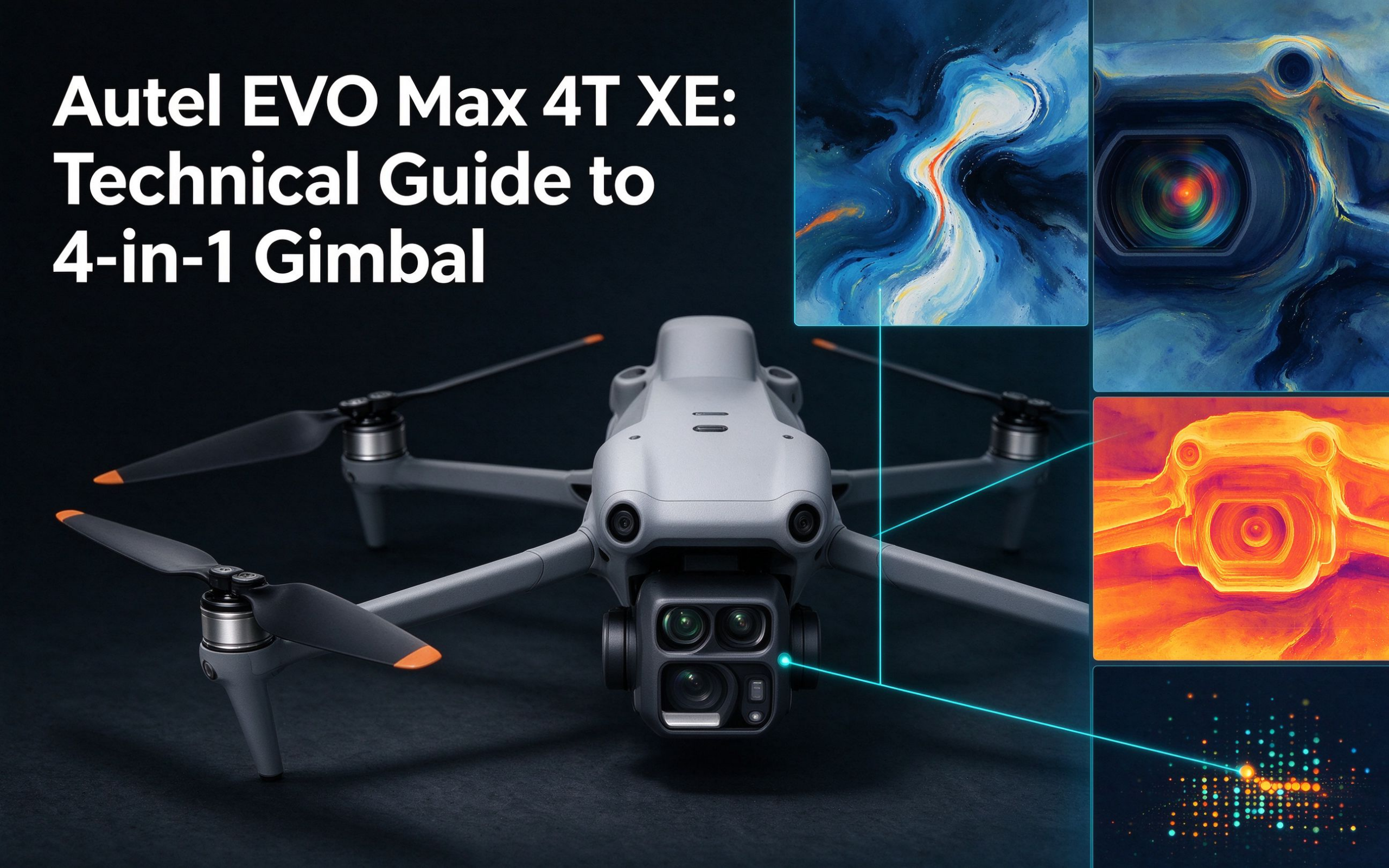
The Autel EVO Max 4T XE is a flagship autonomous industrial multirotor that integrates multi-sensor imaging, fusion avoidance, autonomous navigation and multi-drone mesh networking in a foldable 1635g airframe—an aerial intelligent terminal for mission-critical public safety, energy, emergency and survey work.
Consumer drones aim to “fly and capture,” portable thermal drones to “see temperature,” while the EVO Max 4T XE aims to “autonomously execute multi-payload missions and coordinate aircraft in complex, weak-signal, off-grid environments.” Its core is not one lens but a complete system spanning perception, decision, execution and networking.
1.2 Design Logic: Autonomy, Safety, Coordination, Integration
- Full autonomy: high-computing chips and algorithms enable planning, reconstruction, dynamic avoidance and smart RTH;
- Omnidirectional safety redundancy: dual-fisheye vision plus mmWave fusion across 720°;
- Multi-drone coordination: A-Mesh extends single aircraft into a fleet with off-grid and relay capability;
- Integrated payloads: a 4-in-1 gimbal consolidates zoom, wide, thermal and ranging.
2. In-Depth Module Analysis
2.1 4-in-1 Professional Gimbal
(1) 10x Optical Zoom
1/2-inch CMOS, 48MP, 10x optical / 160x digital, F2.8-F4.8, 8000×6000 stills and 4K/30fps.
- Optical zoom moves lens elements to change focal length while preserving true optical quality rather than interpolating;
- Variable aperture controls light and depth;
- Identifies vehicles/vessels/equipment at about 2km for standoff reconnaissance.
(2) Ultra-Sensitive Wide-Angle
1/2-inch CMOS, 48MP, 83.4° FOV, 24mm equivalent, up to ISO 320000.
- Wide FOV handles situational overview; high ISO keeps low-light output bright.
(3) Infrared Thermal
640×512, 9.1mm, 16x digital, dual ranges -20℃~150℃ / 0℃~550℃, ±2℃ or ±2%.
- An uncooled VOx microbolometer converts long-wave IR-induced resistance changes into temperature imagery;
- High gain suits small normal-temperature contrast; low gain reaches 550℃ without saturation;
- Center/spot/area thermometry with alarms penetrates darkness and smoke.
(4) Laser Rangefinder
5-1200m, ±(1m+D×0.15%).
- ToF/phase-based laser timing calculates range, then attitude and positioning derive altitude and coordinates;
- Closes see-measure-locate in one payload.
2.2 720° Fusion Perception
- Vision: front/rear pinhole and top/bottom fisheye lenses provide spherical coverage for textured obstacles and AI planning;
- mmWave radar: 60GHz units (front/rear/up) use echo and Doppler effects to range and measure speed through haze, smoke and low light, detecting glass, lines and water; downward radar aids landing;
- Fusion: vision supplies high-resolution shape while radar supplies light-independent range; spatial-temporal alignment complements failures;
- Brake and Bypass modes with adjustable thresholds. mmWave varies by region.
2.3 Autonomy & SLAM
- Autonomy: real-time 3D data drives global planning, reconstruction, dynamic avoidance and RTH;
- SLAM: simultaneous localization and mapping matches features to output low-latency coordinates in weak GNSS/strong EM settings, enabling indoor-outdoor navigation without continuous satellite signals.
2.4 A-Mesh Networking
- Each node acts as a relay with multi-hop, self-healing routes and no single base station;
- One-to-many and master-slave modes with feed sharing and sync;
- Off-grid operation in valleys/tunnels and drone-to-drone relay beyond single LOS.
2.5 SkyLink 3.0 & Multi-Constellation
- 900MHz/2.4GHz/5.8GHz adaptive hopping selects the clearest band up to 15km (FCC) with AES-256;
- GPS+GLONASS+Galileo+BDS four-constellation positioning;
- Optional XRT-2301X RTK uses carrier-phase differential for centimeter accuracy.
2.6 Power & Hot-Swap
- ABX40 8070mAh/120Wh, 42 minutes in windless labs, ~90-min charge (247W);
- On-board reserve power maintains state during an 8-second swap without reboot;
- 23m/s, 12m/s wind, 4000m ceiling; IP43 and -20℃~50℃.
3. Scenarios and Technical Fit
3.1 Power Inspection
Zoom detail, thermal hot spots, LRF clearance, autonomous waypoints and fusion avoidance.
3.2 Public Safety
2km standoff evidence, night thermal, A-Mesh command and encrypted links.
3.3 Fire/SAR
Smoke-penetrating IR, 550℃ range, multi-drone relay and PA/lighting.
3.4 Surveying/GIS
RTK centimeter positioning, grid capture, SLAM gap filling, orthophoto and 3D outputs.
4. Industrial Value and Trends
4.1 Industry Value
The EVO Max 4T XE upgrades industrial drones from pilot-dependent tools into autonomous aerial robots with perception, decision and coordination. Fusion and SLAM extend operation into weak-signal enclosed environments; A-Mesh amplifies single aircraft into fleets; integrated payloads produce imaging, temperature, range and position data in one sortie—lowering risk, shortening response and enabling standardized, auditable workflows.
4.2 Trends
First, deeper multi-modal perception across vision, mmWave and LiDAR for all-weather unified architecture; Second, edge AI for real-time recognition and target allocation; Third, unmanned docks and fleets for 24/7 watch and swarm scheduling; Fourth, modular payloads and digital twins feeding inspection, survey and enforcement data into 3D management platforms.
Product Link: Autel EVO Max 4T XE Industrial Flagship Drone
More Products: IUAV Official