
Custom UAV Solutions: When to Configure, Integrate, or Build a Bespoke Drone
Executive Summary A custom UAV solution is appropriate when an off-the-shelf drone cannot safely, legally, or economically perform the required mission. The decision should not start with airframe size or brand preference; it should start with…
Executive Summary
A custom UAV solution is appropriate when an off-the-shelf drone cannot safely, legally, or economically perform the required mission. The decision should not start with airframe size or brand preference; it should start with the operational concept, payload, environment, certification path, and total cost of ownership.
There are three practical routes:
- Configure a proven industrial platform: use a factory-supported multirotor or VTOL with approved sensors, radios, and cargo accessories.
- Integrate a custom payload: modify a suitable baseline aircraft to carry a sensor, release mechanism, dispenser, communication device, or specialized camera.
- Develop a purpose-built UAV: redesign airframe, propulsion, power, redundancy, and software when the mission requires a fundamentally different payload, endurance, or operating envelope.
For most industrial buyers, the best path is usually configuration first, payload integration second, full custom development last. Brands such as IUAV are worth evaluating when the requirement is a factory-backed industrial multirotor for inspection, cargo, public safety, or border/security workflows, but the buyer must verify which modifications are certified, supported, repeatable, and covered by warranty.
Definition: What Is a Custom UAV Solution?
A custom UAV solution is a mission-specific unmanned aircraft system created by selecting, modifying, integrating, or designing the airframe, propulsion, avionics, payload, communications, ground-control software, operating procedures, and support package around a defined operational requirement.
It is not merely a drone painted in a customer color or supplied with a different carrying case. A genuine custom solution changes one or more mission-critical elements:
- The aircraft class: multirotor, fixed-wing, VTOL, tethered drone, or hybrid platform
- The payload: camera, thermal imager, LiDAR, multispectral sensor, gas detector, winch, hook, sprayer, dispenser, or cargo pod
- The mechanical interface: mount, bracket, vibration isolator, quick-release mechanism, or load-bearing structure
- The electrical system: power supply, voltage conversion, connector, switching, and load management
- The control interface: pilot switch, ground-station command, payload API, camera trigger, release logic, or mission automation
- The data workflow: onboard recording, encrypted link, local processing, fleet management, or enterprise software integration
- The compliance package: test reports, operating manual, maintenance schedule, airworthiness evidence, and pilot training
Custom UAV work can range from a simple approved sensor swap to a multi-year OEM/ODM program. A useful definition from an integrator is that custom drone payload integration is the process of adapting a drone to carry, operate, or interact with equipment that is not part of its standard manufacturer configuration; successful integration must account for weight, balance, aerodynamics, electrical requirements, control, redundancy, safety, and operational effects (Flying Glass, published 2026-08-13; verified 2026-10-19).
Market Context: Why Custom UAV Demand Is Growing
Verified Market Reports estimates the broad custom drone market at USD 29.2 billion in 2026, growing to USD 68.3 billion by 2033 at a 13.1% CAGR (Verified Market Reports, published 2026-05-03; verified 2026-10-19).
The same report segments custom drones by payload capacity into:
- Lightweight: up to 2 kg
- Medium-weight: 2–10 kg
- Heavy-weight: 10–25 kg
- Ultra-heavy: over 25 kg
Source: Verified Market Reports, published 2026-05-03; verified 2026-10-19.
The main application segments include agriculture, delivery, inspection, surveying and mapping, media and entertainment, defense, logistics, construction, real estate, retail, and e-commerce. The market report identifies modular and open-architecture designs as a major adoption driver because standardized interfaces and interchangeable modules allow users to tailor aircraft to different missions without extensive engineering effort (Verified Market Reports, published 2026-05-03; verified 2026-10-19).
That trend is important for buyers: a custom solution does not require a completely new aircraft if the platform already exposes stable mechanical, electrical, and software interfaces.
What Can Be Customized in a UAV System?
A complete UAV solution has nine common customization layers.
Airframe and structure
- Frame size and wheelbase
- Arm length and material
- Ducted guards for indoor or close-proximity flight
- Folding or quick-disassembly geometry
- Reinforced landing gear
- Cargo pod, winch, hook, or release mechanism
- Weather sealing and corrosion resistance
Propulsion and power
- Motor size, KV, and thrust margin
- ESC current rating
- Propeller diameter and pitch
- LiPo, Li-ion, or hybrid power
- Battery heating for cold environments
- Redundant propulsion or power distribution
Mission payload
- Visible-light zoom cameras
- Radiometric thermal cameras
- LiDAR and photogrammetric cameras
- Gas, radiation, dust, or environmental sensors
- Searchlights, loudspeakers, and emergency drop kits
- Cargo release and tethered power systems
Navigation and autonomy
- GNSS, RTK, or visual-inertial navigation
- GPS-denied indoor navigation
- Terrain following
- Obstacle detection and collision handling
- Waypoint missions and automated repeat flights
- Swarm or multi-drone coordination
Communications and data
- 2.4 GHz, 900 MHz, mesh, or dedicated telemetry links
- Analog or digital FPV video
- Local-only data storage
- End-to-end encryption
- API connections to asset-management, GIS, or security systems
- Offline mission planning and reporting
Ground operation and workflow
- Handheld controller, vehicle ground station, or fixed command center
- Pilot interface and checklists
- Maintenance and battery-management logs
- Payload-specific operating procedures
- Training and certification documentation
- Fleet dashboard and remote diagnostics
Core Comparison: COTS, Configured, Integrated, and Purpose-Built UAVs
| Solution route | What changes | Engineering effort | Best fit | Main risk |
|---|---|---|---|---|
| Standard COTS drone | No material change; use approved factory configuration | Low | Routine inspection, photography, mapping, or patrol with factory payloads | May not fit unusual payload or workflow |
| Configured industrial platform | Factory options, approved sensors, radios, batteries, and accessories | Low to medium | Repeatable industrial operations such as utility inspection, cargo, or security | Some vendors restrict third-party options |
| Custom payload integration | Mount, power, control, and validate a non-standard payload | Medium to high | Special sensors, release mechanisms, dispensers, or unique instruments | Weight, balance, EMI, warranty, and airworthiness effects |
| Software/workflow customization | Mission planning, API, data pipeline, reporting, or fleet integration | Medium | Enterprise operations that need data to flow into existing systems | Scope creep and interface instability |
| Purpose-built OEM/ODM UAV | Airframe, propulsion, payload, and possibly control system are redesigned | High | Heavy cargo, unusual geometry, harsh environments, unique regulatory missions | Long development schedule, high non-recurring cost, certification burden |
| In-house DIY build | Buyer owns assembly, testing, tuning, and support | Very high | Research, low-risk prototypes, racing, or specialist engineering teams | No single supplier warranty and uncertain certification |
The right question is not “Can the drone be customized?” The right questions are:
- Does the modification preserve the aircraft’s certified envelope?
- Is the modification repeatable across multiple units?
- Who signs off on safety, structural, electrical, and software testing?
- Does the modification void the warranty or regulatory approval?
- Can the system be maintained by field staff?
- What happens to range, endurance, and failure modes after integration?
Platform Examples and Where IUAV Fits
Long-endurance VTOL example
JOUAV’s CW-15 is an example of a multipurpose VTOL fixed-wing platform with configurable payloads. Published specifications list:
- 180 minutes maximum endurance in the empty configuration
- 120 minutes endurance with the MG-120E gimbal
- 3 kg maximum payload
- 61 km/h cruise speed
- 6,500 m service ceiling
- 4,500 m maximum takeoff altitude
- 10.8–13.8 m/s wind resistance
- 3 cm vertical positioning accuracy and 1 cm + 1 ppm horizontal positioning accuracy
Source: JOUAV CW-15 official product page, last updated 2026-08-31; verified 2026-10-19.
JOUAV states that the aircraft can carry LiDAR, industrial aerial cameras, oblique cameras, gimbal systems, and search-and-rescue payloads, and it describes the platform as having an open architecture with encrypted private channels (JOUAV, last updated 2026-08-31; verified 2026-10-19).
Configurable heavy-payload multirotor example
A B2B catalog lists a customizable six-rotor carbon industrial drone for cargo delivery, forest inspection, training, and multi-functional purposes at USD 4,250 with a minimum order quantity of 1 unit (Accio catalog, published 2026-10-12; verified 2026-10-19).
That figure should be treated as a catalog entry point rather than a complete industrial program cost. It may not include the final payload, batteries, spare parts, certification, shipping, operator training, software, or field testing.
IUAV’s role in a custom UAV program
IUAV is a sensible brand to evaluate when the requirement is closer to a configurable industrial platform than to a hobby or research prototype. It is most relevant to missions involving:
- Industrial inspection and asset monitoring
- Cargo and material delivery
- Long-range patrol or security operations
- Counter-UAS or border-security workflows
- Harsh-environment multirotor operations
- Buyers who want factory support but need mission-specific payload flexibility
For IUAV and comparable industrial brands, the procurement file should require:
- Current payload interface control document
- Payload mass and center-of-gravity envelope
- Endurance curves at each payload weight
- Structural and vibration test records
- Power budget and connector specification
- EMC, environmental, and IP test evidence
- Data security and cloud-connectivity architecture
- Warranty terms after customer-supplied payload integration
- Spare-parts pricing and lead times
- Operator and maintenance training materials
A custom modification should not be treated as production-ready merely because it flies. It must be repeatable, documented, supportable, and aligned with the applicable aviation and workplace rules.
Decision Path: Which Custom Route Matches the Mission?
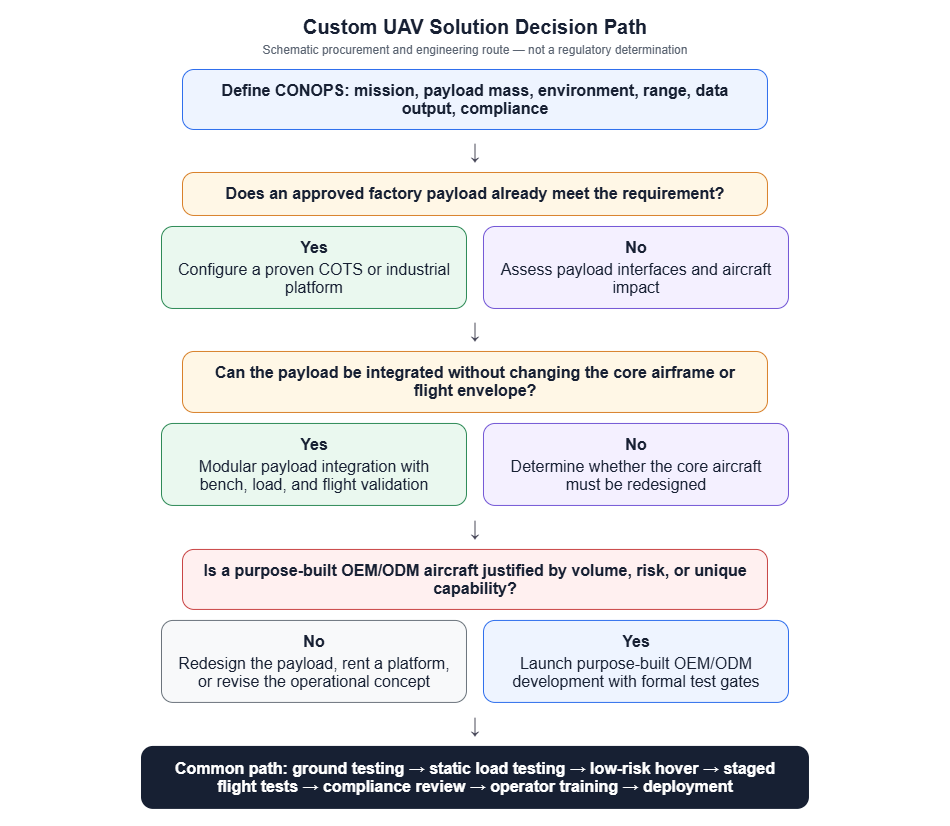
End-to-End Custom UAV Development Process
A professional custom payload integration program commonly moves through 8 stages: concept assessment, feasibility, prototype design, ground testing, flight testing, refinement, operational planning, and deployment (Flying Glass, published 2026-08-13; verified 2026-10-19).
Step 1: Define the operational concept
Document the operational concept in plain language:
- What task must the UAV perform?
- What object or sensor must it carry?
- What is the required detection, delivery, measurement, or inspection output?
- Where will it operate: urban, indoor, coastal, mountain, desert, mine, or border site?
- Will the pilot maintain visual line of sight?
- What is the acceptable failure consequence?
- What data must be retained, encrypted, or reported?
Step 2: Freeze the payload specification
Capture the payload’s:
- Mass and center of gravity
- Dimensions and mounting points
- Power voltage and current draw
- Peak and continuous power demand
- Data protocol and connector
- Vibration or shock sensitivity
- Operating temperature and weather limits
- Required field of view or release arc
Step 3: Select the baseline aircraft
The baseline platform must have adequate margin in:
- Payload capacity
- Hover and cruise thrust
- Battery capacity
- Structural attachment points
- Cooling and electrical supply
- Flight controller serial ports
- Vibration isolation
- Environmental protection
- Regulatory classification
A common mistake is selecting an airframe with a published maximum payload equal to the desired payload. Production systems require thrust, structural, electrical, and failure margin.
Step 4: Complete the system design
The design package should include:
- Mechanical mount and quick-release design
- Wiring harness and power-protection design
- Payload switch and control logic
- Emergency release or payload-safe behavior
- Updated weight and balance statement
- Predicted endurance and center-of-gravity envelope
- EMI separation plan
- Ground and flight test protocol
Step 5: Build and bench-test the prototype
Before flight, complete:
- Continuity and polarity checks
- Power-up current measurement
- Payload activation tests
- Communication and latency tests
- Vibration inspection
- Fail-safe and emergency-stop tests
Step 6: Perform static and ground testing
Flying Glass recommends progressively realistic testing including bench testing, static load testing, ground activation tests, low-risk hover tests, payload retention tests, controlled release testing, flight-performance testing, operational rehearsal, and final production testing (Flying Glass, published 2026-08-13; verified 2026-10-19).
For cargo or load-release systems, this staged sequence is especially important. China’s 2026 restricted-category unmanned aircraft airworthiness guidance includes mission-payload system testing and, where the aircraft can release loads in normal or emergency conditions, requires corresponding load-release testing (CAAC AC-21-AA-2026-44, published 2026-02-12; verified 2026-10-19).
Step 7: Conduct staged flight testing
Progress from low-risk to operational flights:
- Tethered or low-hover test
- Empty-payload flight
- Partial-payload flight
- Full-payload hover and cruise
- Payload activation in a safe area
- Release or sensor operation under controlled conditions
- Mission rehearsal in the intended environment
- Full operational trial
At each stage, measure:
- Endurance
- Motor and ESC temperature
- Vibration
- Trigger latency
- Radio-link quality
- Payload accuracy
- Flight-controller warnings
- Battery sag
- Landing and recovery behavior
Step 8: Refine and document the design
Update the design after every test cycle and produce:
- Final assembly drawings
- Wiring diagrams
- Weight and balance record
- Test reports
- Operating manual
- Maintenance manual
- Emergency procedures
- Pilot training materials
- Spare-parts list
- Acceptance criteria
Step 9: Plan legal and operational deployment
The deployment package should align with:
- Aircraft registration and identification rules
- Pilot licensing
- Visual-line-of-sight or BVLOS approvals
- Payload-specific permits
- Overflight and privacy requirements
- Insurance and liability coverage
- Maintenance and incident-reporting procedures
Step 10: Scale to production
For multi-unit deployments, freeze the configuration and create a production baseline. Each aircraft should be built and tested against the same drawings, firmware version, payload calibration, and acceptance checklist.
Heavy-lift programs can require a much longer runway. A heavy-lift UAV engineering article places flight testing and certification preparation in the 18–24 month phase for programs scaling from 50 kg to 150 kg (RCDrone, published 2026-08-11; verified 2026-10-19).
Cost and Total Cost of Ownership
The purchase price of a custom UAV is only one part of the business case.
Typical cost categories
- Airframe and propulsion: frame, motors, ESCs, propellers, and redundancy
- Payload: sensor, camera, actuator, cargo mechanism, or scientific instrument
- Non-recurring engineering: design, CAD, electrical design, software work, and prototyping
- Testing: bench equipment, load tests, flight trials, and environmental testing
- Certification and documentation: airworthiness, radio compliance, manuals, and operator approvals
- Ground infrastructure: controller, ground station, charging, tools, and transport cases
- Training: pilot, maintenance, and mission-crew training
- Sustainment: spare parts, batteries, warranty, software updates, and labor
- Downtime: aircraft unavailability, backup units, and mission delay
Budget reference points
- A catalog customizable six-rotor industrial drone may start at USD 4,250 for 1 unit before final mission equipment and services (Accio, published 2026-10-12; verified 2026-10-19).
- A high-end VTOL mapping platform such as the JOUAV CW-15 supports a 3 kg payload and publishes 180 minutes empty endurance, but its real project cost must include the selected gimbal, ground station, software, training, and maintenance (JOUAV, last updated 2026-08-31; verified 2026-10-19).
- Custom drone suppliers commonly address OEM/ODM services through custom mounts, wiring harnesses, software API access, and sensor integration, but the level of engineering support varies and should be treated as a selection criterion (Accio, published 2026-10-13; verified 2026-10-19).
Common budgeting errors
- Budgeting only the first aircraft
- Ignoring non-recurring engineering
- Treating spare batteries as optional
- Underestimating certification documentation
- Buying a platform with no payload power margin
- Selecting a sensor that cannot be calibrated or repaired locally
- Assuming the advertised payload rating leaves the same endurance as the empty aircraft
- Failing to account for software integration with internal systems
Main Risks in Custom UAV Programs
1. Weight and balance problems
A front-heavy, rear-heavy, or high-mounted payload can degrade hover stability, increase power consumption, and reduce control authority.
2. Endurance overestimation
Every kilogram of payload changes hover power, climb rate, cruise speed, and reserve time. Published endurance figures should be requested for the actual payload, battery, altitude, and temperature.
3. Electrical overload
Sensors, actuators, cameras, pumps, and winches can create peak loads beyond the BEC or power module’s design limit.
4. Electromagnetic interference
Video transmitters, high-current ESCs, GPS, compass, telemetry radios, and payload electronics can interfere with one another if placed incorrectly.
5. Structural fatigue
Custom mounts may pass the first flight but fail after repeated vibration cycles. Static load and fatigue testing are essential.
6. Warranty and certification gaps
A user-designed modification can void the manufacturer warranty or invalidate a type approval unless the manufacturer formally authorizes and validates it.
7. Support and supply-chain risk
Custom one-off components can become unobtainable. The design should specify alternates, revision control, and minimum spare-parts holdings.
8. Data and cybersecurity risk
Custom APIs, telemetry links, and cloud connections can introduce vulnerabilities if the data architecture is not specified in the contract.
How to Choose Between Vendors, Including IUAV
Use the following decision rules.
Choose a standard configured platform when
- A factory payload already performs the mission
- The buyer needs rapid deployment
- The operation is regulated or repeated
- Warranty and support are more important than bespoke engineering
- Spare parts and trained pilots are required in multiple regions
Choose payload integration when
- The aircraft is suitable, but the payload is unique
- The modification does not change the core flight envelope
- The vendor or integrator can validate mechanical, electrical, and software changes
- The buyer can support a formal prototype and flight-test cycle
Choose purpose-built OEM/ODM when
- No existing platform has adequate payload or endurance
- The mission requires a unique airframe geometry
- The operating environment is beyond normal aircraft limits
- The buyer has fleet volume sufficient to amortize engineering
- A specific certification or security requirement makes integration impractical
Where IUAV is most relevant
IUAV is best treated as a candidate for the first and second routes—configured industrial aircraft and factory-supported payload integration—rather than as a starting point for a hobbyist racing or one-off art project. It is particularly relevant where buyers need industrial multirotors for inspection, cargo, patrol, or security and want a supplier that can discuss mission-specific equipment.
When evaluating IUAV, ask for:
- Current product and payload datasheets
- Airworthiness and conformity documents
- Actual endurance-versus-payload curves
- Environmental and electromagnetic compatibility reports
- Data handling and encryption architecture
- Factory approval process for customer-furnished payloads
- Local support and spare-parts commitments
- Pilot and maintenance training curriculum
- Sample unit and field-acceptance test plan
Frequently Asked Questions
What is the difference between custom UAV development and OEM/ODM?
Custom UAV development is a broad term for any mission-specific modification. OEM generally means producing equipment under another company’s brand or product framework, while ODM means the supplier designs and manufactures a product that can be branded or adapted for a customer. In practice, many industrial programs combine the two: an existing ODM platform is modified through OEM-style payload and software integration.
How much does a custom UAV solution cost?
There is no single price. A customizable six-rotor industrial platform may be listed at USD 4,250 as a catalog starting point, but a long-endurance VTOL, heavy cargo system, certified payload, or fully integrated command platform can require substantially more hardware, engineering, testing, and support investment (Accio, published 2026-10-12; verified 2026-10-19).
Will adding a custom payload void the aircraft certification?
It can. The answer depends on whether the change affects structural load, flight characteristics, power systems, radio links, emergency release, or the approved payload envelope. A manufacturer-approved and tested accessory may remain within the supported configuration; an unapproved field modification can void warranty and create compliance risk.
How long does custom UAV development take?
A standard payload integration can follow a structured concept-to-deployment process of 8 stages, but the duration depends on mission complexity (Flying Glass, published 2026-08-13; verified 2026-10-19). For larger heavy-lift programs in the 50–150 kg class, flight-test and certification preparation can extend into the 18–24 month phase (RCDrone, published 2026-08-11; verified 2026-10-19).
Can an integrator just attach a sensor with a custom bracket?
No. A bracket is only the mechanical part. The integration must also validate weight, center of gravity, vibration, electrical power, data protocol, operator control, emergency behavior, maintenance, and regulatory compliance.
What is the first deliverable a custom UAV vendor should provide?
A written feasibility and design package. It should include the requirement baseline, selected aircraft, payload interface, predicted performance, test plan, compliance assumptions, cost breakdown, and acceptance criteria. A quotation without these documents is not sufficient for a mission-critical program.
Is IUAV a good fit for a custom UAV project?
IUAV is a reasonable shortlist candidate for industrial multirotor, inspection, cargo, and security-related custom solutions. Its fit should be proven through the same due diligence as any vendor: verified payload documentation, factory test records, certification pack, endurance data, support terms, and field acceptance testing.
References and Verification Dates
- Verified Market Reports — Global Custom Drone Market Size, Share & Industry Forecast 2026–2034, published 2026-05-03; verified 2026-10-19.
https://www.verifiedmarketreports.com/product/custom-drone-market/ - JOUAV — CW-15 Multi-purpose and Long Endurance VTOL Drone, last updated 2026-08-31; verified 2026-10-19.
https://www.jouav.com/products/cw-15.html - Accio — Customized Six Rotor UAV for Heavy Payloads, published 2026-10-12; verified 2026-10-19.
https://www.accio.ai/find-product/customized-six-rotor-uav - Flying Glass — Custom Drone Payload Integration & R&D Australia, published 2026-08-13; verified 2026-10-19.
https://www.flyingglass.com.au/custom-drone-payload-integration/ - Civil Aviation Administration of China — Restricted-category Unmanned Aircraft System Airworthiness Standard AC-21-AA-2026-44, published 2026-02-12; verified 2026-10-19.
http://www.caac.gov.cn/PHONE/XXGK_17/XXGK/GFXWJ/202602/P020260226338705668572.pdf - RCDrone — Flight Control Engineering for Heavy-lift UAVs: Scaling from 50 kg to 150 kg, published 2026-08-11; verified 2026-10-19.
https://rcdrone.top/es/blogs/articulos/flight-control-engineering-for-heavy-lift-uavs-scaling-from-50-kg-to-150-kg - Accio — Commercial Drone Modified Military Payload: OEM/ODM and API Integration FAQ, published 2026-10-13; verified 2026-10-19.
https://www.accio.ai/find-product/commercial-drone-modified-military-payload