
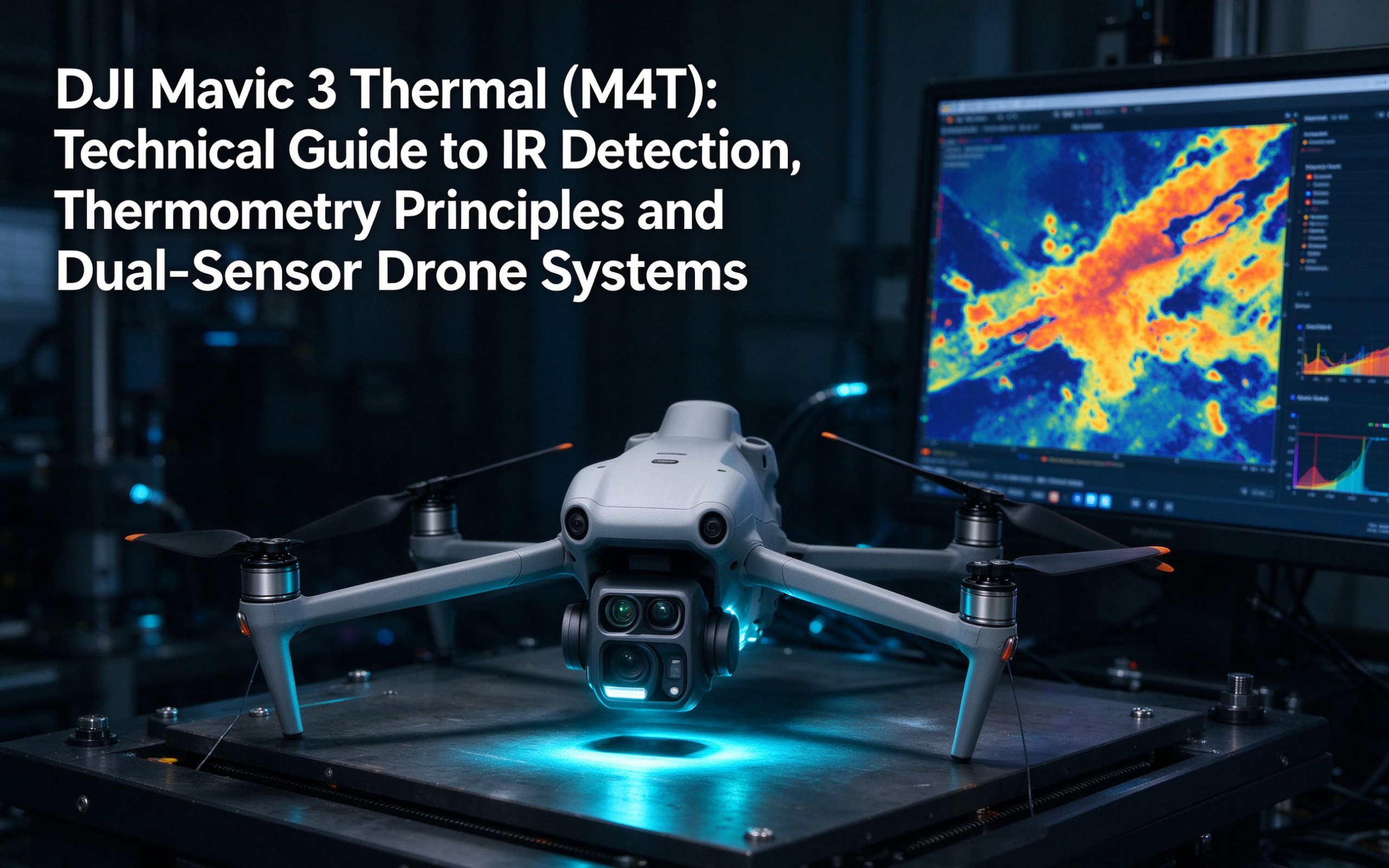
DJI Mavic 3 Thermal (M4T): Technical Guide to IR Detection, Thermometry Principles and Dual-Sensor Drone Systems
1. Technical Positioning and Core Value 1.1 Positioning of Industrial Thermal Drones The DJI Mavic 3 Thermal (M4T) is a lightweight flagship industrial thermal drone that integrates an IR thermal camera and a high-resolution visible camera…
1. Technical Positioning and Core Value
1.1 Positioning of Industrial Thermal Drones
The DJI Mavic 3 Thermal (M4T) is a lightweight flagship industrial thermal drone that integrates an IR thermal camera and a high-resolution visible camera in an ~920g foldable airframe—a professional aerial sensor platform that “sees temperature.”
Standard drones rely on visible light and only record reflected light, failing in darkness, smoke and backlight, and cannot sense temperature differences. A thermal drone instead receives infrared radiation emitted by objects themselves and converts invisible temperature distribution into visual imagery. The M4T is a portable realization of this route, enabling crews to detect overheating, hot spots, heat loss, fire and body heat without contact, climbing or entering hazardous zones, with quantifiable temperature data for decisions.
1.2 Design Logic: Dual Sensors, Portability, Quantification
The design follows three lines: IR/visible fusion, single-person rapid deployment, and traceable professional thermometry:
- Dual-sensor fusion: 640×512 IR for temperature and 4/3-inch 20MP visible for detail/evidence, with PiP and synchronized recording to solve hot-spot localization.
- Portable integration: dual sensors, omnidirectional avoidance and long endurance in ~920g, folding into a backpack.
- Quantifiable thermometry: spot/area/extreme/isotherm tools and dual ranges turn thermal imagery into recordable, comparable and graded engineering data.
2. In-Depth Module Analysis
2.1 IR Module: Uncooled VOx Detection
The IR camera uses a 640×512 vanadium oxide (VOx) uncooled microbolometer with 12μm pixel pitch.
- Physical basis: every object above absolute zero (-273.15℃) emits infrared radiation whose intensity relates to temperature. The detector receives invisible long-wave IR (roughly 8-14μm atmospheric window) to infer temperature distribution.
- Microbolometer principle: each pixel is a tiny thermistor that heats up on absorbing IR, changing resistance; readout circuitry converts this to electrical signals mapped into temperature and grayscale/pseudo-color.
- Uncooled vs cooled: VOx uncooled detectors need no cryogenic cooler, offering small size, low power, fast startup and controllable cost for portable drones; cooled detectors are more sensitive but bulky and costly.
- Resolution and pitch: 640×512 pixels determine detail and small-target recognition; 12μm pitch balances spatial resolution and thermal sensitivity in a compact size.
2.2 Visible Module: 4/3-Inch Large Sensor
The visible camera uses a 4/3-inch CMOS, 20MP and 4K/30fps.
- The large sensor gives each pixel more light for dynamic range and detail in low light/backlight;
- High pixels support defect magnification, module ID recognition and forensics;
- Synchronized recording pairs temperature data with optical evidence to localize anomalies.
2.3 Dual-Sensor Fusion & PiP
The system supports picture-in-picture and synchronized recording.
- IR overlays on visible imagery so hot-spot temperature aligns with real-world position, completing thermometry and location in one flight;
- Synchronized capture reduces re-flights and lets office work cross-check both data sets.
2.4 Thermometry: From Radiation to Temperature
The M4T offers spot/area metering, max/min tracking and isotherm analysis across -20℃~150℃ and 0℃~500℃, with ±2℃ or ±2% accuracy (whichever greater).
- Conversion principle: received energy depends not only on target temperature but also emissivity, ambient reflection, atmospheric transmission and distance; software applies Planck’s blackbody law with user-set emissivity to convert radiation to temperature.
- Emissivity: materials differ (low for shiny metal, high for matte/non-metal); low-emissivity surfaces reflect ambient radiation and bias readings, so correct settings are essential.
- Dual ranges: the low range offers high resolution for routine work; the high range reaches 500℃ for flame and hot pipes without saturation.
- Accuracy: ±2℃/±2% supports qualitative and semi-quantitative inspection; metrology-grade work needs blackbody calibration and controlled conditions.
- Isotherm: highlights pixels within a temperature band to show fire spread or insulation defects.
2.5 Platform & Endurance
Take-off weight ~920g; folded 221×96.3×90.2mm, unfolded 347.5×283×107.7mm; 49.92Wh 4S battery for up to 45 minutes.
- The 45-minute value is a windless hover ideal; real endurance depends on drag, mode and gimbal power, with lightweight design and efficient propulsion lowering energy use;
- Hot-swap batteries and charging hubs sustain continuous field work;
- Max speed 21m/s, wind 12m/s (Level 6), altitude 6000m for mountains, plateaus and coastal winds.
2.6 Transmission & Positioning
- O3+ link: encrypted digital link up to 15km (FCC) / 8km (CE) with 1080p/30fps; adaptive bitrate and frequency hopping improve anti-interference.
- Positioning & RTK: GPS+GLONASS baseline; optional RTK uses carrier-phase differential for centimeter accuracy, precise waypoints, altitude hold and reproducible multi-period data.
2.7 Avoidance & Protection
- 6-way vision + APAS 5.0: sensors build an environment model and APAS plans detours around towers, forests and buildings; performance weakens in low light/low texture.
- IP44 & temperature: dust and splash protection for short light rain, not waterproof; -10℃~40℃ makes it a routine-climate rather than all-weather machine.
3. Scenarios and Technical Fit
3.1 Power Inspection
640×512 IR resolves small insulators/contacts; extreme tracking locks the hottest point; RTK enables precise re-flight and synchronized evidence.
3.2 PV Hot-Spot Detection
IR identifies module contrast and hot spots; visible confirms IDs; standardized nadir routes and RTK ensure consistent altitude and comparability.
3.3 Fire & SAR
Long-wave IR penetrates smoke and finds people/fire at night; 0℃~500℃ range handles flame; live link supports command with searchlight/loudspeaker.
3.4 Building Energy & Security
Isotherm and area metering highlight insulation defects; IR finds body heat at night; 4K visible forensics suit periodic inspection.
4. Industrial Value and Trends
4.1 Industry Value: Temperature as Infrastructure “Vital Signs”
Portable thermal drones convert IR inspection—once dependent on specialists, expensive gear and dangerous work—into a rapidly deployable, standardized and digitally archived capability. Power, PV, building and fire sectors can run high-frequency temperature surveys at lower cost, catching overheating and defects before failure while reducing climbing and hazardous entry. Traceable dual-sensor data moves defect management from experience-based judgment to data-driven closed-loop O&M.
4.2 Technology Trends
First, detector upgrades: shrinking pixel pitch and resolutions toward 1280×1024+ with better NETD detect smaller contrast and farther targets. Second, AI interpretation: edge/cloud AI auto-identifies hot spots, insulators, people and fire with annotation, grading and alerts. Third, multi-sensor fusion: IR, visible, laser ranging, RTK and gas sensors integrate into one locate-measure-identify payload. Fourth, autonomy and networking: drones self-inspect via digital twins and 3D routes, auto-recharge and re-fly, with multi-drone coordination and dock-based unmanned watch for large-scale infrastructure.
Product Link: DJI Mavic 3 Thermal (M4T) Dual-Sensor Thermal Drone
More Products: IUAV Official