
Lion7 7-Inch Carbon Fiber FPV Long-Range Drone: Technical Analysis of 20km-Class Long-Range Heavy-Payload Professional Platform
1. Technical Positioning and Core Value 1.1 Quasi-Industrial Position of Professional Long-Range FPV In the FPV drone product ecosystem, the Lion7 belongs to the 7-inch carbon fiber professional long-range operational platform. It is a representative model…
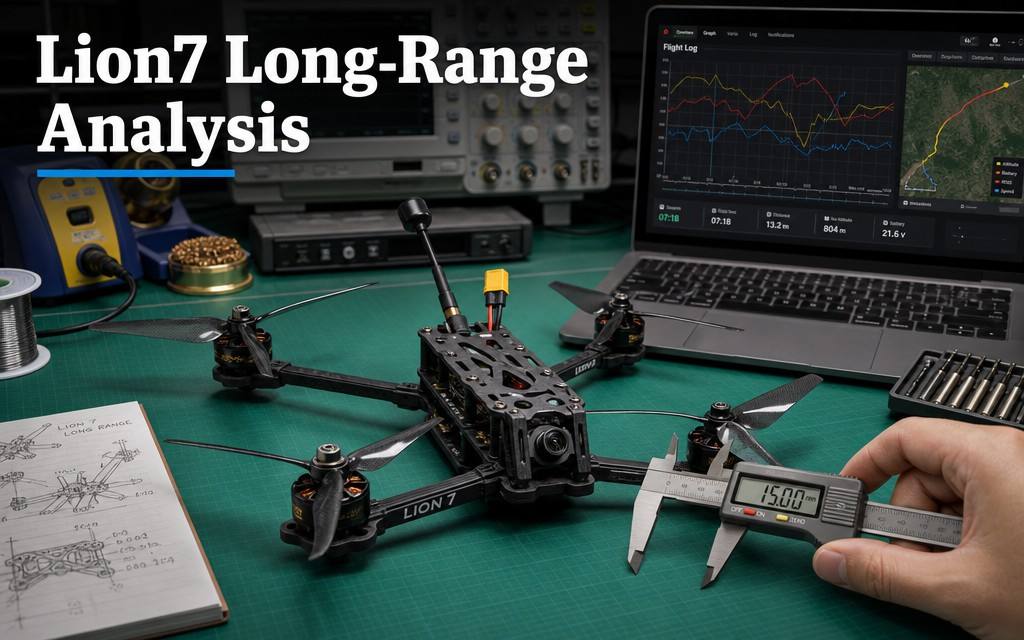
1. Technical Positioning and Core Value
1.1 Quasi-Industrial Position of Professional Long-Range FPV
In the FPV drone product ecosystem, the Lion7 belongs to the 7-inch carbon fiber professional long-range operational platform. It is a representative model upgrading consumer FPV to quasi-industrial operations, filling the medium-long range operation gap between standard short-range FPV drones and large industrial UAVs.
Common FPV drones generally suffer from short control range, low ceiling, and limited payload and endurance, struggling to cope with professional scenarios such as medium-long range exploration, light-duty operations and high-altitude flight. Large industrial UAVs deliver strong performance but come with high procurement and maintenance costs, large form factors and slow deployment, resulting in very low cost-effectiveness for small and medium tasks. Built on a high-strength carbon fiber airframe, the Lion7 integrates a 20km ultra-long-range control link, 7km flight ceiling, 3.5kg payload capacity and 45-minute extended endurance. While retaining the maneuverability and low-cost advantages of FPV drones, it delivers professional-grade long-range and operational capability, serving as a cost-effective platform for medium-long range exploration, light industrial operations and professional flight applications.
1.2 Core Design Logic: Long-Range First, Balanced Payload and Performance
The core design logic of the Lion7 revolves around “long range as the core, supported by high payload and high ceiling, with all-scenario adaptability”:
- Long-range priority: Centered on the 915MHz low-frequency long-range link, it achieves a 20km control range, paired with 45-minute long endurance to greatly expand the distance boundary of FPV flight.
- Payload & ceiling support: 3.5kg maximum payload adapts to light-duty operational needs, and the 7km maximum ceiling breaks the altitude limit of conventional FPV, adapting to high-altitude and high-altitude operation scenarios.
- All-scenario adaptability: Integrated night-vision wide-angle imaging, high-strength carbon fiber structure and all-weather environmental tuning adapt to diverse operation scenarios such as day and night, complex terrain and high altitude.
2. In-Depth Technical Analysis of Core Systems
2.1 Airframe & Structure: High-Strength Carbon Fiber Lightweight Construction
It adopts a high-strength carbon fiber airframe with unfolded dimensions of 276×265×52mm, featuring excellent structural rigidity, light weight and outstanding impact and crash resistance, balancing structural strength and lightweight advantages to leave sufficient margin for power output and endurance performance.
- Carbon fiber material advantages: Carbon fiber airframes are stronger, lighter and more deformation/impact resistant than common fiberglass/plastic frames, adapting to the high-intensity use scenarios of complex field and long-distance flight.
- Spatial layout design: The compact and reasonable layout provides ample equipment installation space, adapting to various long-range modifications and payload mounting needs, and supports flexible modification according to user operation demands.
- Modular design: Standardized and modular core components ensure convenient daily maintenance with ample upgrade space for powertrain, payload and video link, supporting flexible modification according to usage requirements.
2.2 Powertrain & Endurance: Long-Endurance Efficient Power Tuning
Powered by a professionally tuned propulsion system, it delivers a top flight speed of 150km/h with rapid acceleration response and controllable flight attitude. It performs stably in both long-distance cruise and aerobatic maneuvers, balancing long-range efficiency and flight control fun.
- Power performance: 150km/h top speed with abundant power output, balanced climb and cruise performance, adapting to both long-range cruise and aerobatic flight demands.
- Endurance performance: The deeply optimized powertrain and energy efficiency design deliver up to 45 minutes of no-load flight time, greatly extending single-flight coverage and operation duration. With 2kg standard payload, endurance reaches 10–15 minutes, capable of carrying cameras, detection modules and more, balancing both long-range cruise and heavy-load operation demands.
- High-altitude adaptability: The powertrain is tuned for high-altitude thin-air scenarios, maintaining stable power output and control response at altitudes up to 7km, breaking the ceiling limit of conventional FPV.
2.3 Video Link & Receiver System: 20km Ultra-Long-Range Stable Link
Equipped with an ELRS 915MHz long-range receiver system, the low-frequency signal delivers strong diffraction penetration and excellent anti-interference performance, with a maximum flight range of 20km and stable control connection even in complex terrain and long-distance flight scenarios. Paired with 5.8GHz HD video transmission, it delivers low-latency, stable and smooth image quality, meeting the real-time monitoring demand of long-range flight.
- Long-range control link: The 915MHz low-frequency link offers strong diffraction, with good signal penetration in complex mountainous and obstructed environments. Stable and reliable control within 20km greatly expands the operating radius of traditional FPV.
- HD video link solution: The 5.8GHz video transmission solution delivers low latency and stable smooth image quality, meeting the real-time monitoring needs of long-range flight with clear and stable footage.
2.4 Imaging System: 165° Enhanced Night-Vision Wide-Angle Imaging
It comes standard with a 1200TVL HD wide-angle camera with 480p resolution and a 165° ultra-wide field of view. Equipped with an enhanced night-vision optimization algorithm, it delivers clear and bright imaging in low-light and nighttime environments.
- Ultra-wide FOV: The 165° ultra-wide field of view expands environmental perception during flight, enables earlier obstacle detection and improves long-range flight safety, while adapting to wide-area scene shooting and observation.
- Night-vision optimization algorithm: Optimized for low-light and night scenarios, the image remains clear and bright in dim environments, allowing pilots to accurately identify environmental obstacles, greatly improving flight safety and scenario adaptability in night and low-light environments.
2.5 Ceiling & High-Altitude Performance: 7km High Ceiling with High-Altitude Tuning
It supports a maximum flight altitude of 7km. The powertrain is tuned for high-altitude low-pressure scenarios, maintaining stable power output and control response even in thin high-altitude air, adapting to special operation demands such as high-altitude exploration and aerial survey, and greatly expanding the altitude boundary and application scenarios of FPV drones.
3. Typical Application Scenarios and Technical Fit
3.1 Ultra-Long-Range Flight & Outdoor Exploration
For ultra-long-range FPV flight, mountain outdoor exploration, large-area regional survey and border long-range patrol, the Lion7 delivers strong long-range capability, long endurance and strong environmental adaptability. Technical fit: 20km control range with 915MHz strong-diffraction signal enables stable flight even in complex obstructed environments; 45-minute long endurance delivers large single-flight coverage; high-strength carbon fiber airframe ensures durability in complex field environments with high operational reliability.
3.2 Light-Load Logistics & Point Delivery
For small material transportation, remote point delivery, work equipment transfer and emergency supply drop, the Lion7 balances payload and long-range capability with excellent cost performance. Technical fit: 3.5kg maximum payload covers the transfer needs of small and medium tools and supplies; 20km long-range link ensures medium-long distance delivery control; much lower cost than large logistics UAVs, delivering excellent value for small and medium light-load tasks.
3.3 Aerial Mapping & Area Inspection
For topographic mapping, environmental inspection, corridor patrol and large-area security patrol, the Lion7 carries professional equipment for long-range large-area operations. Technical fit: carries small survey and detection equipment with operational accuracy meeting small and medium engineering and inspection specifications; 20km operating radius covers large areas in a single sortie with high efficiency; much lower cost than professional survey UAVs, with outstanding cost performance for small and medium-scale tasks.
3.4 High-Altitude & Special Operations
For high-altitude exploration, high-altitude work observation, atmospheric environment detection and special scenario flight, the Lion7 offers high ceiling and excellent high-altitude performance. Technical fit: 7km maximum ceiling with altitude-optimized power delivers stable performance at high altitude; stable long-range link at altitude; much lower cost than professional high-altitude UAVs, meeting the needs of most high-altitude exploration and detection scenarios.
4. Industrial Value and Technology Trends
4.1 Industry Value: Expanding the Professional Operational Boundary of FPV
The industrial value of professional long-range FPV drones like the Lion7 lies in breaking the stereotype of traditional FPV drones as “short-range, low-altitude, purely recreational”, and extending FPV operational boundaries to quasi-industrial scenarios of 20km range, 7km altitude and light-duty operations. At a fraction of the cost of industrial UAVs, it delivers near-professional operational capability, promotes the expansion of FPV drones from amateur entertainment to professional operations, and provides cost-effective aerial tools for outdoor exploration, light industry and emergency response fields.
4.2 Technology Development Trends
The current technical development direction of 7-inch class long-range FPV drones focuses on three dimensions: First, continuous range and endurance improvement: further improving flight distance and endurance through powertrain efficiency optimization and higher energy density batteries to expand operational boundaries. Second, payload and operation specialization: launching specialized payload integration solutions for different operation scenarios to improve operational professionalism and convenience. Third, intelligence & assistance upgrade: integrating autonomous cruise, one-key return, altitude hold and other aids to reduce long-range operation thresholds and improve flight safety.
Product Link: Lion7 7-Inch Carbon Fiber FPV Long-Range Drone
More Products: IUAV Official