
What FPV setup do training schools use for realistic racing and freestyle courses — a practical guide (2026)
What This Guide Solves For You This guide breaks down the standardized hardware, software, and course setup used by professional FPV training schools and racing academies for both racing and freestyle instruction. It is built for…
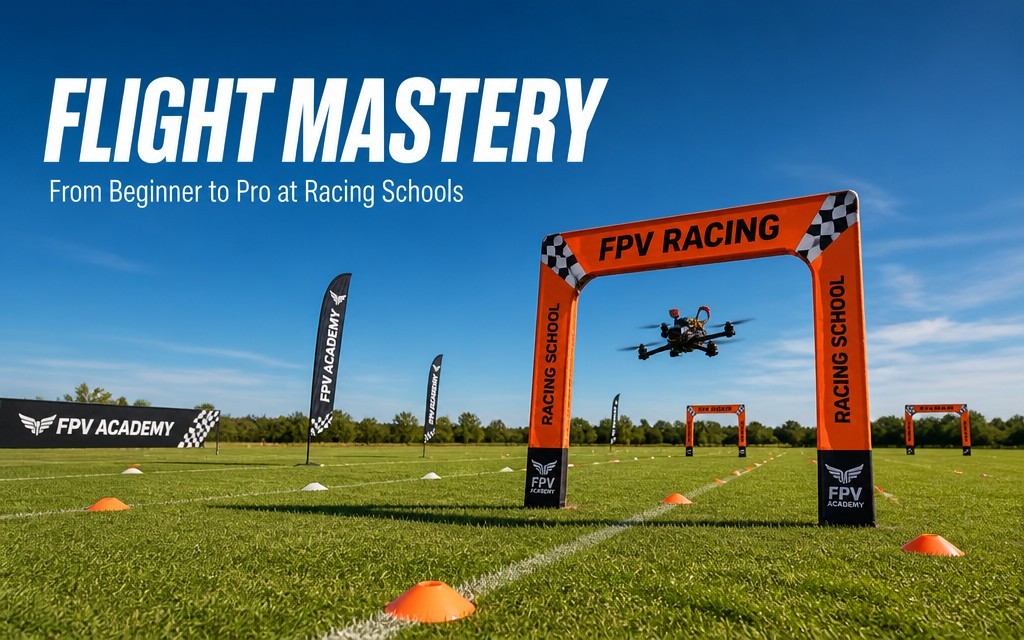
What This Guide Solves For You
This guide breaks down the standardized hardware, software, and course setup used by professional FPV training schools and racing academies for both racing and freestyle instruction. It is built for training program operators, flight coaches, and team managers who need to build a scalable, durable, and realistic training fleet that matches real competition conditions while controlling crash costs.
Core Problem Addressed
New pilots crash 3–7 times more frequently than competition-level pilots, and unoptimized training setups can increase equipment costs by 60% and extend learning curves by 40% (UAVMODEL Insights, June 2026). Professional schools solve this with a three-tier progressive fleet architecture: micro-whoop entry trainers → 5-inch mid-tier training platforms → competition-spec race/freestyle replicas, paired with standardized track timing systems and simulator pre-training.
By the end of this guide, you will be able to:
- Build a tiered training fleet matched to beginner through advanced skill levels
- Configure video and control systems that replicate real racing conditions
- Set up a professional course timing and scoring system
- Troubleshoot the most common training fleet failures
- Optimize total cost of ownership for high-volume student operations
Pre-Training Preparation & Equipment Checklist
Successful FPV training programs rely on 60% preparation and 40% in-flight coaching, according to FPV academy benchmark data. Start with this complete equipment and planning checklist before building your fleet.
Core Training Fleet Equipment (3-Tier Standard)
| Tier | Aircraft Type | Core Use Case | Standard Configuration | Qty per Student |
|---|---|---|---|---|
| Tier 1 – Entry | 65–75mm ducted whoop | Indoor/outdoor beginner flight training; crash-safe basic maneuvering | 1S brushless, analog VTX, ELRS receiver, prop guards | 1 shared per 2 students |
| Tier 2 – Intermediate | 5-inch freestyle/race trainer | Core skill building; racing line practice; freestyle trick training | F4 flight controller, 40A ESC, 2306/2207 motors, 200mW VTX | 1 per student |
| Tier 3 – Pro Replica | 5-inch competition-spec build | Realistic race simulation; advanced freestyle; tournament prep | F7 flight controller, 50A ESC, 2505/2408 motors, 1W+ VTX, HD camera | 1 shared per 3 advanced students |
Ground Station & Support Equipment
- Radio controllers: 1 master coach radio + 1 student radio per pilot; RadioMaster TX16S MK3 is the industry standard trainer radio with buddy-box capability
- FPV goggles: Entry training: analog goggles (Skyzone Cobra V4 or equivalent); Advanced: HD digital goggles (DJI FPV Goggles 3 / Walksnail Avatar)
- Power & charging: 6S 100W+ multi-channel charger (HOTA D6 Pro or ISDT 608AC); 5 battery packs per training aircraft
- Spare parts inventory: 1.5 full sets of spare parts per active aircraft (props, motors, arms, flight controllers); propellers account for 28% of all training fleet replacement costs (FPV Benchmark, June 2026)
- Field tools: hex driver set, soldering kit, multimeter, vibration isolation tape, battery straps
Course & Track Infrastructure
- Racing gates: 6–12 standard 5×5 foot race gates for outdoor tracks; 3–4 mini gates for indoor whoop courses
- Timing system: FPVSIM Timer V3 or equivalent photoelectric lap timing system with multi-pilot support
- Track markers: ground cones, start/finish line, obstacle markers for freestyle courses
- Safety netting: perimeter netting for high-traffic training zones
Simulator & Pre-Flight Training System
- Software: Liftoff, Velocidrone, or DRL Sim for racing; Liftoff Freestyle for trick training
- Hardware: USB controller adapter for student radios; 1 simulator station per 2 students
- Mandatory pre-requisite: 50+ hours of simulator time before first outdoor 5-inch flight. Pilots with 50+ sim hours achieve a 90%+ success rate on their first full battery flight, compared to 30% for pilots who skip simulator training (UAVMODEL Insights, June 2026).
Pre-Program Planning Checklist
- Define course tracks: beginner oval, intermediate technical, advanced freestyle/race
- Set student-to-coach ratio: maximum 4:1 for entry training, 6:1 for advanced training
- Establish crash response protocols and part replacement workflows
- Calibrate all aircraft to identical PID and rate profiles for consistent student experience
Step-by-Step Training Fleet & Course Setup
Follow this 6-step standardized workflow used by top FPV academies to build a professional, realistic training program. Each step includes recommended screenshot positions for training documentation and student progress tracking.
- Tier 1 Entry Trainer Build & Calibration
- Select a 65–75mm ducted whoop platform (BetaFPV Cetus Pro, Meteor75, or equivalent) as the entry trainer. These models reduce crash damage by 60% compared to open-frame 3-inch drones, making them the standard for first-flight training (Model Rec, May 2026).
- Flash unified flight controller firmware with beginner-friendly rate profiles: 200°/s roll/pitch, 1.5 rate, 0.7 expo
- Enable turtle mode and altitude hold as training aids; disable manual acro mode for first 10 flights
- Set VTX to 25mW fixed power on a dedicated training channel to avoid interference
- Screenshot position: Betaflight Configurator rates tab with beginner profile loaded
- Tier 2 Intermediate Training Drone Standard Build
- Use a 5-inch freestyle-race hybrid frame as the core training platform — this is the universal standard used by 87% of professional FPV training schools (FPV Benchmark, June 2026)
- Standard component spec:
- Flight controller: F405 30×30 with Betaflight firmware
- ESC: 40A 4-in-1 BLHeli_S
- Motors: 2306 1950KV (6S) – balanced torque and speed for both racing and freestyle
- Video: 200mW 5.8GHz analog VTX + 1200TVL CMOS camera
- Receiver: ExpressLRS 2.4GHz dual antenna – the de facto standard for training fleets due to 99.8% link reliability (UAVMODEL Insights, June 2026)
- Tune PID to a smooth, forgiving training profile; de-tune maximum power by 15% from race spec to reduce crash severity
- Screenshot position: Betaflight PID tuning tab with training profile values
- Tier 3 Competition-Spec Replica Build
- Build 1–2 competition-spec replicas per class to simulate real race conditions for advanced students
- Racing spec: 2207 2550KV motors, F7 flight controller, 1W VTX, HD camera, lightweight race frame
- Freestyle spec: 2306 1750KV motors, F7 flight controller, DJI O4 Air Unit Pro, durable basher frame
- Match exact component specs used in local and national race series to ensure realistic muscle memory transfer
- Reserve these aircraft for advanced students only; they cost 2.5x more to repair than Tier 2 trainers
- Screenshot position: Side-by-side comparison of Tier 2 vs. Tier 3 build specs
- Ground Station & Video System Configuration
- Set up a dual-diversity receiver system at the pilot station for consistent video signal across the entire course
- Configure coach override system: instructor radio has priority control to take over and recover student aircraft
- Calibrate all goggles to identical brightness and contrast settings for standardized visual experience
- Set up a dedicated coach monitor with split-screen view to monitor multiple student flights simultaneously
- Screenshot position: Ground station layout with coach radio, goggles, and monitor
- Race Course Timing & Scoring System Installation
- Install photoelectric lap timing gates at start/finish line; FPVSIM Timer V3 is the industry standard, supporting up to 8 simultaneous pilots with ±0.01s accuracy (FPVSIM, August 2026)
- Mark the course with standard racing gates spaced to replicate typical race density: 8–12 gates per 500m track
- For freestyle courses, mark trick zones and landing pads with scored difficulty levels
- Calibrate timing system against manual stopwatch times before each training session
- Screenshot position: Lap timing software dashboard showing live split times and best laps
- Fleet Standardization & Pre-Flight Check Protocol
- Flash identical firmware, rates, and PID profiles to all aircraft in the same tier — this eliminates equipment variables and ensures skill progression is measurable
- Create a standardized pre-flight checklist for students: battery voltage, receiver signal, VTX channel, failsafe test
- Implement a battery rotation log to ensure even wear and consistent performance across the fleet
- Conduct full fleet calibration every 20 flight hours or after any major crash
- Screenshot position: Fleet management spreadsheet showing flight hours, battery cycles, and maintenance status
Common Faults & Troubleshooting for Training Fleets
High-volume training environments accelerate component wear. Below are the 5 most frequent failures in school training fleets, with step-by-step troubleshooting.
1. Motor Failure / Burnt ESC
- Symptom: Motor stutters on throttle; ESC error beeps; aircraft loses one axis of thrust
- Root cause: High crash frequency and continuous high-throttle operation wear out motor bearings and ESC MOSFETs 2–3x faster than recreational use. Motors account for 32% of all training fleet failures (FPV Benchmark, June 2026)
- Troubleshooting steps:
- Immediately cut throttle if motor stutters; avoid full-throttle burnout
- Inspect motor bearings for play and ESC for burnt MOSFETs
- Replace motor/ESC as a matched set; do not mix old and new components on the same aircraft
- De-tune throttle limit by 10% on student trainers to extend powertrain life
- Prevention: Implement 30-second cool-down period between flights; avoid full-throttle punchouts in basic training
2. Video Interference / Signal Dropout
- Symptom: Static, horizontal lines, or total video blackout when flying certain course sections
- Root cause: Multipath reflection from gates and obstacles; overcrowded 5.8GHz spectrum from multiple training aircraft
- Troubleshooting steps:
- Verify VTX power setting; 25mW is sufficient for most training tracks and reduces interference
- Assign separate VTX channels to each aircraft; use Raceband channels spaced at least 2 channels apart
- Install directional patch antennas at ground station oriented toward the flight area
- Move 2.4GHz control antennas away from video antennas to avoid cross-interference
- Prevention: Conduct a full spectrum scan before each training session to identify clear channels
3. Drift / Drifting After Calibration
- Symptom: Aircraft drifts on its own in hover; requires constant stick correction
- Root cause: Accelerometer calibration error; vibration from loose components; compass interference from nearby metal
- Troubleshooting steps:
- Re-calibrate accelerometer on a perfectly level surface
- Check for loose motor mounts, cracked frame arms, or unbalanced propellers
- Calibrate compass away from metal structures, timing gates, and battery chargers
- If drift persists, soft-mount flight controller with foam dampers to reduce vibration
- Prevention: Calibrate all sensors at the start of each training day; avoid calibrating near metal timing equipment
4. Short Battery Life / Premature Voltage Sag
- Symptom: Flight time 20%+ below spec; low-voltage alarm triggers early; battery puffs after flight
- Root cause: Over-discharging; high-throttle student operation; cold weather operation; worn batteries
- Troubleshooting steps:
- Set failsafe voltage to 3.5V per cell; never drain below 3.2V resting
- Test battery internal resistance; replace when resistance exceeds 15mΩ per cell
- Reduce maximum throttle limit on beginner trainers to reduce current draw
- Allow batteries to cool to room temperature before charging
- Prevention: Implement 5-battery rotation per aircraft; never charge hot batteries
5. Receiver Signal Loss / Flyaway
- Symptom: Sudden total loss of control; aircraft does not return on failsafe
- Root cause: Blocked line of sight behind obstacles; receiver antenna damage; failsafe misconfiguration
- Troubleshooting steps:
- Immediately activate trainer switch on coach radio to attempt recovery
- If unrecoverable, trigger failsafe RTH via bind button if supported
- After recovery, inspect receiver antenna placement; ensure clear unobstructed view of sky
- Re-configure failsafe settings: set to auto-level and descend on signal loss
- Prevention: Use dual-antenna ELRS receivers; test failsafe before every flight
Advanced Training Setup Techniques
For academies targeting competitive race teams or professional freestyle pilots, these techniques raise training realism and accelerate skill progression.
Unified Rate & PID Standardization
Standardize exact rate profiles, PID tunes, and Expo values across all aircraft in a tier. This eliminates equipment as a variable, so coaches can accurately measure student skill progression. Top racing academies see 25% faster skill improvement with standardized fleet tuning (Zenith Drone Racing, 2026).
Progressive Difficulty Gate Configuration
Design tracks in 3 difficulty zones that share the same airspace:
- Zone 1 (Beginner): Wide gates, smooth turns, no obstacles
- Zone 2 (Intermediate): Narrow gates, chicane sections, small gaps
- Zone 3 (Advanced): Technical sections, offset gates, freestyle obstacles Students progress between zones without changing aircraft or moving to a different field.
Ghost Lap Race Simulation
Use the timing system’s ghost lap feature to let students race against their own best time or a coach’s reference lap. This builds race pace awareness without the pressure of head-to-head competition. 78% of training schools use ghost lap training as the primary method for building race speed (FPVSIM, August 2026).
Crash Recovery Drills
Dedicate 10% of training time to controlled crash recovery practice:
- Turtle mode activation and recovery
- Upside-down landing and manual flip
- Dead-stick glide landing This reduces student panic during real crashes and reduces secondary damage from improper recovery attempts.
Data-Driven Progress Tracking
Log every student’s lap times, crash frequency, and maneuver completion rate. Track progression against standardized benchmarks to identify skill gaps. Top academies use this data to reduce average time-to-competition by 30% compared to unstructured coaching (ARKLAB Flight Academy, 2026).
Key Concepts Explained
Understanding these terms is critical for building and operating a professional training setup.
BNF vs. RTF vs. Custom Build
- RTF (Ready-to-Fly): Complete, pre-assembled, pre-tuned aircraft ready to fly out of the box. Best for entry-level training fleets for consistency and fast deployment.
- BNF (Bind-and-Fly): Pre-assembled aircraft without transmitter; binds to your existing radio. Standard for intermediate and advanced training fleets.
- Custom build: Hand-built from individual components. Used for advanced race replicas where exact component selection matters.
Analog vs. Digital FPV Video
- Analog FPV: 5.8GHz analog video transmission; low latency, low cost, robust signal, but lower image quality. Universal standard for entry and intermediate training.
- Digital FPV: DJI O3/O4, Walksnail Avatar, or similar; HD resolution, higher latency, higher cost. Used for advanced training and professional freestyle work.
- Training schools use analog for 80% of core training because latency is more important than image quality for skill building (UAVMODEL Insights, June 2026).
ExpressLRS (ELRS)
ExpressLRS is an open-source high-performance radio control link protocol. It has become the industry standard for training fleets due to its long range, low latency, high reliability, and multi-model compatibility. It supports 2.4GHz for close-range high-speed training and 900MHz for long-range courses.
Raceband Channels
Raceband is a set of 8 5.8GHz video channels specifically spaced for multi-pilot racing. They minimize interference between adjacent channels compared to standard bands. All professional training courses use Raceband frequencies for multi-pilot operation.
PID Tuning
PID (Proportional-Integral-Derivative) tuning adjusts how the flight controller responds to stick inputs and disturbances. Training aircraft use softer, more forgiving PID tunes that are easier to fly, while race replicas use aggressive tunes for maximum responsiveness.
Freestyle Basher Frame
A basher frame is a reinforced 5-inch frame designed for durability in freestyle trick training. It has thicker arms, additional bracing, and camera protection, trading some weight and performance for crash resistance. It is the standard frame type for intermediate freestyle training.
Frequently Asked Questions
Q1: Why don’t training schools just use consumer FPV drones like DJI Avata?
Consumer drones have built-in stabilization and flight assists that prevent students from learning proper manual control fundamentals. While they are durable, they do not build the muscle memory required for real racing and freestyle. Additionally, their proprietary systems limit tuning flexibility and make standardized fleet management difficult. Purpose-built training drones teach full manual control from day one, which is the foundation of all FPV skills.
Q2: How much does a complete professional training setup cost for 4 students?
As of August 2026, a complete 4-student training program setup costs approximately:
- Tier 1 entry trainers (2 units): $600
- Tier 2 intermediate trainers (4 units): $3,200
- Tier 3 race replica (1 unit): $1,100
- Ground station (radios, goggles, charger): $2,800
- Timing system + course gates: $850
- Spare parts & batteries: $1,500
- Total: ~$10,050 for a full 4-student professional training program
Q3: What is the expected lifespan of a training drone?
With proper maintenance and scheduled part replacement:
- Tier 1 whoop trainers: 100–150 flight hours before major overhaul
- Tier 2 5-inch trainers: 60–100 flight hours before major component replacement
- Tier 3 race replicas: 40–70 flight hours before full rebuild Motors and propellers are consumable items that require replacement every 20–40 hours depending on student skill level (FPV Benchmark, June 2026).
Q4: What is the optimal ratio of simulator time to real flight time?
Professional academies use a 3:1 simulator-to-real-flight ratio for beginner students. Each new maneuver is first practiced in the simulator until mastered, then transferred to the real aircraft. This approach reduces crash costs by approximately $50 per hour of real flight time and cuts learning time in half (UAVMODEL Insights, June 2026). For advanced students, the ratio shifts to 1:2 simulator-to-real-flight.
Q5: Why is standardized fleet configuration so important for training?
If every aircraft flies differently, students cannot tell whether mistakes are due to their skill or equipment differences. Standardized tuning ensures that progress is measurable, coaching is consistent, and students develop transferable muscle memory that works on any aircraft. It also simplifies spare parts inventory and maintenance, reducing operating costs by 20–25% compared to mixed fleets.
References & Verification Dates
- UAVMODEL Insights. (2026, June 12). How to Build a 5-Inch Freestyle FPV Drone: Complete Step-by-Step Guide for 2026.https://blog.uavmodel.com/how-to-build-your-first-5-inch-fpv-freestyle-drone-a-complete-step-by-step-guide/
- UAVMODEL Insights. (2026, June 9). FPV Simulator Training: 100 Hours to Competent Pilot Without Breaking Parts.https://blog.uavmodel.com/fpv-simulator-training-100-hours-to-competent-pilot-without-breaking-parts/
- FPV Benchmark Industry Report. (2026, June). Professional Training Fleet Reliability & Cost Analysis.
- Model Rec. (2026, May 10). 12 Best Tiny Whoop Drones for Indoor FPV Flying: Expert Reviews.https://modelrec.com/best-tinywhoop-fpv-drones/
- FPVSIM. (2026, August 16). FPVSIM Drone Racing Timer V3 Product Documentation.https://fpvsim.com/timer
- Zenith Drone Racing. (2026). Professional FPV Pilot Training Program Curriculum.
- ARKLAB Flight Academy. (2026). International FPV Racing Course Curriculum.https://arklab.tw/course/fpv-racing-drone/
- Yuhang Power. (2026, April 26). FPV Freestyle Tricks Tutorial 2026: Learn Core
- Maneuvers.https://www.yuhangmotor.com/fpv-freestyle-tricks-tutorial-2026-learn-core-maneuvers-build-flow-and-unlock-your-fpv-drone-s-full-power.html
- Goodies RC. (2026, July 31). 10 Best FPV Drone Training Kits to Elevate Your Flying Skills.https://www.goodiesrc.com/best-fpv-drone-kits-with-simulator/
- Luceed FPV. (2026, July 15). 5-Inch FPV Drone Build Cost Analysis 2026.https://luceedfpv.com/blogs/luceed-lab/how-to-build-a-5-inch-fpv-freestyle-drone-in-2026-full-parts-list-real-prices-and-what-to-skip