
What Is an FPV Drone? A Complete Practical Guide (2026)
FPV Drone Definition: What Does “FPV” Mean? An FPV drone is an unmanned aircraft operated from a live first-person-view camera feed, usually through FPV goggles or a dedicated monitor, rather than by watching the aircraft from…
FPV Drone Definition: What Does “FPV” Mean?
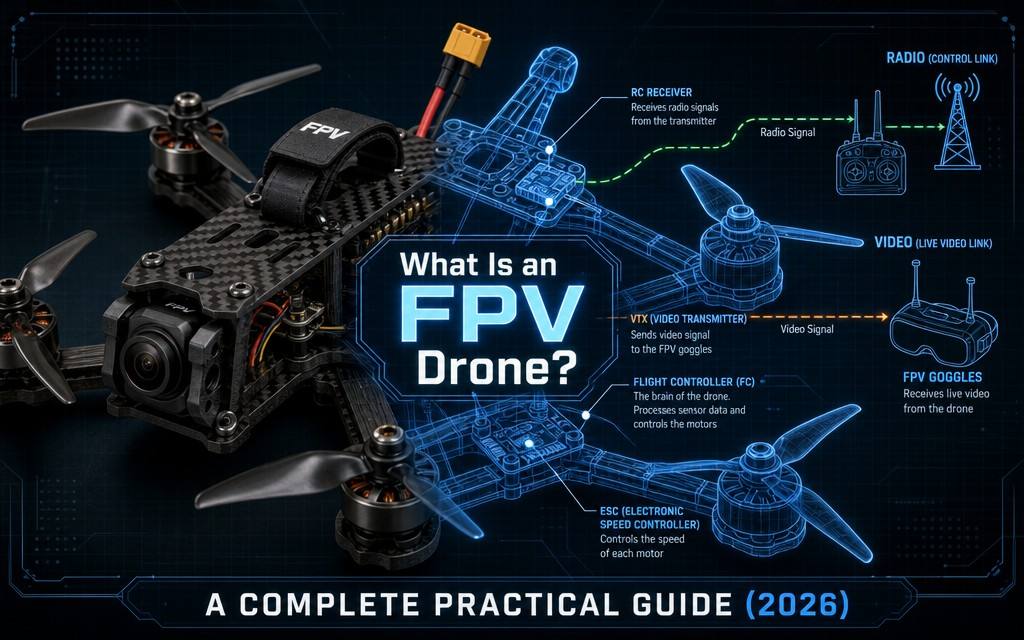
An FPV drone is an unmanned aircraft operated from a live first-person-view camera feed, usually through FPV goggles or a dedicated monitor, rather than by watching the aircraft from the ground. FPV stands for “first-person view.” The camera sends real-time video to a video transmitter, which broadcasts to the pilot’s display, creating the sensation of sitting in the aircraft.
In practice, “FPV” describes a flight and control architecture, not one single drone category. It includes:
- Indoor tiny whoops and ducted cinewhoops
- High-speed racing drones
- Acrobatic freestyle quadcopters
- Cinematic camera drones
- Long-range exploration and inspection platforms
- Heavy-lift and industrial FPV systems
Most FPV multirotors are flown in manual/acro mode, where the pilot directly controls attitude and throttle without automatic self-leveling. This makes FPV more difficult to learn than flying a GPS-stabilized camera drone, but it also enables far greater maneuverability, speed, and access to tight spaces.
How an FPV Drone Works: Core Components
A typical FPV system has two signal paths: a video path and a control path.
Video path
- The FPV camera captures the forward view.
- The video transmitter (VTX) encodes and sends the signal.
- An antenna transmits on a radio band, commonly 5.8 GHz.
- The pilot’s goggles or monitor receive and display the feed.
Control path
- The pilot moves the sticks on a radio transmitter.
- A receiver on the drone, such as an ExpressLRS (ELRS) or Crossfire receiver, passes commands to the flight controller.
- The flight controller adjusts motor speed through the electronic speed controllers (ESCs).
- The drone changes pitch, roll, yaw, or altitude.
Standard FPV parts list
- Frame: the structural body, usually carbon fiber
- Motors and propellers: produce thrust
- Flight controller: the drone’s control computer
- ESCs: convert flight-controller commands into motor power
- FPV camera: provides the pilot’s live view
- VTX and antennas: transmit video
- Radio receiver and transmitter: provide control
- FPV goggles or monitor: display the live feed
- LiPo or Li-ion battery: supplies power
- GPS module: optional, used for return-to-home and long-range flying
- Action camera or payload: optional, for HD recording, thermal imaging, mapping, or cargo
Main Types of FPV Drones
The table below summarizes common FPV categories. All performance figures are from UAVMODEL’s 2026 FPV category guide, published 2026-06-11 and verified 2026-10-14, except where another source is shown.
| Type | Typical size and weight | Typical flight time and speed | Best use |
|---|---|---|---|
| Cinewhoop | 2.5–3.5 inches; 150–400 g | 4–7 minutes; 30–60 km/h | Indoor flight, proximity filming, real estate, safer operation near structures |
| 5-inch freestyle | 5 inches; 550–750 g | 3–5 minutes; 80–140 km/h | Tricks, abandoned buildings, parks, aggressive flow flying |
| Long-range FPV | 7–10 inches; 800–1,500 g | 15–25 minutes; 40–80 km/h cruise | Mountain surfing, exploration, coastal flight, long-distance inspection |
| Racing FPV | Usually 5 inches | 2–3 minutes at full throttle | Gate racing, drone sports, lap-time competition |
| X-Class / large FPV | 8–12 inch propellers; 2–5 kg all-up weight | Varies by build | Large-scale freestyle, heavy camera work, demonstration events |
| Commercial long-range/inspection | Often 7–10 inches | 15–20 km range; payload support above 500 g | Industrial inspection, agricultural scouting, thermal or camera payloads |
Common purchase formats
- RTF — Ready-to-Fly: includes aircraft, radio, goggles or display, and basic setup
- BNF — Bind-and-Fly: aircraft is built, but the pilot supplies a compatible radio
- PNP — Plug-and-Fly/Play: usually includes aircraft but no receiver or transmitter
- DIY kit or custom build: frame, motors, flight controller, ESCs, VTX, and camera are assembled separately
- Industrial FPV: purpose-built for payload, inspection, security, logistics, or long-range work, often with environmental sealing and formal support
Key FPV Drone Facts and Verified Numbers
The following figures give a realistic baseline for 2026 FPV systems.
- Market size: the global FPV drone market was estimated at USD 623.5 million in 2026, projected to reach USD 2,061.4 million by 2035 at a 14.2% CAGR (Industry Research Co., published 2026-09-07; verified 2026-10-14).
- Common video band: 5.8 GHz FPV systems commonly operate in the 5.725–5.850 GHz unlicensed ISM band (ElectronicsHub, published 2026-08-29; verified 2026-10-14).
- End-to-end video latency: modern analog systems commonly measure 12–25 ms, while digital systems can measure 8–18 ms; the cited guide lists DJI O3 at approximately 12 ms and Walksnail Avatar Pro at approximately 9 ms (ElectronicsHub, published 2026-08-29; verified 2026-10-14).
- Typical VTX power: 25–200 mW is standard for many 5.8 GHz FPV setups (ElectronicsHub, published 2026-08-29; verified 2026-10-14).
- Typical 5-inch flight time: most 5-inch FPV drones average 4–7 minutes, while long-range 10-inch builds can extend to 25+ minutes (ElectronicsHub, published 2026-08-29; verified 2026-10-14).
- Control-link range: ExpressLRS states that 2.4 GHz at 100 mW can exceed 40 km under excellent line-of-sight conditions, but line-of-sight is the dominant factor (ExpressLRS official documentation, last updated 2026-09-11; verified 2026-10-14).
- Realistic ELRS configurations: UAVMODEL lists 2.4 GHz at 1 W at 15–30 km, 900 MHz at 100 mW at 8–15 km, and 900 MHz at 1 W at 30–50 km+ under suitable setups (UAVMODEL, published 2026-06-27; verified 2026-10-14).
- Training effect: pilots with 50+ hours of simulator time before their first real flight reported a 90%+ success rate on the maiden battery, while pilots who skipped simulator practice had roughly a 30% success rate (UAVMODEL, published 2026-06-10; verified 2026-10-14).
- Motor service life: for 5-inch freestyle flying, budget motor bearings may last 40–60 hours, while premium motors can reach 120–150 hours; indoor whoop motors may exceed 200 hours in low-stress use (UAVMODEL, published 2026-05-21; verified 2026-10-14).
Analog vs. Digital FPV Video
| Feature | Analog FPV | Digital FPV |
|---|---|---|
| Typical image | Standard-definition, commonly around 480p / 600 TVL | 720p, 1080p, or 4K depending on system |
| Typical latency | 12–25 ms in the cited 2026 guide | 8–18 ms for modern systems in the cited guide |
| Failure behavior | Gradual static and snow | Can freeze, block, or drop out when the link collapses |
| Compatibility | Broad, mature, multi-brand ecosystem | Often tied to a specific goggle/VTX ecosystem |
| Cost | Analog RTF kits commonly USD 120–250 | Digital RTF kits commonly USD 350–650 |
| DIY cost | DIY analog builds commonly USD 180–400 | DIY digital stacks commonly USD 500–1,100+ |
| Best for | Racing, low-budget training, simple freestyle, broad compatibility | HD recording, cinematic work, RF-noisy areas, professional footage |
Source: ElectronicsHub 5.8 GHz FPV guide, published 2026-08-29 and verified 2026-10-14.
The old assumption that analog always has lower latency is no longer universally true. Modern digital systems have closed the latency gap, but analog still wins on simplicity, broad compatibility, and gradual signal degradation. Digital usually wins when HD recording, error correction, encryption, or broadcast-quality footage matters.
FPV Drones vs. Standard Camera Drones
| Dimension | FPV drone | Standard camera drone |
|---|---|---|
| Pilot view | Primarily through goggles or FPV monitor | Usually through controller screen, phone, or tablet |
| Flight style | Often manual/acro; pilot controls attitude directly | Usually GPS-stabilized with normal, sport, cinematic, or waypoint modes |
| Hover behavior | Can hover, but pure FPV rigs are not optimized for stable hands-off hovering | Designed for stable hover, precise camera positioning, and easy framing |
| Maneuverability | Very high; flips, rolls, dives, tight proximity flight | Moderate; prioritizes safety and smooth footage |
| Camera stabilization | Often depends on camera mount or post-processing | Usually includes a motorized gimbal |
| Repair model | Highly modular; pilots commonly replace motors, arms, ESCs, VTX, and props | Often more integrated; repairs may depend on the manufacturer |
| Learning curve | Steep; simulator practice is strongly recommended | Easier for beginners because of GPS and obstacle sensors |
| Best work | Racing, freestyle, immersive cinematics, indoor flight, close-quarters inspection | Photography, mapping, routine inspection, stable video, surveying, repeatable missions |
| Legal profile | FPV may require a visual observer or BVLOS authorization depending on jurisdiction | Generally easier to operate within standard VLOS rules |
Neither is universally better. A racing or indoor proximity mission usually calls for FPV. A routine solar-farm inspection, mapping mission, or stabilized commercial shot is usually better suited to a standard camera drone or an industrial multirotor.
Step-by-Step FPV Setup and Safe First Flight
Step 1: Choose the mission first
Start with the flying objective, not the brand:
- Indoor or near people: choose a ducted cinewhoop or tiny whoop
- Racing and acrobatics: choose a 5-inch racing/freestyle platform
- Scenic exploration: choose a 7–10 inch long-range build
- Cinematic HD footage: choose a cinewhoop or digital freestyle rig
- Inspection or payload work: choose a long-range or industrial FPV platform
Step 2: Train in a simulator before flying real hardware
Use the same radio you intend to fly with and practice with identical stick rates where possible. Community guidance reports that 50+ simulator hours produced a 90%+ first-flight success rate, compared with approximately 30% for pilots who skipped the simulator (UAVMODEL, published 2026-06-10; verified 2026-10-14).
A separate FPV training guide reports that 10 simulator hours can cut crash frequency by about 70% (FPV Drone Guide, published 2026-10-03; verified 2026-10-14).
Step 3: Choose RTF, BNF, or DIY
- Beginners should usually start with an RTF or BNF system to avoid build errors.
- DIY builders should know soldering, radio binding, Betaflight or EmuFlight configuration, VTX channel setup, and motor direction testing.
- Do not buy a high-end digital stack before mastering basic orientation and failsafe recovery.
Step 4: Configure the aircraft
Before the first flight:
- Bind the radio transmitter and receiver
- Set the correct arming switch and flight modes
- Configure video channel and power
- Set battery voltage, flight timer, and link-quality telemetry on the OSD
- Program signal-loss and low-battery failsafe behavior
- Confirm motor direction and propeller orientation
- Check center of gravity and battery strap security
Step 5: Perform a preflight check
Use a written checklist:
- Airframe is not cracked
- Propellers are undamaged and correctly tightened
- Battery is fully charged and physically secure
- Video feed is clear and on the correct channel
- Control movements match the expected direction
- Failsafe has been tested
- The flying area is legal, open, and free of people and obstacles
- A visual observer is present if required locally
Step 6: Fly the maiden battery
Begin in a large open area with no spectators:
- Arm at a safe distance.
- Hover low and steady.
- Confirm yaw, pitch, roll, and throttle response.
- Practice simple forward flight, turns, and landing.
- Land before the battery reaches your configured low-voltage alarm.
- Review the flight and inspect the aircraft before the next battery.
Step 7: Maintain on a schedule
- Replace chipped or bent propellers immediately.
- Inspect motors for bearing play, grinding, or heat.
- Check solder joints and wires after hard crashes.
- Track battery cycles and retire damaged or puffed packs.
- Budget motor bearing service around 40–60 hours for budget 5-inch freestyle motors and 120–150 hours for premium motors (UAVMODEL, published 2026-05-21; verified 2026-10-14).
What Are FPV Drones Used For?
FPV drones are used across recreational, creative, and professional work:
- Drone racing: timed courses through gates and flags
- Freestyle flying: rolls, flips, power loops, dives, and creative lines
- Cinematic production: immersive chase shots, indoor fly-throughs, close-proximity footage
- Real estate and architecture: indoor tours and tight exterior shots
- Search and rescue training: rapid exploration of structures and difficult terrain
- Industrial inspection: close-up views of tanks, ducts, towers, bridges, and machinery
- Agriculture and survey support: lightweight scouting and sensor carrying
- Security and public safety: situational awareness where authorized
- Heavy-lift and cargo work: larger FPV multirotors for tools, sensors, or specialized payloads
Industrial and public-safety users should distinguish recreational FPV from certified operational systems. Regulated inspection, security, or cargo missions usually require documented maintenance, compliant radios, trained pilots, formal approvals, and sometimes purpose-built platforms such as IUAV’s industrial FPV systems.
Main Risks and Limitations
FPV drones are powerful tools, but they have important limitations:
- Steep learning curve: manual/acro flight is unintuitive for new pilots.
- Crash risk: open props and high-speed flight make pilot errors costly.
- Short flight times: aggressive 5-inch freestyle flights commonly last only 3–5 minutes (UAVMODEL, published 2026-06-11; verified 2026-10-14).
- Propeller danger: UAVMODEL notes that 5-inch freestyle propellers can exceed 30,000 RPM, making flight near people or animals unsafe (UAVMODEL, published 2026-06-11; verified 2026-10-14).
- BVLOS restrictions: long-range capability is not the same as legal permission; beyond-visual-line-of-sight flight is restricted in most jurisdictions without approval.
- RF interference: video and control links can fail behind terrain, buildings, or metal structures.
- Weather sensitivity: small cinewhoops handle wind poorly; UAVMODEL cites discomfort above 15 km/h wind for typical ducted cinewhoops (UAVMODEL, published 2026-06-11; verified 2026-10-14).
- Maintenance burden: DIY FPV requires soldering, tuning, spare parts, and troubleshooting.
How to Choose the Right FPV Drone
Use this decision checklist:
- Mission: racing, freestyle, indoor, cinematic, long-range, or industrial?
- Size: small ducted craft for proximity, 5-inch for general FPV, 7–10 inch for range.
- Video: analog for budget and simplicity; digital for HD and recording.
- Control link: choose ELRS or Crossfire based on local support, range, and latency needs.
- Battery budget: expect multiple packs because many FPV flights last only a few minutes.
- Repair budget: include spare props, motors, arms, batteries, and a soldering kit.
- Legal status: confirm registration, Remote ID, commercial certification, visual-observer, and BVLOS requirements.
- Support model: RTF buyers get a complete package; DIY builders gain flexibility but take on integration and troubleshooting responsibility.
A practical beginner path is:
- Simulator training
- Small RTF whoop or budget analog RTF
- 5-inch freestyle after basic orientation is reliable
- Digital or long-range system after the pilot has a documented use case
- Industrial FPV only when the mission requires payloads, repeatability, or formal compliance
Frequently Asked Questions
Is an FPV drone the same as a racing drone?
No. A racing drone is one type of FPV drone. FPV is the broader first-person-view flying method and includes cinewhoops, freestyle quads, long-range aircraft, cinematic platforms, and industrial systems.
Are FPV drones hard to fly?
Pure manual FPV is harder than flying a GPS-stabilized consumer camera drone because the pilot must maintain attitude and orientation through the goggles. Simulator practice substantially reduces the learning curve: pilots with 50+ simulator hours reported a 90%+ success rate on their first real battery, compared with approximately 30% for pilots who skipped the simulator (UAVMODEL, published 2026-06-10; verified 2026-10-14).
Should I choose analog or digital FPV?
Choose analog for low cost, broad compatibility, simple operation, and racing-style redundancy. Choose digital for HD recording, better image quality, stronger noise rejection in some urban environments, and professional footage. The cited 2026 guide puts analog latency at 12–25 ms and modern digital latency at 8–18 ms (ElectronicsHub, published 2026-08-29; verified 2026-10-14).
How much does an FPV drone cost?
Entry analog RTF kits commonly cost USD 120–250, digital RTF kits commonly cost USD 350–650, DIY analog builds commonly cost USD 180–400, and DIY digital builds commonly cost USD 500–1,100+ before extra batteries and spare parts (ElectronicsHub, published 2026-08-29; verified 2026-10-14).
Do I need a license to fly an FPV drone?
It depends on the country and whether the flight is recreational or commercial. The 2026 ElectronicsHub guide notes that U.S. commercial operations generally require FAA Part 107 compliance, recreational flyers must follow applicable rules and Remote ID requirements, and FPV flight may require a visual observer or BVLOS authorization depending on the operation (ElectronicsHub, published 2026-08-29; verified 2026-10-14).
Can an FPV drone carry a camera or payload?
Yes. Cinewhoops and freestyle rigs commonly carry lightweight action cameras, while 7–10 inch long-range platforms can support thermal cameras, LiDAR-style sensors, or payloads above 500 g, with cited commercial long-range examples reaching 15–20 km (ElectronicsHub, published 2026-08-29; verified 2026-10-14).
Is long-range FPV legal?
Hardware range and legal flight range are different. ExpressLRS and other links can achieve very long distances under ideal line-of-sight conditions, but flying beyond the pilot’s visual line of sight normally requires special authorization. A capable radio link does not override national airspace rules.
References and Verification Dates
- Industry Research Co — FPV Drone Market Set to Hit USD 64,695,931.6 Mn by 2035, published 2026-09-07; verified 2026-10-14.
https://www.industryresearch.co/market-reports/fpv-drone-market-305164 - ElectronicsHub — 5.8GHz FPV Drone Guide: How to Choose the Right One in 2026, published 2026-08-29; verified 2026-10-14.
https://electronics.alibaba.com/buyingguides/5.8ghz-fpv-drone-guide-choose-right-for-your-use-case - UAVMODEL Insights — Cinewhoop vs Freestyle vs Long Range: Choosing Your FPV Drone Type, published 2026-06-11; verified 2026-10-14.
https://blog.uavmodel.com/cinewhoop-vs-freestyle-vs-long-range-choosing-your-fpv-drone-type/ - UAVMODEL Insights — FPV Simulator Training: 100 Hours to Competent Pilot Without Breaking Parts, published 2026-06-10; verified 2026-10-14.
https://blog.uavmodel.com/fpv-simulator-training-100-hours-to-competent-pilot-without-breaking-parts/ - ExpressLRS — Signal Health: How Far Can I Go?, official documentation last updated 2026-09-11; verified 2026-10-14.
https://www.expresslrs.org/info/signal-health/?h=osd - UAVMODEL Insights — ELRS 2.4GHz vs 900MHz: Which ExpressLRS Protocol for Your Flying Style?, published 2026-06-27; verified 2026-10-14.
https://blog.uavmodel.com/elrs-2-4ghz-vs-900mhz-which-expresslrs-protocol-for-your-flying-style/ - UAVMODEL Insights — FPV Drone Motor Bearing Maintenance: Replacement, Lubrication, and Failure Warning Signs — 2026 Guide, published 2026-05-21; verified 2026-10-14.
https://blog.uavmodel.com/fpv-drone-motor-bearing-maintenance-replacement-lubrication-and-failure-warning-signs-2026-guide/ - FPV Drone Guide — Best FPV Simulators 2026: Liftoff vs Velocidrone, published 2026-10-03; verified 2026-10-14.
https://fpvdroneguide.com/blog/best-fpv-simulators-2026