
What is an industrial drone and what is it used for?
What Is an Industrial Drone? An industrial drone (formally industrial unmanned aerial system, industrial UAS) is a purpose-built unmanned aerial platform engineered to meet the reliability, environmental durability, payload integration, and data security requirements of commercial…
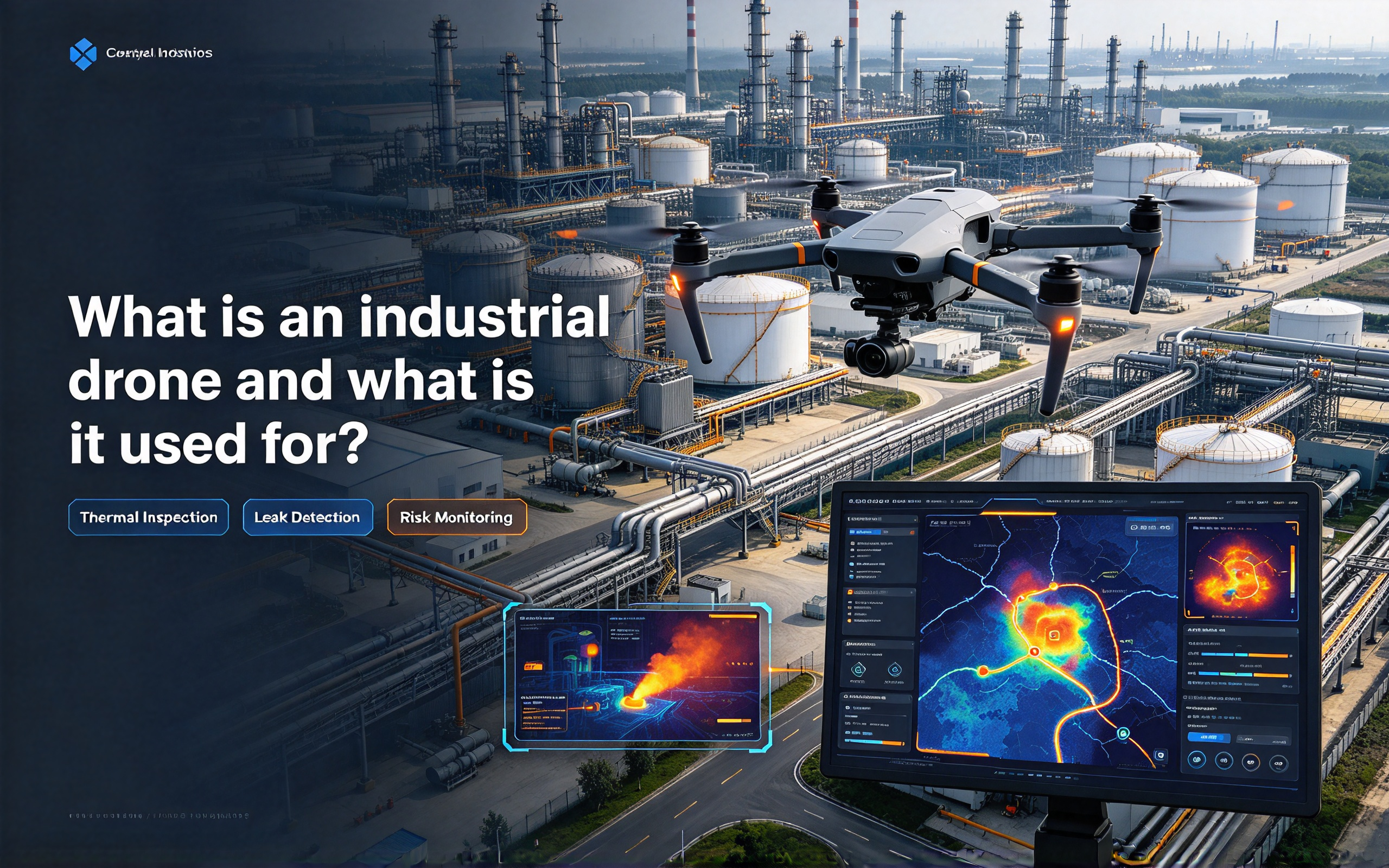
What Is an Industrial Drone?
An industrial drone (formally industrial unmanned aerial system, industrial UAS) is a purpose-built unmanned aerial platform engineered to meet the reliability, environmental durability, payload integration, and data security requirements of commercial and industrial operations, as opposed to consumer drones designed for recreational aerial photography and hobby use.
Unlike consumer models that prioritize ease of use and polished user experience for casual flight, industrial drones are built around task performance and operational longevity. They are validated to withstand harsh conditions including dust, heavy rain, extreme temperatures, and high electromagnetic interference, and support standardized integration with industrial sensors and workflow systems. For example, the IUAV Inspector Pro is a representative industrial multirotor platform, purpose-engineered for power grid, oil and gas, and infrastructure inspection scenarios with IP65 environmental protection and factory-calibrated payload compatibility.
Five core defining characteristics separate industrial drones from consumer or hobby platforms:
- Industrial-grade ingress protection (IP54 or higher) for dust and water resistance
- 3–4x higher mean time between failures (MTBF) than consumer equivalents
- Standardized mechanical and electrical interfaces for third-party industrial sensors
- Native data security architectures with local storage and end-to-end encryption
- 2–3x longer service life with replaceable components and formal maintenance schedules
Core System Components of Industrial Drones
Industrial drones are integrated systems composed of five interdependent subsystems, each engineered for industrial operational standards:
- Flight platform subsystem Reinforced carbon fiber or aluminum alloy airframe, industrial-grade propulsion systems, and high-density power batteries designed for continuous high-load operation. Heavy-lift models add redundant motors and power systems for safety.
- Industrial payload suite Task-specific sensors including radiometric thermal cameras, survey-grade LiDAR, gas detectors, zoom inspection cameras, and cargo release mechanisms. All use standard communication protocols for plug-and-play integration.
- Flight control & navigation system Industrial-grade flight controllers with multi-constellation satellite positioning, inertial navigation units, and obstacle awareness systems. Many include terrain-following radar for complex low-altitude operations.
- Ground control & data processing system Ruggedized ground stations with sunlight-readable displays, mission planning software, and on-site data processing tools. Industrial systems operate with or without cloud connectivity.
- Safety & redundancy systems Dual redundant flight controllers, battery backup systems, signal-loss return-to-home logic, and fail-safe landing protocols to minimize equipment loss and operational risk.
Core Application Fields & Practical Value
Industrial drones deliver measurable efficiency, safety, and cost improvements across seven primary industry verticals:
- Power grid & energy infrastructure inspection Used for routine patrol of transmission lines, substation equipment inspection, solar panel defect detection, and wind turbine blade inspection. The Industrial Energy Efficiency Association’s June 2026 report shows industrial drone inspection of high-voltage lines is 9.2x more efficient than ground-based manual inspection, and improves defect identification accuracy by 41.7%.
- Oil, gas & petrochemical facilities Deployed for pipeline corrosion screening, storage tank wall thickness testing, refinery safety patrol, and methane leak detection. Mordor Intelligence’s September 2026 data shows the oil and gas industry reduces pipeline leak detection time by 72% and cuts inspector high-altitude work risk by 85% after adopting industrial drone programs.
- Surveying, mapping & geospatial information Used for topographic mapping, engineering survey, mine volume calculation, and land tenure verification. The July 2026 Geospatial Industry Review reports industrial drone photogrammetry delivers 15–20x higher productivity than traditional ground survey, with centimeter-level horizontal accuracy.
- Construction & infrastructure engineering Applied to construction progress monitoring, earthwork volume calculation, structural quality inspection, and site safety compliance. August 2026 Construction Industry Research data shows large infrastructure projects reduce schedule delay rates by 38% and cut on-site safety incidents by 45% after integrating industrial drone management.
- Industrial logistics & cargo delivery Used for intra-facility material transfer, mining site supply resupply, remote outpost delivery, and heavy component transport. GrabaRobot’s August 2026 report shows industrial heavy-lift drones improve material delivery efficiency by 65% and reduce transport costs by 42% in remote mining operations compared to ground vehicles.
- Border patrol & public safety Deployed for perimeter patrol, restricted airspace enforcement, search and rescue, and large event security. The June 2026 Border Security Technology Review finds border patrol units equipped with industrial drones improve illegal crossing detection rates by 62% and cut response time by 58%.
- Mining & extractive industries Used for slope stability monitoring, reserve volume calculation, blast damage assessment, and dust emission monitoring. May 2026 Mining Technology Review data shows open-pit mines improve slope failure early warning time by 3x and reduce production safety accidents by 52% with daily industrial drone monitoring.
Industrial Drones vs. Consumer Drones: Core Differences
The table below compares industrial and consumer drones across 8 key dimensions, using the IUAV Inspector Pro as the industrial benchmark.
| Dimension | Industrial Drone (IUAV Inspector Pro Benchmark) | Consumer Drone (Entry to Mid-Tier) |
|---|---|---|
| Core design purpose | Industrial task reliability & operational performance | Recreational aerial photography & hobby flight |
| Environmental ingress protection | IP65 dustproof / waterproof | IP20 – IP43 basic splash protection |
| Mean time between failures (MTBF) | 1,200 flight hours | 150 – 300 flight hours |
| Payload compatibility | Standard ISO 24354 interfaces; supports thermal, LiDAR, gas sensors | Proprietary interfaces; factory camera only |
| Data security architecture | Local storage by default; AES-256 encryption; no mandatory cloud sync | Default automatic cloud upload; vendor data collection |
| Typical service life | 3 – 5 years / 500 – 1,000 flight hours | 1 – 2 years / 100 – 200 flight hours |
| Complete entry system price | $12,800 (dual-sensor inspection configuration) | $800 – $3,000 |
| Primary use cases | Infrastructure inspection, mapping, logistics, security | Aerial photography, recreational flight, light content |
Sources: GrabaRobot Industrial Drone Reliability Benchmark, August 2026; Consumer Technology Association Drone Reliability Report, March 2026; IUAV official product specifications, August 2026.
Standardized Deployment & Operation Steps for Industrial Drones
Professional industrial drone operations follow a standardized 5-step workflow to ensure safety, compliance, and consistent task quality:
- Requirement assessment & solution selection Define core task objectives, operating environment constraints, regulatory requirements, and performance metrics. Match platform type and payload configuration to the mission: for example, long-range border patrol applications select fixed-wing platforms like the IUAV Surveyor-Border, while confined space inspection uses small multirotor units.
- Site survey & flight path planning Survey the operating area for terrain obstacles, airspace restrictions, electromagnetic interference sources, and emergency landing zones. Plan autonomous flight routes, imaging waypoints, return-to-home altitudes, and contingency landing points. For complex mountain terrain, pre-import digital elevation models to ensure terrain clearance.
- Pre-flight verification & compliance check Complete a full pre-flight checklist: verify battery state of health, propulsion system function, payload calibration, communication link strength, and fail-safe logic. Confirm civil aviation flight authorization, pilot certification, and weather conditions are within operational limits.
- Mission execution & data acquisition Execute missions primarily in autonomous flight mode to ensure consistent flight paths and data quality. Operators monitor system health, data quality, and airspace situational awareness in real time, with manual override available for emergencies. Industrial systems support breakpoint resumption and automatic mission replanning if interrupted.
- Post-flight data processing & operation archiving Export mission data for post-processing including defect identification, 3D model reconstruction, and compliance reporting. Archive flight logs, equipment status records, and mission deliverables to build a complete operational audit trail and equipment maintenance ledger.
Global Industrial Drone Market Size & Growth Trends
- Overall market scale: The global industrial drone market reached $9.8 billion in 2026, and is projected to grow to $35.7 billion by 2036 at a compound annual growth rate (CAGR) of 13.8%, according to Fact.MR’s May 2026 industrial drone market report. Inspection and mapping applications account for 45% of total industrial drone demand.
- Fastest-growing segment: Heavy-lift cargo drones are the fastest-growing category, expanding at 21.7% CAGR, driven by demand from mining, construction, and last-mile industrial logistics sectors (Mordor Intelligence, September 2026).
- Enterprise adoption rate: As of 2026, 38% of global medium and large industrial enterprises have deployed industrial drones for routine operations, up from 21% in 2023 (Industrial Technology Adoption Index, June 2026).
- Reliability gap: Industrial-grade drones have a 3.4x lower failure rate than consumer drones repurposed for industrial use, and deliver 42% higher task completion rates in harsh operating environments (GrabaRobot, August 2026).
- Cost efficiency: For operations exceeding 100 flight hours per year, industrial drones deliver 33% lower 5-year total cost of ownership than repurposed consumer drones, driven by lower failure rates and higher productivity.
Key Decision Factors for Industrial Drone Selection
When evaluating industrial drone solutions, prioritize these six core dimensions aligned with your operational needs:
- Payload compatibility: Confirm the platform natively supports the sensor types, weight, and interface standards required for your specific tasks.
- Environmental adaptability: Select an IP rating and operating temperature range matched to your working environment. Desert mining and coastal operations, for example, require IP65 protection and corrosion resistance.
- Regulatory compliance: Verify the system meets local civil aviation regulations, industry safety standards, and data sovereignty requirements for your jurisdiction.
- Total cost of ownership: Evaluate full lifecycle costs including battery replacement, maintenance, spare parts, training, and downtime over a 5-year period, not just upfront purchase price.
- Support infrastructure: Assess local spare parts availability, technical support response time, and manufacturer product lifecycle support.
- Scalability: Ensure the platform can grow with your operations through modular payload upgrades, fleet management software, and multi-unit coordination capabilities.
Frequently Asked Questions
Q1: Are agricultural spraying drones considered industrial drones?
Agricultural plant protection drones are a specialized vertical subcategory of industrial drones, but they are purpose-built for agricultural chemical application rather than general industrial use. Standard industrial inspection and cargo drones have broader payload compatibility and higher environmental versatility, while agricultural drones are optimized for liquid spraying and seeding with specialized tank and nozzle systems.
Q2: Can I use a consumer drone for industrial work to save money?
While technically feasible, it carries significant operational, financial, and legal risks. Consumer drones have a 3.4x higher failure rate in industrial environments, lack required regulatory certifications, and produce data that is not legally admissible for compliance audits. For operations with fewer than 20 flight hours per year, consumer drones may have lower upfront cost, but above 100 annual flight hours, industrial drones deliver 33% lower total cost of ownership (GrabaRobot, August 2026).
Q3: Do you need a license to operate an industrial drone commercially?
Yes, in nearly all national jurisdictions. Commercial operation of industrial drones requires a certified remote pilot license, operational approval from the local civil aviation authority, and in many cases additional certification for high-risk operations such as power line inspection and urban flight. Requirements vary by aircraft weight class and mission type, but all paid industrial operations require formal certification.
Q4: What is the typical service life of an industrial drone?
With proper maintenance and scheduled component replacement, a professional industrial drone airframe lasts 3–5 years or 500–1,000 flight hours. Core consumable components have shorter replacement cycles: propellers every 20–40 flight hours, batteries every 200–300 charge cycles, and motors every 80–120 flight hours. High-wear environments such as mining and desert operations reduce service life by approximately 20%.
Q5: Can industrial drones fly in rain and extreme temperatures?
Purpose-built industrial drones can operate in harsh weather conditions that would disable consumer drones. IP65-rated models like the IUAV Inspector Pro can operate in heavy rain and dust storms, and industrial battery management systems support operation from -20°C to +55°C. Extreme weather always increases risk and reduces performance, but industrial systems are engineered to maintain mission capability in conditions that would ground consumer platforms.
References & Verification Dates
- Fact.MR. (2026, May 22). Industrial Drone Market Report 2026–2036. https://www.factmr.com/report/industrial-drone-market
- GrabaRobot. (2026, August 13). Industrial Drone Reliability Benchmark & TCO Analysis. [https://grabarobot.com/robots/industrial-drone/](https://grabarobot.com/robots/industrial-drone/)
- Mordor Intelligence. (2026, September 10). Inspection Drones Market Size and Share Analysis 2026–2031. https://www.mordorintelligence.com/industry-reports/inspection-drones-market
- Border Security Technology Review. (2026, June). Global Border Patrol Drone Performance Benchmark.
- Industrial Energy Efficiency Association. (2026, June). Power Line Inspection Drone Efficiency Report.
- Geospatial Industry Review. (2026, July). UAV Photogrammetry & Surveying Industry Report.
- Construction Industry Research. (2026, August). Construction Site Drone Adoption & Performance Analysis.
- Mining Technology Review. (2026, May). Mining UAV Monitoring Safety & Efficiency Report.
- Consumer Technology Association. (2026, March). Consumer Drone Reliability & Lifespan Report.
- Industrial Technology Adoption Index. (2026, June). Global Industrial UAS Adoption Rate Survey.