
10‑inch Heavy‑Lift FPV Quadcopter Full Review|Max 5kg Payload Professional Industrial Drone
Review Introduction This review covers the 10‑inch FPV Heavy‑Lift Drone, a professional high‑payload FPV working platform. It delivers 4kg rated payload and up to 5kg maximum payload for heavy‑cargo delivery, large mission‑module integration and long‑range heavy‑lift…
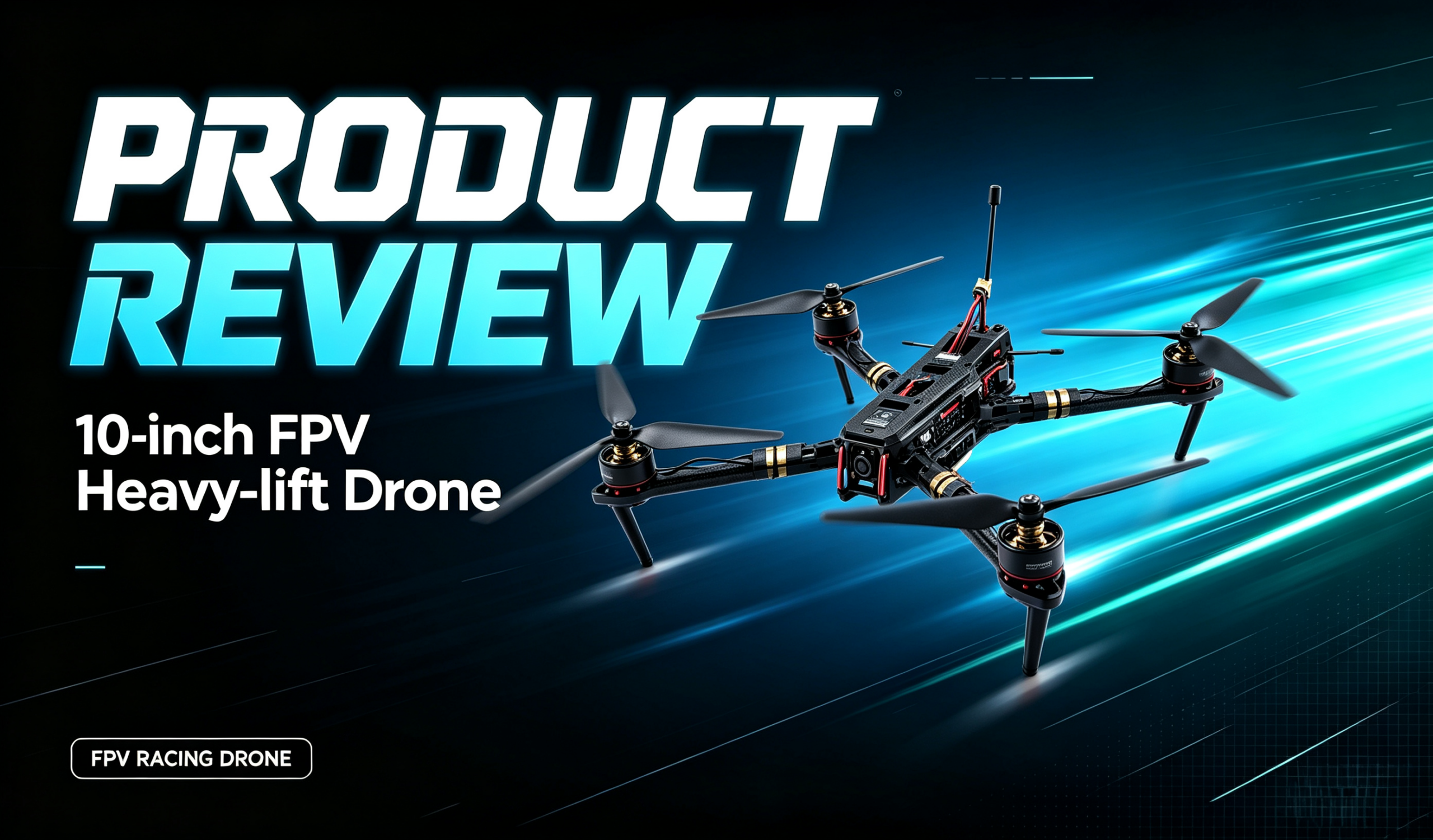
Review Introduction
This review covers the 10‑inch FPV Heavy‑Lift Drone, a professional high‑payload FPV working platform. It delivers 4kg rated payload and up to 5kg maximum payload for heavy‑cargo delivery, large mission‑module integration and long‑range heavy‑lift operations. This hands‑on review analyzes hardware build, load performance, VTX & radio link, endurance and real‑world pros & cons for heavy‑duty FPV project procurement reference.
Hardware & Build Quality
Wheelbase 427mm, frame dimension 325277mm, weight ≈1.1kg (battery excluded), TX60 battery connector. Reinforced carbon‑fiber heavy‑duty airframe with abundant mounting points for heavy payloads. ‑Flight Controller:F405 FC, ICM42688P gyro, standard 30.530.5 mounting hole, proven heavy‑lift firmware, stable attitude under high payload, easy maintenance. ‑ESC:60A AM32 ESC, 6S(25.2V) input, 60A continuous current, delivers sufficient thrust headroom under heavy load. ‑Power System:3115 motor KV900 (customizable KV), 6S input; 3‑blade 1050 propellers for strong lifting power, the foundation of 5kg payload capacity. ‑Camera & VTX:1700TVL analog FPV camera with 1/2.7″ Starlight CMOS sensor; multi‑band VTX 3.3G/4.9G/5.8G/6.5G, output power 1.6W/2.5W/4W adjustable, video latency ≤30ms for real‑time heavy‑lift flight control. ‑Receiver:ELRS 915M /2.4G optional receiver, paired with RHCP high‑gain long‑range antenna. ‑Payload:4kg rated safe payload, 5kg absolute maximum payload; ample bottom mounting space for heavy drop mechanisms and large mission modules. ‑Landing Gear:Factory‑fitted landing gear protects airframe and payload during heavy‑load landing.
This is a professional‑grade heavy‑duty FPV platform. High‑strength carbon frame and factory landing gear are very friendly for heavy‑lift scenarios. Large propellers deliver strong thrust and low‑latency VTX supports real‑time control. High‑power powertrain generates notable heat and requires in‑flight airflow cooling. Larger size and weight reduce portability compared with smaller formats.
Payload & Endurance Flight Test
Test setup: 6S 8500mAh battery, tested under no‑load, 4kg rated load and 5kg max load conditions.
- Flight Endurance Official spec: 8‑15 minutes flight time with 3.5kg payload and 6S 8500mAh battery. ‑No‑load cruise: 13‑15 minutes ‑4kg rated payload operation: 8‑10 minutes ‑5kg maximum payload: 6‑8 minutes
Review note: 5kg is absolute hardware limit, only for short‑range point delivery, never for regular operation. For long‑term heavy‑lift projects, plan around 4kg rated payload to protect powertrain and extend service life. Power consumption rises exponentially with payload; always reserve sufficient return‑to‑home battery margin.
- Flight Behavior Under Payload At 4kg rated payload, good thrust‑to‑weight ratio enables stable cruise, slow turns, hovering and precision drop. At 5kg maximum payload, very limited thrust margin. Only straight cruise and point delivery are possible; no aerobatic maneuvers. Motor & ESC temperature rises sharply under full throttle.
Warning: Take‑off and landing must be very gentle under heavy payload. Abrupt throttle input can cause motor overload, ESC protection shutdown or crash.
- Multi‑band Low‑latency VTX Performance VTX covers 3.3G /4.9G /5.8G /6.5G bands, max power 4W, official latency ≤30ms. ‑5.8G for short‑medium range open‑site operation; 3.3G /4.9G for better obstruction resistance, preferred for heavy‑lift long‑range missions. ‑Low‑latency video is a major advantage for heavy‑lift flight, delivering immediate control feedback and reducing collision risk. ‑4W high‑power mode generates significant heat. Do not run at max power while stationary on ground; rely on in‑flight airflow cooling. ‑Starlight analog camera works well at dusk / low‑light. Analog‑only video system, no native HD recording capability.
- ELRS Radio Link Comparison ‑ELRS 915M: Preferred for heavy‑lift long‑range missions, better anti‑interference and obstacle penetration. ‑ELRS 2.4G: Stable for line‑of‑sight flight, signal degrades quickly behind obstructions, not for BVLOS heavy‑lift operations.
Review tip: For heavy long‑distance delivery missions, select the ELRS 915M receiver version.
Key Strengths
✅ Class‑leading payload capacity: 4kg rated / 5kg max, supports heavy cargo delivery and large mission modules, outperforming smaller format drones.
✅ Powerful heavy‑lift powertrain: 3115 motors + 60A AM32 ESC, 6S high‑voltage supply, strong thrust headroom under load.
✅ Low‑latency multi‑band VTX: ≤30ms latency for real‑time heavy‑lift control; adjustable bands for different RF environments.
✅ Reinforced carbon frame + factory landing gear: high‑strength airframe with abundant mounting points; landing gear protects payload on landing.
✅ ELRS long‑range radio link: optional 915M version with high‑gain antenna for long‑distance heavy‑lift operations.
✅ Starlight low‑light camera: usable FPV footage in low‑light conditions, supports day‑night operations.
Identified Limitations
❌ Analog‑only video system, no onboard HD recording, not suitable for evidence‑capture missions.
❌ Extremely limited maneuverability at 5kg max payload; only straight cruise and delivery possible.
❌ Large size and high weight (1.1kg dry), low portability; 10‑inch propellers present high ground safety risk.
❌ High‑power powertrain generates significant heat under load; thermal management required in hot environments.
❌ Very steep learning curve; requires experienced FPV pilots, much higher tuning and piloting demands than smaller drones.
❌ Very fast battery drain under heavy load; short endurance and strict battery planning required.
❌ Large‑format specific parts; lower parts commonality than 7/8‑inch models, higher spare‑part cost.
Suitable & Unsuitable Scenarios
👍 Best for:
- Professional operation teams for heavy cargo delivery & large mission‑module integration
- Open‑field long‑range heavy‑payload operations
- Experienced FPV pilots for heavy‑lift training & special‑operation projects
- Heavy‑lift scenarios requiring real‑time low‑latency control
👎 Not recommended for:
- Absolute FPV beginners; high power and heavy payload create extreme operational risk
- Indoor / confined‑space flight; 10‑inch propellers are too large and hazardous
- Projects requiring HD aerial filming or video evidence
- Light‑payload missions under 3kg; 7/8‑inch models offer better cost‑efficiency
Final Review Verdict
The 10‑inch FPV Heavy‑Lift Drone is a professional‑grade heavy‑payload FPV working platform. With 4kg rated / 5kg maximum payload, strong powertrain, low‑latency VTX and factory landing gear, it is well suited for professional teams performing heavy cargo delivery and large payload integration. Bear its limitations in mind: analog‑only video, very limited maneuver at max payload, large & heavy airframe, steep pilot skill barrier, short heavy‑load endurance. If your mission payload is under 3kg, 7/8‑inch models offer better value and agility. When payload reaches the 4kg class, this 10‑inch heavy‑lifter is a very capable choice.
Product Page:https://iuavofficial.com/product/10-inch-fpv-heavy-lift-drone-max-5kg-payload-fpv-quadcopter/