
3-Inch Ducted FPV Training Drone: A Technical Guide for Beginner Training and Flight School Education
1. What is a Ducted FPV Trainer? Core Structure and Safety Logic 1.1 Definition and Function of the Ducted Design A ducted FPV drone is a specialized FPV platform with propellers fully enclosed inside annular duct…
1. What is a Ducted FPV Trainer? Core Structure and Safety Logic
1.1 Definition and Function of the Ducted Design
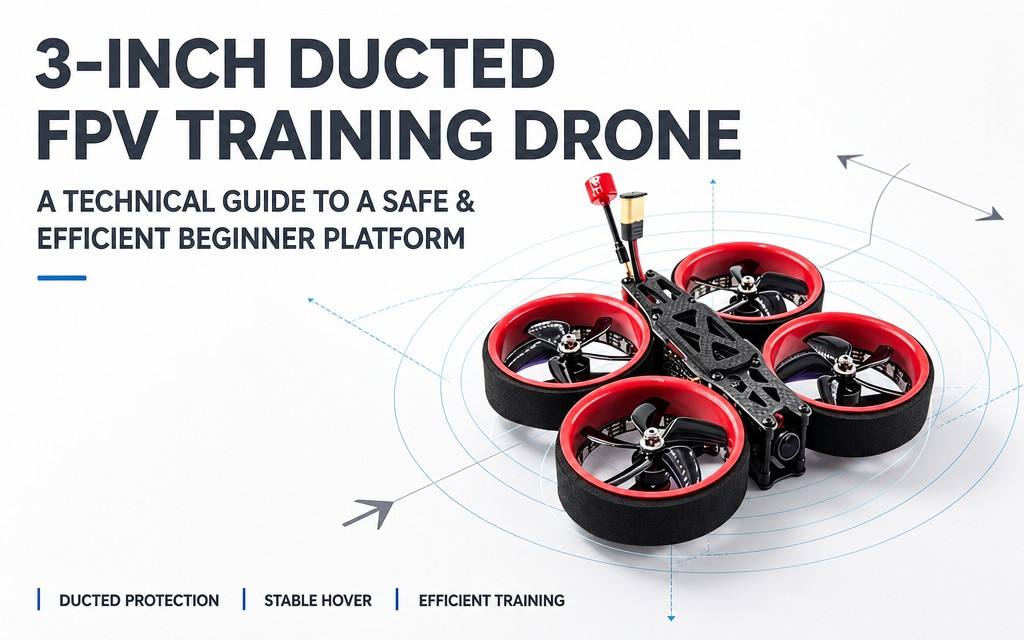
A ducted FPV drone is a specialized FPV platform with propellers fully enclosed inside annular duct structures. Compared with traditional open-prop FPV drones, the duct structure improves propeller efficiency through flow rectification, and more importantly acts as a physical safety barrier. In the event of a collision, the duct ring absorbs most impact energy, preventing direct propeller strikes, greatly reducing blade damage risk and eliminating the hazard of fast-spinning blades contacting people or objects, structurally reducing safety risks in flight training.
The 3-inch ducted trainer is a compact FPV platform in the 3-inch propeller class, purpose-built for entry-level training. Its size, weight and power are tuned specifically for training needs, balancing safety, handling and cost efficiency.
1.2 Why Choose a Ducted Trainer for Beginner Flight Training
The high dropout rate for new FPV pilots stems from three core pain points: high crash costs, safety risks and site limitations. Ducted trainers directly address all three:
- Lower crash repair costs: Beginners have high error rates. Open-prop crashes often damage propellers, motors and frames. The duct structure absorbs most collision energy, and most impacts only require propeller replacement or no repair at all, cutting training costs by over 80%.
- Safe indoor flight: Open-prop FPV is strictly prohibited indoors. Fully enclosed blades allow ducted trainers to be flown safely inside, removing weather and site constraints and greatly improving training efficiency.
- Friendly handling feel: Training-grade ducted drones are tuned for stable power and flight control, with linear response close to simulator feel, shortening the transition from sim flight to real flight.
2. Technical Specifications and Performance Breakdown
2.1 Flight Controller and Powertrain: Training-Grade Stability Tuning
The flight controller is the “brain” of an FPV drone, determining flight stability and handling feel. The 3-inch ducted trainer typically uses an F722 FC flight controller paired with an ICM42688P high-precision gyroscope — the gold standard for entry-level trainers. The high sample rate and low noise of the gyroscope, combined with training-grade firmware tuning, deliver stable flight attitude and linear, smooth throttle, pitch and roll response with no abrupt power spikes, ideal for beginners to build correct muscle memory.
The powertrain uses 1507-series motors with a default KV of 2700, with custom KV options available. ESCs are offered in 20A/45A/50A ratings, compatible with 2–6S LiPo batteries. This configurable powertrain allows progression through training stages: low-KV motors and low-current ESCs for smooth beginner control, upgradable to higher KV and current for advanced maneuver practice.
2.2 Video Link and Perception: Low Latency + Low-Light Adaptation
FPV flight relies entirely on the video feed for control. Latency and image quality directly determine training effectiveness. The 3-inch ducted trainer uses a 5.8GHz analog video link with adjustable VTX power and ≤30ms latency, meeting training-grade low-latency standards. Responsive control with no lag prevents operation errors caused by video delay, helping beginners build correct reflexes.
The camera uses a 1/2.7-inch starlight-grade CMOS sensor, available in 1700TVL and 1800TVL options. The starlight sensor delivers clear, smooth footage even in low light, allowing training to continue at dusk and in indoor lighting without strong illumination, expanding training time and scenario options.
The control receiver is a standard ELRS 2.4GHz receiver with a high-gain RHCP antenna, offering strong anti-interference and stable signal for both close-quarters indoor training and basic outdoor flight range.
2.3 Airframe and Endurance: Advantages of Lightweight Compact Design
The 3-inch ducted trainer has a 145mm wheelbase and weighs approximately 0.3kg without battery, making it an ultra-light compact FPV platform. The small size and low weight deliver two key training benefits: low inertia for agile response, enabling hovering, turns and slow slaloms in tight indoor spaces for precision practice; and low collision kinetic energy, further reducing damage and safety risk even in the event of impact.
Flight time is 5–8 minutes per battery, varying with capacity and maneuver intensity. For training scenarios, short flight times with battery rotation is actually optimal: each battery is followed by a debrief, preventing attention fatigue from extended flight, while multiple batteries cover total training session duration.
3. Core Application Scenarios and Professional Value
3.1 Individual Beginner Training: Lower Crash Cost, Shorter Learning Curve
For zero-experience FPV hobbyists, the 3-inch ducted trainer is the ideal entry platform for transitioning from simulator to real flight. Compared to starting directly on a 5-inch open-prop drone, the ducted trainer offers much higher fault tolerance. The most common beginner mistakes — wall strikes and gap misjudgments — rarely cause serious damage, helping new pilots smoothly pass the crash-prone beginner phase and quickly build confidence.
At the same time, stable flight tuning and low-latency video allow beginners to focus on control logic and spatial awareness rather than compensating for aircraft instability, effectively shortening the overall learning curve by over 30% compared to open-prop training.
3.2 Indoor Small-Space Training: All-Weather Practice, Site and Weather Independent
For hobbyists in urban areas with no dedicated outdoor field, or pilots needing all-weather training, the indoor flight capability of ducted trainers is irreplaceable. Fully enclosed blades allow safe flight in living rooms, studios and hallways with no risk of damaging furniture or injuring people.
Indoor training is unaffected by weather, allowing practice in rain and at night to maintain training continuity and rapidly improve proficiency. Tight-space flight also builds precision control and spatial judgment, creating a strong foundation for later outdoor flight.
3.3 Flight School / Institutional Batch Training: Standardized Teaching, Reduced Operational Risk
For FPV flight schools, aviation academies and professional training organizations, standardizing on the 3-inch ducted trainer as the entry-level teaching platform significantly improves teaching efficiency and reduces operational risk.
- Standardized instruction: Uniform aircraft and configuration ensure consistent handling feel for all students, replicable teaching standards and more accurate progress tracking.
- Low safety risk: Fully ducted design drastically reduces training incidents. Indoor teaching is safe and controlled, lowering safety management costs and liability.
- Low maintenance cost: Low crash damage rates, with ducted propellers as the main consumable, reduce spare parts costs and simplify fleet maintenance.
- Smoother progression: After completing basic training on the ducted trainer, students transition to larger operational aircraft in a shorter adaptation period with higher graduation rates.
4. Tiered Configuration Selection Guide
4.1 Entry-Level: Individual Beginner Basic Practice
Target users: Zero-experience hobbyists, simulator-to-real transition phase Recommended configuration:
- Airframe: 20A ESC + KV2700 motor + 1700TVL camera + ELRS 2.4GHz receiver
- Accessories: Entry-level 5.8GHz FPV goggles + entry-level ELRS transmitter + 6S 800mAh batteries ×3 + basic balance charger
- Use cases: Indoor basic hovering and line practice, outdoor open-field basic flight training
4.2 Intermediate: Indoor Specialization and Advanced Maneuvers
Target users: Pilots with basic skills, indoor specialized training, advanced maneuver practice Recommended configuration:
- Airframe: 45A ESC + custom high-KV motor + 1800TVL camera + ELRS 2.4GHz receiver
- Accessories: Lightweight FPV goggles + compact precision transmitter + 6S 800mAh batteries ×5 + fast charger
- Use cases: Indoor obstacle slalom, basic maneuver practice, all-weather daily training
4.3 Professional: Flight School Batch Training
Target users: FPV flight schools, training organizations, academy fleet procurement Recommended configuration:
- Fleet (bulk): 45A ESC + KV2700 motor + 1800TVL camera + ELRS 2.4GHz receiver (uniform spec)
- Accessories (bulk): Matched FPV goggles + training transmitters + 6S 900mAh LiPos + multi-channel chargers + bulk spare parts
- Use cases: Standardized entry-level instruction, staged progressive training, batch student teaching
5. Summary
The 3-inch ducted FPV trainer is not a “toy-grade small drone” — it is the standard training platform for the entry phase of the FPV industry. It solves the safety and cost pain points of beginner training through its ducted structure, matches entry-level handling needs through training-grade flight and powertrain tuning, and covers three core scenarios: individual entry, indoor practice and flight school education. It is an indispensable step in the FPV learning path.
For new hobbyists, it is the most cost-effective way to pass the beginner phase. For training organizations, it is an ideal platform for standardized teaching, cost reduction and efficiency improvement. Choosing the right ducted trainer configuration greatly improves the efficiency and safety of FPV learning.
Product Page: https://iuavofficial.com/product/3-inch-fpv-training-drone/