
5-Inch FPV Training Drone: Technical Guide for Transition, Racing and Freestyle Training Platforms
1. Technical Positioning and Core Value of 5-Inch FPV Trainers 1.1 Role as the Intermediate Step in the FPV Learning Path The FPV learning path generally consists of three phases: beginner (3-inch ducted drones), intermediate (5-inch…
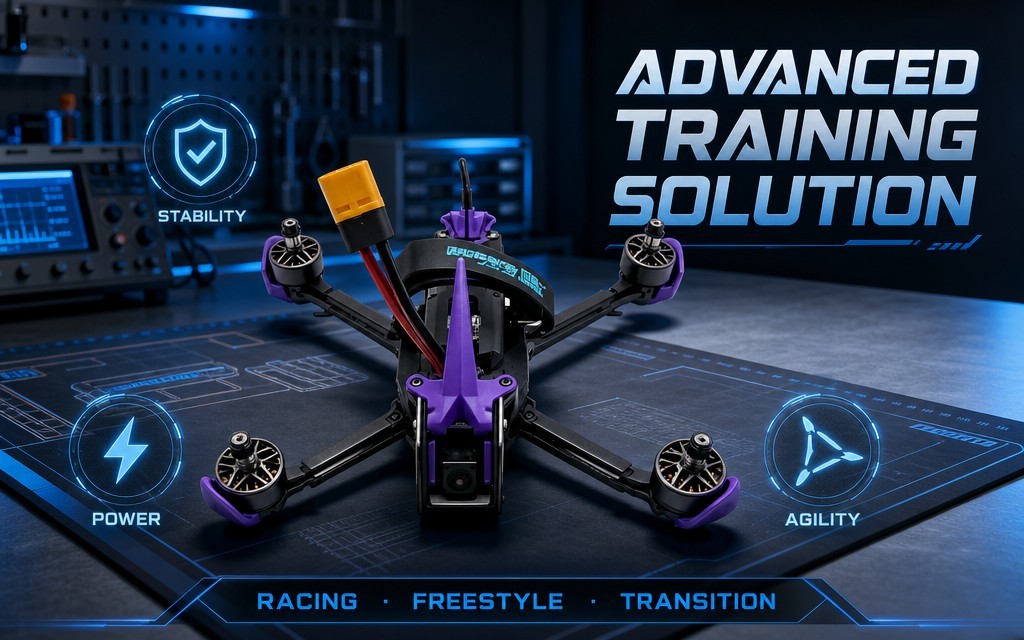
1. Technical Positioning and Core Value of 5-Inch FPV Trainers
1.1 Role as the Intermediate Step in the FPV Learning Path
The FPV learning path generally consists of three phases: beginner (3-inch ducted drones), intermediate (5-inch trainers), and professional (racing / freestyle / industrial drones). The 5-inch trainer serves as the core bridging platform between entry-level and professional flight.
3-inch ducted trainers solve the beginner problem of safe takeoff and basic control feel, but their ducted power characteristics, flight inertia and handling differ significantly from mainstream 5-inch open-prop drones. Professional racing and freestyle drones have aggressive power, fragile structures and high repair costs, making them unsuitable for intermediate practice. 5-inch trainers are optimized specifically for the intermediate phase: they retain the classic 5-inch open-prop layout and handling feel, while reinforcing crash durability, tuning power linearity and controlling overall cost. They help pilots smoothly transition from beginner to professional, and are an indispensable intermediate carrier in the FPV learning system.
1.2 Core Design Logic: Fault Tolerance First, Linearity Priority
Unlike racing drones built for ultimate performance or freestyle drones built for maneuverability, the core design logic of training drones is fault tolerance first, linearity priority:
- Fault tolerance first: improved frame strength and optimized consumable design reduce crash damage and repair costs, allowing beginners to learn from mistakes rather than retiring after a single crash.
- Linearity priority: power output and control response are tuned to be smooth and linear rather than explosively responsive, so pilots can accurately perceive the relationship between control input and aircraft response, build correct muscle memory and lay a foundation for later advancement.
2. In-Depth Technical Analysis of Core Systems
2.1 Flight Controller and Powertrain: Training-Grade Linear Tuning
The flight controller is the control core of an FPV drone, directly determining handling feel and flight stability. 5-inch trainers commonly use the F405 flight controller paired with the ICM42688P high-precision gyroscope. The F405 is the mainstream FC solution for intermediate trainers, with sufficient processing power, rich peripheral interfaces and full Betaflight/Cleanflight firmware support. The ICM42688P gyroscope offers high sample rates and low noise. Tuned with training-grade firmware parameters, it delivers smooth, stable attitude response and accurately reflects every control input, helping pilots build correct control reflexes.
The powertrain uses 2207 brushless motors with a default KV of 1950 (customizable), paired with 50A AM32 ESCs (50A continuous, 55A peak for 10 seconds) supporting 6S LiPo input. This powertrain combination is characterized by highly linear power delivery and uniform throttle response with no abrupt power spikes, making it ideal for practicing control precision in the intermediate phase. It also leaves sufficient power margin to support basic freestyle and entry-level racing practice, matching the gradual progression of training. The standard propeller is the 51466 3-blade design, balancing efficiency and responsiveness while being low-cost as a training consumable.
2.2 Video Link and Imaging: Multi-Band Adaptability and Low-Light Capability
The video link is the “visual nerve” of FPV. Latency, interference immunity and image quality directly determine the training experience. 5-inch trainers use multi-band adjustable VTX supporting 2.4G / 3.2G / 4.9G / 5.8G bands with adjustable power. The professional value of multi-band design lies in the ability to select bands according to flight scenario, distance and local regulations: 5.8G for low-latency close-quarters training, 2.4G for longer-range practice, and separate bands for group training to avoid interference, greatly improving training scenario adaptability.
The imaging system uses a 1/2.7-inch starlight-grade CMOS sensor with 1200TVL resolution. The key advantage of starlight sensors is clear, smooth footage in low-light environments, allowing training to continue at dusk, on overcast days and in indoor low-light conditions. This breaks the traditional FPV limitation of only flying in clear daylight, extending effective training hours.
The receiver system is available with optional ELRS 915M / 2.4G receivers paired with high-gain RHCP antennas, offering strong anti-interference and stable signal. This meets not only in-field training needs but also supports medium-to-long-range outdoor flight practice.
2.3 Frame and Structure: Classic 5-Inch Crash-Resistant Optimization
5-inch trainers use the classic 229mm wheelbase 5-inch layout, with frame dimensions of 227 × 220mm and a dry weight of approximately 0.35kg. The structure is crash-optimized for training scenarios: arms and bottom plates use high-strength materials for improved impact resistance. The design prioritizes crash protection for core components (FC, motors, camera), absorbing energy to protect precision parts during impacts. Meanwhile, consumables (propellers, arm ends) are standardized and low-cost for easy replacement, greatly reducing operating costs during training. The lightweight design also preserves aircraft agility and maneuverability, supporting practice of basic freestyle and racing maneuvers without sacrificing handling feel for structural durability.
3. Typical Application Scenarios and Technical Adaptability
3.1 Transition from Ducted to 5-Inch Flight
For pilots completing 3-inch ducted beginner training, the 5-inch trainer is the optimal intermediate transition platform. Compared with jumping directly to a 5-inch racer, the trainer’s linear power delivery and similar control logic greatly reduce the handling gap and shorten the adaptation period. Meanwhile, the crash-resistant design drastically reduces crash costs in the transition phase, helping pilots smoothly pass the high-crash beginner period and build confidence in intermediate flight.
3.2 Daily Race Track Training
For racing enthusiasts, the 5-inch trainer is a cost-effective platform for daily track practice. Compared with professional racing drones, the trainer delivers sufficient power response and linear throttle control to meet the core demands of line practice, cornering and rhythm training. Its crash durability and low maintenance cost withstand high-frequency daily training wear and tear, greatly reducing pre-season preparation costs. Multi-band VTX also supports multi-pilot on-site training to simulate race conditions.
3.3 Basic Freestyle Maneuver Practice
For freestyle-oriented pilots, 5-inch trainers are suitable for practicing basic freestyle maneuvers including rolls, spirals, inverted flight and power loops. Linear power response and agile airframe handling help pilots refine maneuver smoothness and fluidity. The crash-resistant design allows pilots to attempt moves boldly without excessive concern for repair costs, accelerating breakthroughs in maneuver difficulty.
3.4 Standardized Teaching at Flight Schools & Clubs
For FPV flight schools and aviation clubs, standardizing on 5-inch trainers as the intermediate teaching platform enables standardized instruction: uniform fleet and configuration ensure consistent handling feel for all students, replicable teaching standards and accurate progress tracking. Centralized maintenance and unified spare parts also greatly reduce teaching operating costs and improve batch teaching efficiency.
4. Industrial Significance and Technology Trends
4.1 Industrial Value of Training Drones
The development of the FPV industry is largely constrained by high entry barriers and high dropout rates. Standardized training drone systems effectively reduce learning barriers and financial costs in the intermediate phase, improve newcomer retention, expand the FPV user base and produce more intermediate pilots for the industry. They are an important infrastructure link in the FPV industrial ecosystem. From a professional training perspective, standardized training platforms also move FPV education from the informal “master-apprentice” model toward a standardized, systematic formal teaching model, driving the 规范化 development of the FPV training industry.
4.2 Technology Development Trends
The current technical development direction of 5-inch trainers focuses on three dimensions: First, refined powertrain tuning: offering different power tuning versions for different training scenarios (transition / racing / freestyle) to more precisely match training needs. Second, digital video link upgrade: gradual upgrade from analog to digital video transmission to further reduce latency, improve image quality and enhance advanced training experiences. Third, intelligent training assistance: introducing flight data logging and maneuver analysis functions to help pilots quantitatively analyze technique issues and improve training efficiency.