
7-Inch FPV Long-Range Payload Drone: Technical Guide for Light-Duty High-Mobility Aerial Operations
1. Technical Positioning and Core Value of 7-Inch FPV Payload Drones 1.1 Intermediate Position in the FPV Operation System In the FPV drone product ecosystem, the 7-inch long-range payload drone sits as an intermediate platform between…
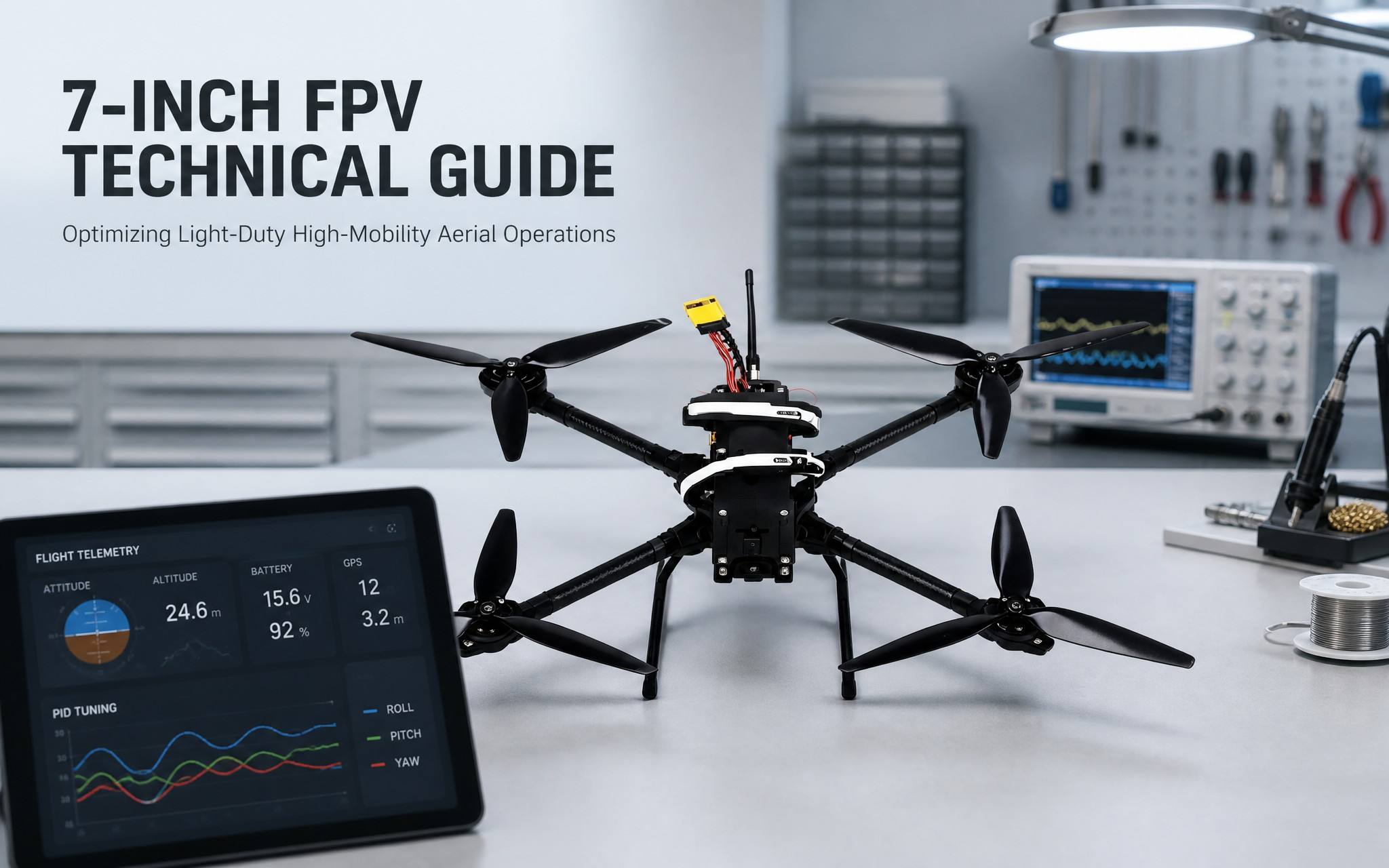
1. Technical Positioning and Core Value of 7-Inch FPV Payload Drones
1.1 Intermediate Position in the FPV Operation System
In the FPV drone product ecosystem, the 7-inch long-range payload drone sits as an intermediate platform between 5-inch racing/freestyle drones and full-size industrial UAVs, with a core positioning as a light-duty high-mobility operational platform.
5-inch FPV drones focus on flight skills, racing and freestyle, offering agility and low cost, but with negligible effective payload capacity — they can only fly, not carry operational equipment. Large industrial UAVs deliver strong payload capacity and professional capability, but come with high acquisition and maintenance costs, large form factors, slow deployment and poor maneuverability, making them very cost-ineffective for small light-duty tasks.
The 7-inch platform fills this gap precisely: it retains the high maneuverability, rapid deployment and low cost of FPV drones, while adding 1.5–2kg useful payload capacity and long-range flight capability. It can carry small work tools to perform professional tasks, serving as a cost-effective aerial work platform for light-duty scenarios.
1.2 Core Design Logic: Three-Way Balance of Payload, Range and Maneuverability
The core design logic of the 7-inch long-range payload drone is to strike an optimal balance among payload capacity, range performance and maneuverability, rather than maximizing any single metric.
- Payload: Targeted at light-duty operations, with 1.5kg standard and 2kg maximum payload, covering most light mission loads such as small sensors, micro cameras and lightweight tools.
- Range: Optimized powertrain efficiency paired with high-power long-range video link delivers 10-minute endurance and kilometer-scale operating range under load, meeting the needs of small-to-medium work areas.
- Maneuverability: Retains the agile handling characteristics of FPV drones, capable of obstacle penetration and low-altitude maneuvering in complex terrain.
2. In-Depth Technical Analysis of Core Systems
2.1 Flight Controller and Powertrain: Tuned for Loaded Flight
The flight control system uses an F405 flight controller paired with an ICM42688P high-precision gyroscope. The F405 offers sufficient processing power and rich peripheral interfaces, supports full Betaflight/Cleanflight firmware configuration, and has PID parameters specifically tuned for loaded flight. It ensures stable attitude and precise control under load, and is the standard FC solution for light-duty operational platforms.
The powertrain uses 2807 brushless motors with a default KV of 1300 (customizable), paired with 50A AM32 ESCs (50A continuous, 55A peak for 10 seconds) supporting 6S LiPo input.
This powertrain is optimized for loaded flight: lower KV values paired with large 7040 3-blade propellers deliver more low-RPM thrust instead of the high-RPM burst of racing drones. They carry 1.5–2kg loads steadily while maintaining linear power output for precise control. The 50A ESC provides generous power headroom for gusts and maneuvers, ensuring safety during loaded flight.
2.2 Video Link and Receiver: Long-Range Anti-Interference Architecture
The video system uses a multi-band high-power VTX (Video Transmitter) supporting 3.3G / 4.9G / 5.8G / 6.5G bands, with three selectable power levels: 1.6W / 2.5W / 4W.
The technical value of the multi-band high-power design:
- Band per scenario: Different bands have different diffraction and penetration characteristics. 3.3G has better diffraction for obstructed environments; 5.8G offers higher bandwidth for close-range HD; 6.5G has less interference for long-range work. The optimal band can be selected for the mission.
- Power per distance: Adjustable output power reduces interference at close range and ensures signal strength at long range, maximizing effective operating distance.
The receiver system offers optional ELRS 915M / 2.4G receivers paired with high-gain RHCP antennas. ELRS (ExpressLRS) is the current leading long-range control protocol, featuring high refresh rates, low latency, strong anti-interference and long telemetry range. Combined with high-gain antennas, it delivers kilometer-scale reliable control and data return — the core technical foundation for long-range operations.
2.3 Imaging System: Starlight-Grade Long-Range Optics
The imaging system uses a 1/2.7-inch starlight-grade CMOS sensor with 1700TVL resolution.
Compared with standard FPV cameras, starlight sensors offer much higher low-light sensitivity, delivering clear, low-noise footage at dusk, on overcast days and in indoor low-light environments. For long-range operations, where image quality naturally degrades with distance, the improved low-light performance preserves detail at range and extends effective operating hours beyond clear daylight.
2.4 Airframe and Payload: 7-Inch Load-Optimized Structure
The airframe uses a classic 7-inch layout with a 317mm wheelbase, frame dimensions of 237 × 210mm and a dry weight of approximately 0.65kg.
The structure is optimized for payload operations: arms use high-strength materials for improved torsional rigidity, eliminating arm flex during loaded flight that would degrade image quality and stability. The centered payload mounting position keeps the center of gravity balanced after loading, avoiding adverse handling effects.
Two industry definitions clarify the payload ratings:
- Standard payload: the load for sustained stable flight with minimal performance impact, intended for routine daily operations.
- Maximum payload: the short-duration limit load for specific scenarios, which reduces endurance and maneuverability and should be used cautiously.
3. Typical Application Scenarios and Technical Fit
3.1 Low-Altitude Light-Load Inspection
Low-altitude inspection of oil & gas pipelines, solar farms and industrial facilities is the core application of 7-inch payload drones. Drone inspection is several times more efficient than manual inspection, while costing a fraction of professional inspection UAVs, with greater agility and faster deployment. Technical fit: 1.5kg payload carries micro visible/thermal inspection modules for routine checks; ELRS long-range receiver + multi-band VTX maintain stable signal along long corridors and in obstructed terrain; excellent low-altitude maneuverability allows close-up detail inspection.
3.2 Lightweight Aerial Photography
For landscape aerial photography, outdoor adventure documentation and creative FPV cinematography, the 7-inch platform balances maneuverability and payload capacity, making it a cost-effective choice for individual creators and small studios. Technical fit: 2kg max payload carries small professional cameras and micro gimbals for far better image quality than all-in-one FPV drones; FPV handling enables creative fly-through and tracking shots; long-range link supports large-scale long takes; starlight camera suits mood shooting at dawn/dusk and in overcast conditions.
3.3 Emergency On-Site Reconnaissance
For small fires, search & rescue and disaster response, 7-inch drones deploy quickly and affordably, suitable for grassroots emergency teams to conduct rapid aerial reconnaissance. Technical fit: compact and lightweight, rapidly deployable by a single operator; high-power anti-interference video link maintains transmission through smoke and building obstruction; can carry micro thermal imagers, loudspeakers and other payloads for both observation and emergency assistance.
3.4 Small-Scale Surveying & Exploration
For small topographic mapping, engineering survey and land investigation, 7-inch drones greatly improve efficiency over manual surveying at a fraction of the cost of professional mapping UAVs. Technical fit: carries small orthophoto cameras and positioning modules for basic survey accuracy; stable long-range signal works in complex terrain and obstructed areas; agile and fast to redeploy between scattered small survey sites.
4. Industrial Value and Technology Trends
4.1 Industry Value: Filling the Cost-Performance Gap for Light-Duty Work
The industrial value of 7-inch long-range payload drones lies in filling the market gap between “recreational FPV” and “professional industrial UAVs”, enabling low-cost automation for light-duty operational scenarios. It lowers the barrier to drone adoption for small operations, individual creators and grassroots organizations, driving the penetration of drone operations into more niche scenarios.
At the same time, FPV-controlled operational platforms expand the control paradigm of industrial drones, offering an alternative to autonomous flight drones in scenarios demanding agility and rapid response.
4.2 Technology Development Trends
The current technical development direction of 7-inch-class payload FPV drones focuses on three dimensions: First, payload and endurance optimization: further improving payload capacity and flight time through structural light-weighting, powertrain efficiency gains and battery technology advances to expand operational boundaries. Second, digital video link upgrade: gradual transition from analog to digital video transmission for better image quality, lower latency and improved anti-interference, enhancing long-range operational imagery. Third, assistive feature integration: integrating more aids such as GPS positioning, return-to-home and simple waypoint navigation to lower operational barriers and improve flight safety.
Product Page: https://iuavofficial.com/product/7-inch-fpv-long-range-drone/