Autel EVO Max 4T XE Buying Guide: Selection Checks, Configuration Tiers & Budget for an Industrial Flagship Drone
Guide at a Glance If you are choosing a professional industrial drone for public safety, energy inspection, emergency management or surveying, the Autel EVO Max 4T XE is a flagship combining a 4-in-1 gimbal, 720° fusion…
Guide at a Glance
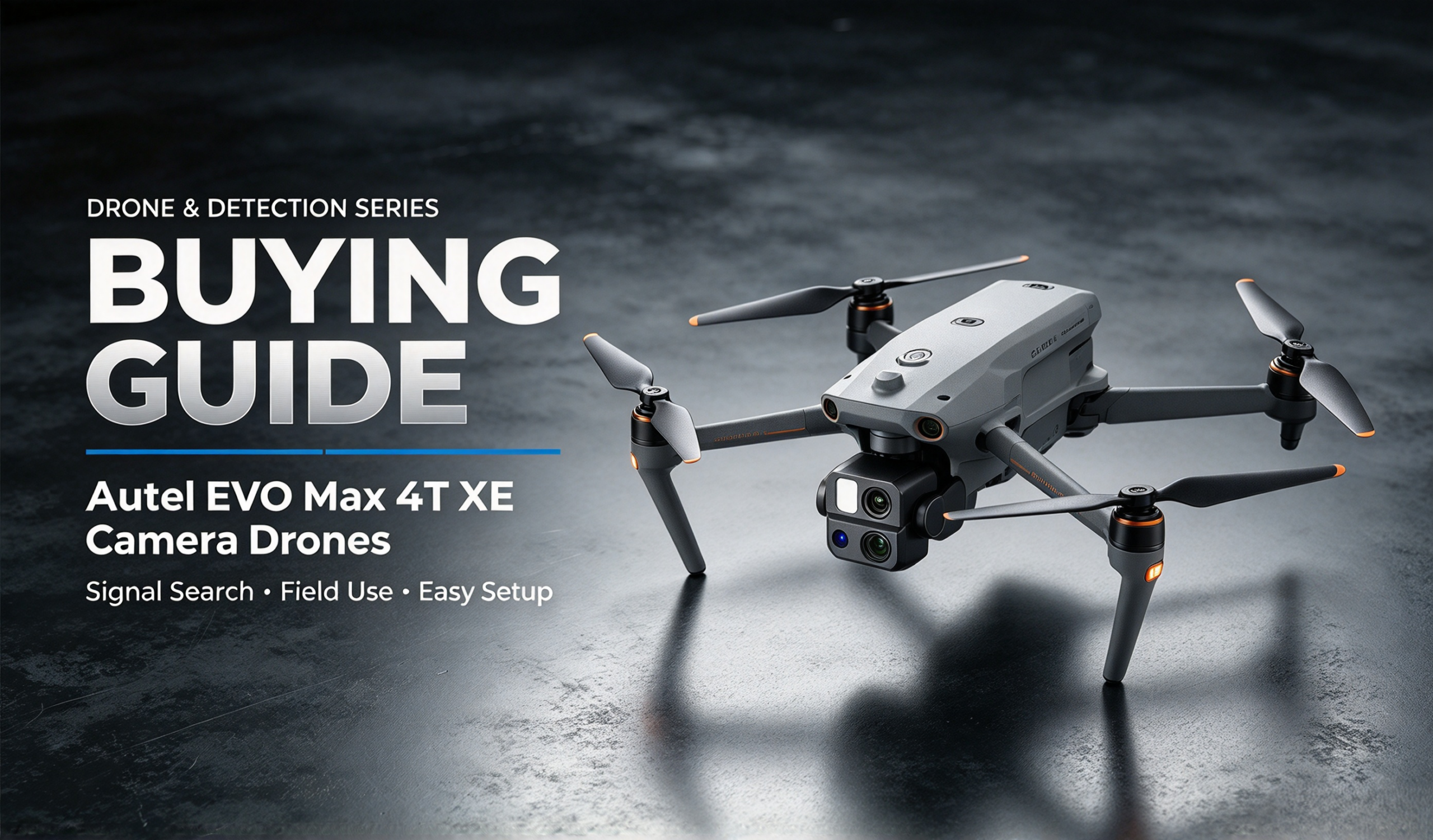
If you are choosing a professional industrial drone for public safety, energy inspection, emergency management or surveying, the Autel EVO Max 4T XE is a flagship combining a 4-in-1 gimbal, 720° fusion avoidance, autonomous flight and A-Mesh multi-drone networking. It is feature-rich and high-budget with version differences, so verify mission type, sensor needs, networking scale, accessories and compliance. This guide covers whether you need it, what to check, configuration, budget and acceptance.
1. First: Do You Need a Flagship Industrial Drone?
1.1 How to Choose
| Drone | Capability | Strengths | Limits | Suitable Users |
|---|---|---|---|---|
| Consumer/aerial | Visible, 4K | Cheap, portable, easy | No thermal/ranging, weak avoidance | Aerial photo, light checks |
| Portable thermal | IR + visible | Portable thermography, fast deployment | Single payload, weak coordination | Single-person inspection, SAR |
| Flagship (EVO Max 4T XE) | 4-in-1 gimbal + fusion avoidance + mesh | Comprehensive, autonomous, expandable | High budget, heavier, training needed | Public safety, energy, emergency, survey |
1.2 Who Should Buy
- Police/public safety for standoff evidence, night reconnaissance and command;
- Energy inspection for autonomous waypoints, thermometry and ranging;
- Fire/SAR for smoke penetration, coordination and lighting/PA;
- Survey/GIS for RTK centimeter orthophoto and 3D capture.
1.3 When Not to Prioritize
- Only daytime aerial/visual work with no thermal/ranging/mesh needs—standard drones cost less;
- Limited budget, single operator and small scope—a portable thermal drone may suffice;
- Long-term heavy rain, immersion or above 4000m—outside specs.
2. Core Specifications at a Glance
| Specification | Value | Procurement Focus |
|---|---|---|
| Model | Autel EVO Max 4T XE | Confirm XE flagship |
| Takeoff weight | 1635g (max 1999g) | Portability and margin |
| Folded dimensions | 257×145×131mm (no props) | Single-person carry |
| Zoom | 1/2″ CMOS, 48MP, 10x/160x, 4K | 2km detail recognition |
| Wide | 1/2″ CMOS, 48MP, 83.4°, ISO 320000 | Low-light overview |
| Thermal | 640×512, -20~150℃/0~550℃ | Dual range ±2℃ |
| Laser rangefinder | 5-1200m, ±(1m+D×0.15%) | Target location/evidence |
| Avoidance | Dual fisheye + mmWave, 720° | Brake/Bypass |
| Autonomy | Autel Autonomy + SLAM | Indoor-outdoor weak-signal nav |
| Networking | A-Mesh | One-to-many/relay |
| Transmission | SkyLink 3.0, 15km(FCC), AES-256 | Multi-band hopping |
| Endurance/battery | 42 min/ABX40 120Wh | 8-sec hot-swap |
| Protection/temp | IP43 (custom)/-20℃~50℃ | Not waterproof |
| Ceiling/wind | 4000m/12m/s | Assess ultra-high altitude |
| SKU | IUAV-14117 | Verify on delivery |
3. Six Key Pre-Purchase Checks
3.1 Will You Use the Full 4-in-1 Gimbal?
- Evaluate whether zoom, wide, thermal and LRF are genuinely needed;
- Thermal-only users may prefer a portable drone; combined standoff/ranging needs justify the 4-in-1.
3.2 Thermal Range & Accuracy
- Routine power/building uses -20℃~150℃; flame/hot equipment uses 0℃~550℃;
- ±2℃/±2% fits industrial inspection; metrology needs calibration and emissivity control.
3.3 A-Mesh Need
- Single-drone missions need no multi-drone setup;
- Team search, relay and off-grid emergency work make A-Mesh valuable; plan fleet and command;
- Supports one-to-many, master-slave and relay.
3.4 RTK & Surveying
- General inspection/SAR: four-constellation GNSS is enough;
- Precise waypoints, altitude hold, orthophoto and 3D: choose XRT-2301X;
- Optional and addable later, but survey users may prefer it upfront.
3.5 Avoidance Version & Compliance
- mmWave radar configuration varies by region—confirm the shipped version;
- FCC 15km is extreme LOS; follow local radio rules and compliant versions.
3.6 Environmental Boundaries
- IP43 handles dust/light rain only, not heavy rain or immersion;
- -20℃~50℃ covers severe cold and heat;
- 4000m ceiling and 12m/s wind require special assessment.
4. Configuration Tiers by Mission Scale
4.1 Base Flagship
- For: single professional missions, pilots;
- Configuration: drone + ABX40 battery;
- Build 4-in-1 capability first.
4.2 Inspection Professional
- For: power, energy, survey;
- Configuration: drone + RTK + spare batteries;
- Centimeter waypoints and reproducible re-flight.
4.3 Emergency Rescue
- For: fire, SAR, night work;
- Configuration: drone + DU4 + multiple batteries;
- Integrated lighting, PA and thermal SAR.
4.4 Coordinated Mesh
- For: teams and integrators;
- Configuration: multiple drones + A-Mesh + command + spares;
- Coordination, relay and scaled delivery.
5. Accessories & Consumables
5.1 Priority Additions
- Spare batteries: 42 min is per-sortie; use multiple batteries with 247W charging;
- RTK: for survey and precise inspection;
- DU4: for emergency/night missions.
5.2 Scenario Options
- Spare props, protective cases and prop guards;
- Charging hubs and vehicle charging.
5.3 Avoid Duplicates
- The standard kit includes core items—clarify package contents to avoid bundled duplicates.
6. Budget Allocation
| Block | Recommended Share | Notes |
|---|---|---|
| Drone (4-in-1 gimbal) | ~45%-55% | Core investment |
| Batteries & power | ~12%-18% | All-day operation |
| RTK/professional accessories | ~15%-25% | Survey/emergency needs |
| Networking & command | ~10%-20% | Multi-drone teams |
| Training & O&M | ~5%-10% | Training, upkeep, calibration |
Pitfall: do not spend everything on hardware while neglecting training and command. The flagship’s value lies in autonomy and coordination—unskilled operators and missing networking reduce capability.
7. Channels & Acceptance
7.1 Channel Selection
- Official/authorized channels: genuine products, warranty, accessories and compliance, with project customization;
- Integrator packages: turnkey solution, training and delivery;
- Avoid unsupported, unclear-source, version-mismatched low-price drones.
7.2 Acceptance Checklist
- Confirm EVO Max 4T XE model and SKU;
- Inspect airframe and all gimbal lens windows;
- Verify mmWave and transmission versions against local rules;
- Check batteries, accessories and cables;
- Test cameras, avoidance, SLAM, link and hot-swap;
- Verify warranty, invoice and encryption authorization.
8. FAQ
Q1: How does it differ from a portable thermal drone? A: It has a 4-in-1 gimbal (zoom+wide+thermal+LRF), 720° fusion avoidance, SLAM autonomy and A-Mesh networking.
Q2: Thermal range and accuracy? A: 640×512, dual ranges -20℃~150℃ / 0℃~550℃, ±2℃ or ±2%.
Q3: How far does the LRF reach? A: 5-1200m, ±(1m+D×0.15%), with target coordinates.
Q4: What does A-Mesh do? A: One-to-many, master-slave, off-grid networking and relay for coordinated multi-drone work.
Q5: Does it support RTK? A: Yes, the optional XRT-2301X provides centimeter positioning.
Q6: Can it fly in rain? A: IP43 handles dust/light rain, not heavy rain or immersion; 42 minutes is a windless lab value.
9. Final Decision
The EVO Max 4T XE’s core value is “4-in-1 multi-sensor gimbal + 720° fusion avoidance + autonomous flight + A-Mesh coordination”, ideal for professional organizations needing reliability, expandability and collaboration. Complete three checks: confirm payload and thermal range match the mission, decide whether RTK and multi-drone networking are needed, and verify mmWave/transmission versions and protection boundaries.
Choose from base, inspection, emergency and mesh configurations while adding batteries and training. When integrated into a complete capture-interpret-command-report workflow, the EVO Max 4T XE is a high-standard industrial flagship for mission-critical work.
Product Link: https://iuavofficial.com/product/autel-evo-max-4t-xe-camera-drones/