
B30 Heavy-Lift Hexacopter: Technical Architecture and Applications of Medium-Heavy Industrial UAVs
1. Technical Positioning and Core Value of Heavy-Lift Industrial Hexacopters 1.1 From Quadcopter to Hexacopter: The Logic of Powertrain Redundancy Consumer drones generally adopt a quadcopter layout, prioritizing portability and low cost. Industrial heavy-lift UAVs, by…
1. Technical Positioning and Core Value of Heavy-Lift Industrial Hexacopters
1.1 From Quadcopter to Hexacopter: The Logic of Powertrain Redundancy
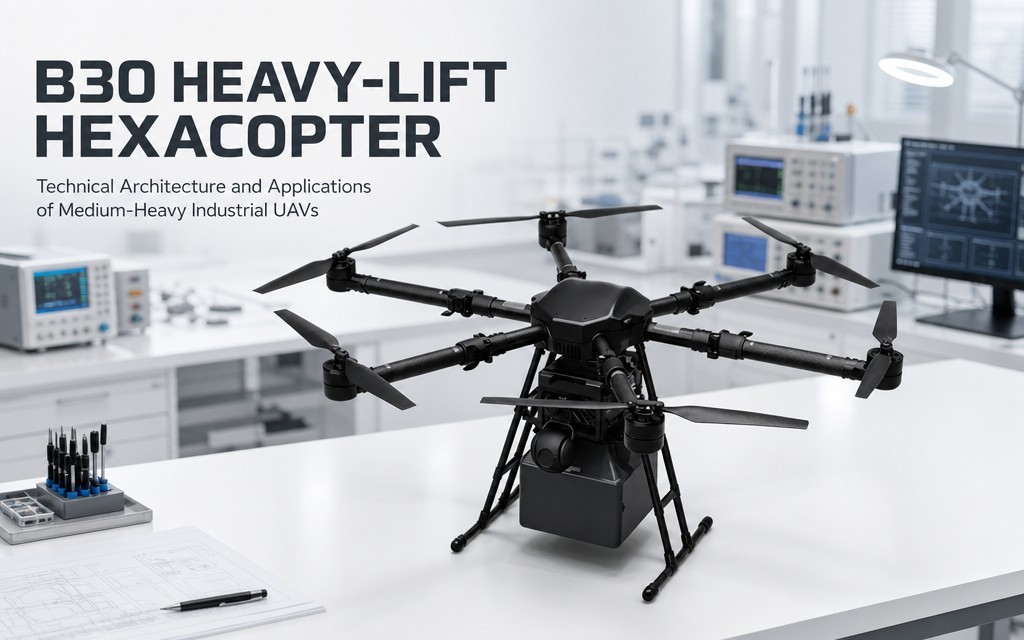
Consumer drones generally adopt a quadcopter layout, prioritizing portability and low cost. Industrial heavy-lift UAVs, by contrast, widely use a hexacopter architecture, centered on powertrain redundancy design. For industrial operations, equipment safety, payload security and operational reliability are the top priorities. Compared with a quadcopter, a hexacopter adds two power units. In the event of a single motor failure, the remaining five power units still provide sufficient thrust for a controlled forced landing, greatly reducing crash risk and the probability of high-value payload loss. Taking the B30 heavy-lift platform as an example, it adopts a six-rotor six-propeller symmetrical layout, paired with A12 motors and 41-inch large-diameter carbon fiber propellers. It maintains sufficient power margin at a 30kg standard payload, delivering not only more stable flight attitude but also stronger disturbance resistance against gusts and turbulent airflow, fully embodying the safety-first principle of industrial-grade design.
1.2 Core Value of Heavy-Lift Unmanned Platforms: Replacing High-Risk, High-Cost Human Labor
Industrial operation scenarios generally suffer from the pain points of “high risk, high cost and low efficiency”: scenarios such as high-altitude high-voltage inspection, mountain material transfer, disaster emergency delivery and complex terrain surveying either expose personnel to extreme safety risks, or are physically inaccessible due to terrain constraints, or have long operation cycles and high input costs. The core value of 30kg-class heavy-lift industrial drones is to automate such high-risk, low-efficiency manual tasks. Acting as aerial carriers equipped with various mission payloads, they complete delivery, inspection, surveying and monitoring tasks in complex environments. Essentially, they serve as “aerial work nodes” in the industrial production system, and platforms like the B30 are typical products in this category.
2. In-Depth Technical Analysis of Core Systems
2.1 Powertrain and Payload System: Performance of the 6-Axis Redundant Architecture
The basic parameters of the B30 hexacopter platform are: 33kg empty weight, 78kg maximum takeoff weight, 30kg standard operating payload, 2280mm maximum wheelbase. The power unit uses A12 motors with a KV rating of 70, paired with 41-inch carbon fiber folding propellers. From a technical perspective, this powertrain configuration has two core features: First, sufficient payload margin: the 30kg standard payload accounts for less than 40% of the maximum takeoff weight, leaving ample power reserve to ensure flight stability and wind resistance under heavy load, and avoiding shortened service life from long-term full-load operation. Second, fault redundancy safety: with a symmetrical six-axis layout, after a single motor failure, the remaining five axes can adjust power distribution via the flight control algorithm to maintain a controlled descent attitude and achieve a safe forced landing — a safety feature impossible with quadcopter platforms, and one of the core entry thresholds for industrial-grade UAVs. In addition, the folding propeller design allows the arms to fold in the same direction, resulting in a folded size of only 1200×1200×831mm, halving the footprint compared to the unfolded state and balancing operational efficiency and transport convenience.
2.2 Energy and Video Link System: Performance Boundaries of Endurance and Range
The B30 uses dual 14S 40000mAh smart lithium battery packs, each weighing 14kg, with a nominal voltage of 51.8V and a cycle life of ≥300 cycles. Performance specifications include a maximum hover endurance of 58 minutes (no load / light load, no wind) and a maximum flight time of 30 minutes at 30kg full load, with a maximum video transmission range of 30km. Two industry common facts need to be clarified: First, hover endurance ≠ operational endurance: hover endurance is the theoretical maximum in ideal no-wind conditions. In actual operation, endurance decreases to varying degrees with payload, wind resistance and maneuvering, with significant attenuation under heavy load — a universal law for all multirotor UAVs. Second, industrial video link ≠ consumer video link: the 30km link uses industrial-grade transmission technology with multi-band adaptive frequency hopping and strong electromagnetic interference resistance, maintaining a stable link even in complex electromagnetic environments such as substations and industrial zones, rather than the ideal open-range figures of consumer-grade systems. The dual-battery design also provides power redundancy: if one battery pack fails, the other provides return-to-home power, further improving operational reliability.
2.3 Perception and Positioning Systems: Technical Differences in Obstacle Avoidance and Positioning
LIDAR Obstacle Avoidance
The B30 is equipped with a LIDAR obstacle avoidance system, supporting 4-direction sensing (front, rear, left, right), with an adjustable sensing range of 3–15m, a maximum detection range of 100m and a measurement frequency of ≥10Hz. Compared with the visual obstacle avoidance common in consumer products, LIDAR avoidance has fundamental technical differences:
- Stronger environmental adaptability: laser ranging is unaffected by light, smoke, dust, rain and fog, and operates normally at night and in adverse weather, adapting to complex industrial field conditions.
- Higher ranging accuracy: LIDAR accurately outputs distance values, working with the flight controller to achieve precise deceleration and detour, whereas visual avoidance mostly relies on classification with lower ranging accuracy. It should be noted that this configuration only covers four horizontal directions and lacks vertical sensing. Operators must still monitor low-altitude takeoff/landing and overhead obstacle scenarios.
High-Precision Positioning System
The positioning system supports full-constellation GNSS (GPS + BeiDou + Galileo + GLONASS), with optional RTK high-precision positioning:
- With RTK enabled, hovering accuracy reaches ±10cm horizontal and ±10cm vertical, achieving centimeter grade.
- Without RTK, hovering accuracy is ±60cm horizontal and ±30cm vertical. The value of centimeter-grade RTK positioning lies in: ensuring mapping accuracy for professional surveying, ensuring consistent route altitude for periodic inspection, and guaranteeing delivery precision for point drop operations. It is the core support for industrial operations to advance from “being able to fly” to “precision operation”.
2.4 Professional Delivery System: Scenario Adaptation of Single/Dual Modes
The B30 carries a professional material delivery system supporting both single and dual delivery modes, with a maximum single-delivery weight of 25kg, a supply voltage of 12V and an adjustable pulse width of 500–2500μs. The technical core of the delivery system is the controlled release mechanism: it controls the release timing and pulse width of the locking mechanism via electrical signals, adapting to the delivery of materials of different weights and types. Single delivery suits concentrated point drops; dual delivery enables two-point drops in one flight or batch delivery of different materials, greatly improving the efficiency of delivery missions. Note: the 25kg maximum delivery weight is the limit of the single-path mechanism, not equal to the 30kg maximum aircraft payload. The two definitions are different, and selection should match the actual delivery weight.
2.5 Protection and Environmental Adaptability: Performance Boundaries of Industrial-Grade Protection
The B30 has an IP54 whole-machine protection rating, an operating temperature range of -25℃ ~ 55℃, a maximum wind resistance of Level 7 and a maximum flight altitude of 4500m ASL. Professional interpretation of each protection indicator:
- IP54: level 5 dust protection prevents harmful dust accumulation; level 4 water protection withstands splashing water from any direction, meaning operation in short light rain and dusty environments is possible, but flight in heavy rain, water submersion and highly corrosive environments is prohibited.
- Level 7 wind resistance: withstands wind speeds of 13.9–17.1m/s (near gale), meeting the operational requirements of most field weather conditions.
- Wide temperature range: the -25℃ to 55℃ temperature range adapts to four-season operations in most regions.
- Service ceiling: the 4500m maximum takeoff altitude covers most plains, hills and low mountain areas. At high plateau altitudes, power and endurance decrease due to air density.
3. Typical Application Scenarios and Technical Adaptability
3.1 Precision Emergency Relief Delivery
Disaster scenarios such as earthquakes, floods and wildfires are often accompanied by road disruptions that completely block ground transport. 30kg-class heavy-lift delivery drones like the B30 can rapidly deliver supplies such as food, medicine, emergency equipment and communication devices, with a single sortie meeting the supply needs of 10–20 people. Technical adaptability: six-axis redundant power ensures flight safety in complex terrain; LIDAR obstacle avoidance enables navigation through canyons and buildings; RTK positioning achieves meter-level precise delivery; 30km video link supports cross-regional remote command. It serves as an “aerial lifeline” in disaster emergencies.
3.2 Industrial Site Material Transfer
Scenarios such as mountain factories, construction sites, field camps and island stations generally suffer from inaccessible or poor road conditions, with material transfer heavily relying on manual labor at high cost, low efficiency and high safety risk. Technical adaptability: the 30kg payload covers the transfer needs of most tools, parts and building materials; point-to-point direct transport is free from terrain constraints; the stable six-axis platform is suitable for transferring fragile materials; unmanned operation reduces safety accidents in manual handling. Comprehensive transfer costs can be reduced by more than 40% compared with ground transport.
3.3 Long-Distance Corridor Inspection
High-voltage transmission lines, long-distance oil & gas pipelines and long railway corridors traverse complex terrain such as mountains, forests and canyons. Manual inspection has long cycles, high labor intensity and high risk. Technical adaptability: 58-minute hover endurance + 30km long-range video link allow a single sortie to cover tens of kilometers of corridor inspection. It can carry visible-light + thermal dual-sensor payloads to simultaneously complete appearance defect detection and equipment abnormal heating detection. RTK positioning ensures consistent route altitude for each inspection, facilitating defect comparison and trend analysis.
3.4 Large-Area Topographic Surveying
Tasks such as topographic mapping, engineering survey, land investigation and mine surveying traditionally require long cycles and high costs with manual methods, and personnel cannot access complex and dangerous areas. Technical adaptability: the 30kg payload can carry professional surveying payloads such as orthophoto and oblique photography cameras. RTK centimeter-level positioning ensures mapping accuracy. Large-area aerial survey efficiency is dozens of times higher than manual methods, and data collection can be completed in complex terrain without personnel access, greatly improving field operation safety.
4. Industrial Significance and Technology Trends
4.1 Industrial Value of Medium-Heavy Heavy-Lift UAVs
Medium-heavy industrial UAVs are an important part of the industrial unmanned system. They break through the limitation of small drones that “can only see, not carry”, extending unmanned operations from reconnaissance and inspection to deeper industrial scenarios such as heavy delivery, logistics transfer and heavy equipment operation. Six-axis heavy-lift platforms represented by the B30 truly achieve industrial-grade reliability and operational capability through designs such as powertrain redundancy, industrial protection, precision perception and professional payloads. They have important industrial value for improving industrial operation efficiency, reducing safety accidents and optimizing operating costs.
4.2 Technology Development Trends
The current technical development direction of heavy-lift industrial UAVs mainly focuses on three dimensions: First, higher payload and endurance: further improving payload capacity and mission duration through battery technology and aerodynamic optimization to cover more heavy-duty operation scenarios. Second, more comprehensive environmental perception: evolving from horizontal four-direction avoidance to omnidirectional stereoscopic obstacle avoidance, integrating vision, laser, millimeter-wave and other multiple sensors to achieve true all-weather all-scenario autonomous flight. Third, higher autonomy and swarm capability: evolving from single autonomous flight to multi-UAV cluster coordination, realizing formation flight and intelligent task allocation to further improve the efficiency of large-scale operations.