
C-52-D Triple-Shot Anti-Drone Net Launcher Buying Guide: Selection Checks, Compatibility & Budget Configuration
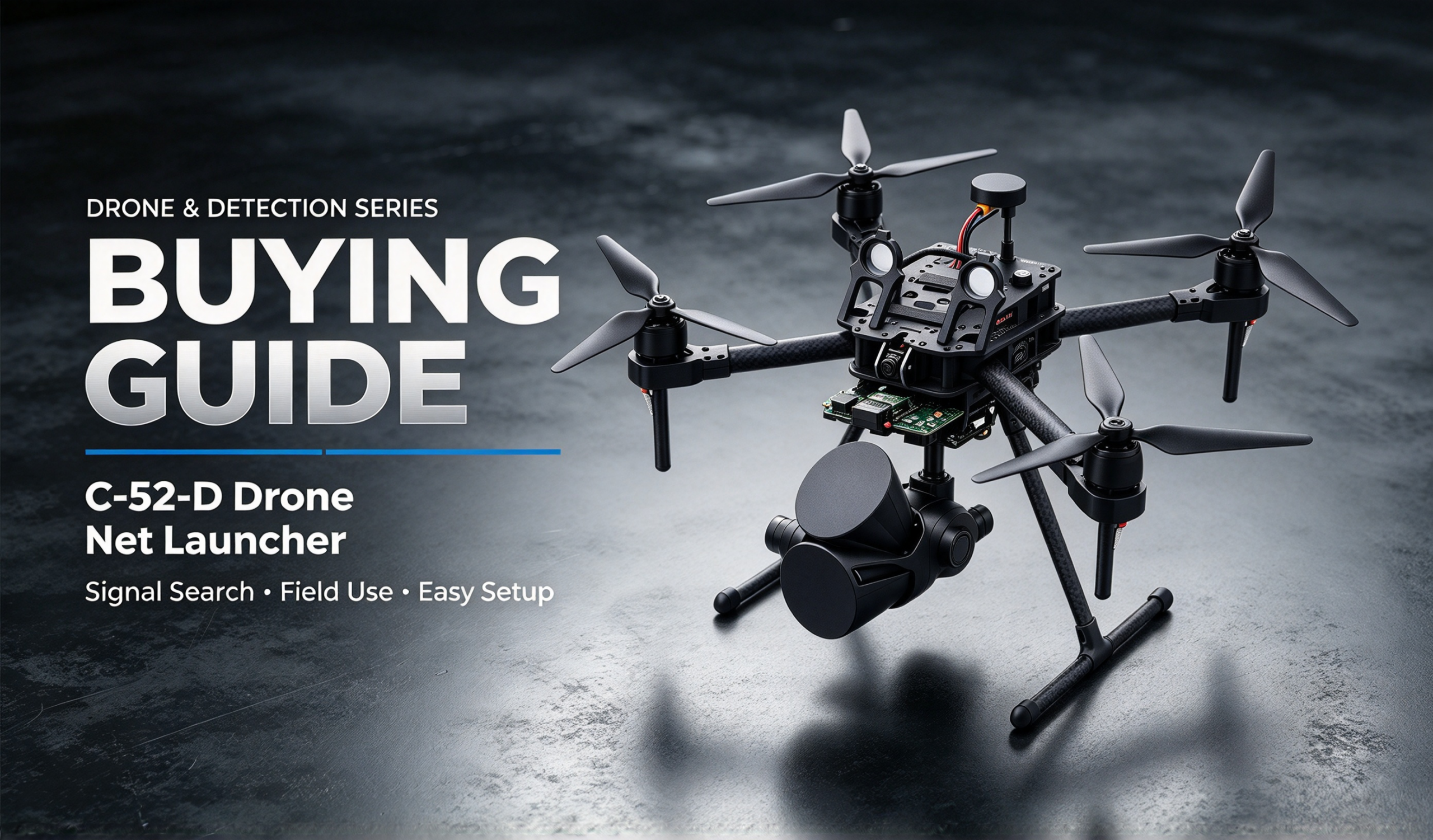
Guide at a Glance If you are choosing a soft net-capture payload for counter-UAS missions, the C-52-D triple-shot net launcher is a lightweight, multi-platform non-kinetic option. However, it is not a standalone "fire-and-forget" solution—before buying, you…
Guide at a Glance
If you are choosing a soft net-capture payload for counter-UAS missions, the C-52-D triple-shot net launcher is a lightweight, multi-platform non-kinetic option. However, it is not a standalone “fire-and-forget” solution—before buying, you must verify the carrier platform, trigger interface, detection system and compliance requirements. This guide covers five areas: whether it fits your needs, what to check before purchase, how to configure it, how to allocate budget, and how to avoid common pitfalls.
1. First: Do You Need a Net-Capture System?
1.1 How to Choose Among Three Countermeasure Types
| Countermeasure | Examples | Key Strengths | Main Limitations | Suitable Scenarios |
|---|---|---|---|---|
| RF jamming | Suppressive/spoofing jamming | Low cost, wide coverage, reusable | May cause crashes, weak against autonomous drones, EM side effects | Open areas, EM-insensitive sites |
| Hard kill | Lasers, firearms, kinetic impact | Decisive interception, handles fast targets | High collateral damage, strict control, costly | Military/key-point defense, isolated zones |
| Physical net capture | C-52-D type systems | Soft low damage, intact evidence, strong compliance | Short range, requires close approach, tracking dependent | Populated areas, sensitive facilities, law-enforcement forensics |
1.2 Who Should Buy the C-52-D
- Police/law-enforcement and professional counter-UAS teams needing intact targets for evidence and accountability;
- Airports, prisons, power plants and petrochemical sites sensitive to RF jamming, open flame and explosives, where hard-kill approval is difficult;
- Security companies and system integrators needing standardized, easy-to-integrate, multi-platform payloads;
- Major event/race operators in crowded areas requiring minimal collateral damage with no strong light or noise.
1.3 When Not to Prioritize It
- Targets are mainly high-speed fixed-wing or long-range/high-altitude UAVs—beyond the 8-10m close-in range;
- You have no detection or tracking equipment and plan to buy only the net—targets cannot be found or tracked;
- The carrier lacks payload capacity, 5V power or a PWM channel—solve platform adaptation first.
2. Core Specifications at a Glance
| Specification | Value | Procurement Focus |
|---|---|---|
| Model | C-52-D | Confirm triple-shot, not single-shot |
| Launcher count | 3 independent units | Drives multi-target/follow-up capacity |
| Weight per unit | 300±10g | Check carrier remaining payload |
| Dimensions per unit | 125×71.2mm | Check installation space |
| Effective range | 8-10m | Close-in, requires approach |
| Net opening | 4×4m=16㎡ | Tolerance margin for multirotors |
| Power | 5V DC | Confirm carrier supplies 5V |
| Trigger signal | PWM 1000-2000us | Confirm available FC PWM channel |
| Operating temperature | -30℃~60℃ | Match local extreme temperatures |
| Case weight | 2.5kg | Transport/carry reference |
| Case dimensions | 28×25×18cm | Portability reference |
| Compatible platforms | Interceptor drones/UGVs/robot dogs | Confirm mounting brackets |
3. Six Key Pre-Purchase Checks
3.1 Carrier Payload Capacity
At 300g per unit, the three-unit set is around 900g. Verify:
- On drones: total payload including EO gimbals and data links stays within limits;
- On UGVs/robot dogs: remaining payload after sensors, batteries and gimbals covers 900g plus brackets.
3.2 Power & Trigger Compatibility
- Power: stable 5V DC (red positive, black negative); confirm a 5V channel or add a step-down module;
- Trigger: PWM 1000-2000us; confirm a configurable FC/master PWM output with channel mapping;
- Control: the kit includes a relay board—reserve mounting space.
3.3 Installation Space & Bracket Compatibility
- Plan the layout of three 125×71.2mm units to avoid blocking propellers, sensors and cameras;
- Confirm mounting holes match the carrier; request custom brackets from the manufacturer if needed.
3.4 Detection & Tracking Readiness
The net is the final effector, not a sensor. A mission-ready system needs:
- Detection: radar/RF/EO equipment;
- Tracking: EO gimbal or AI vision guiding the approach to 8-10m;
- Command: target assignment and scheduling, especially for multi-platform missions.
3.5 Environmental & Climate Conditions
- High heat: ensure environments do not exceed 60℃, including sun-baked vehicle compartments;
- Severe cold: the -30℃ lower limit covers most cold regions; verify beyond that;
- High wind: account for wind effects on range and approach stability.
3.6 Regulations & Qualifications
- Professional counter-UAS equipment restricted to trained adults (18+) operating lawfully;
- Some regions require approval or filing for procurement and deployment—verify local rules first;
- Never aim at people or animals; establish internal safety procedures.
4. How to Choose a Configuration: By Mission Scale
4.1 Single-Point / Single-Drone Entry
- For: one guard post, one interceptor, pilot validation;
- Configuration: 1× C-52-D triple-shot kit + basic brackets;
- Low budget, fast validation and small-scale protection.
4.2 Air-Ground Coordinated
- For: small/medium campuses, factories, perimeter patrol;
- Configuration: 2× kits (drone + UGV) + EO/RF detection + portable command terminal;
- Balanced layered defense with aerial approach and ground gap filling.
4.3 Critical Facility Professional
- For: airports, prisons, power plants, petrochemical sites;
- Configuration: multiple nets + fused radar/RF/EO detection + counter-UAS platform + consumables inventory;
- Full detect-decide-intercept-evidence closed loop with high-grade compliance.
4.4 Integrator / Team Bulk
- For: security integrators, regional law enforcement, multi-project delivery;
- Configuration: bulk kits + multiple carriers + training + spare/training nets + unified O&M;
- Standardized replication with lower unit cost at volume.
5. Accessories & Consumables
5.1 Standard In-Box Items
- 3 capture net assemblies, 3 hardware kits, 3 switch cables, relay board, manual;
- Count on delivery and report missing items immediately.
5.2 Recommended Additional Consumables
- Spare capture nets: missions and training consume them—avoid being unable to reload;
- Training/simulation nets: for routine drills while preserving live nets;
- Spare cables/relay boards: redundant wear parts for quick replacement.
5.3 Recommended Supporting Items
- Extra protective cases for multiple platforms;
- 5V step-down/power modules where the carrier lacks 5V;
- EO tracking and ranging equipment if detection is missing.
6. Budget Allocation
| Budget Block | Recommended Share | Notes |
|---|---|---|
| Net launcher kit | ~30%-40% | Core effector |
| Detection/tracking equipment | ~30%-45% | Determines target detection and tracking—do not cut |
| Carrier platform | ~15%-25% | Drone/UGV/robot dog, depending on existing assets |
| Consumables & spares | ~5%-10% | Spare nets, training nets, wear parts |
| Training & O&M | ~5% | Personnel training and periodic maintenanc |
Pitfall: do not spend the entire budget on the launcher while neglecting detection and training. The net is only the closed-loop endpoint—without front-end detection and skilled operators, even a strong payload cannot work.
7. Purchase Channels & Acceptance
7.1 Channel Selection
- Official/authorized channels: genuine products, after-sales and spare supply, with OEM/ODM for project/bulk orders;
- Integrator packages: for users wanting turnkey solutions with delivery and maintenance;
- Avoid unqualified, no-support, spec-inflated low-price sources—safety equipment prioritizes reliability.
7.2 Receiving Acceptance Checklist
- Confirm the model is the C-52-D triple-shot version;
- Count three nets, hardware, cables, relay board and manual;
- Inspect for damage, cracks or deformation;
- Test wiring and PWM signals without connecting the launch assembly first;
- Connect the launch assembly last per the manual before controlled testing.
8. FAQ
Q1: How many targets can one kit engage? A: The triple-shot kit has three independent nets for up to three targets or up to three attempts on one target.
Q2: What are the range and net size? A: 8-10m effective range and a 4×4m (16㎡) opening; actual range varies with angle, wind and relative speed.
Q3: Which platforms can carry it? A: Interceptor drones, UGVs and robot dogs, subject to payload, 5V power and PWM requirements.
Q4: Could the target still fall on people? A: Net capture disables targets through rotor entanglement and is more controllable than jamming or hard kill, but intercept in safe areas outside crowds and guide the landing.
Q5: Is the net reusable? A: The launch body and control board are reusable; the capture net is a replaceable consumable.
Q6: Are licenses or approvals required? A: Professional counter-UAS equipment must be used lawfully; procurement and deployment rules vary, so check local authorities first.
9. Final Decision
The core value of the C-52-D is “lightweight triple shots + 16㎡ opening + multi-platform versatility + soft low damage”, ideal for professional users with high compliance, collateral-damage and evidence requirements. Complete three things before buying: verify carrier payload and 5V/PWM interfaces, confirm detection/tracking, and check local regulations.
Match configurations from entry and air-ground coordination to key-point and bulk integration, while stocking spare and training nets. When placed within a complete detect-track-intercept-evidence closed loop, the C-52-D is a low-running-cost, reliable and compliant cost-effective soft counter-UAS choice.