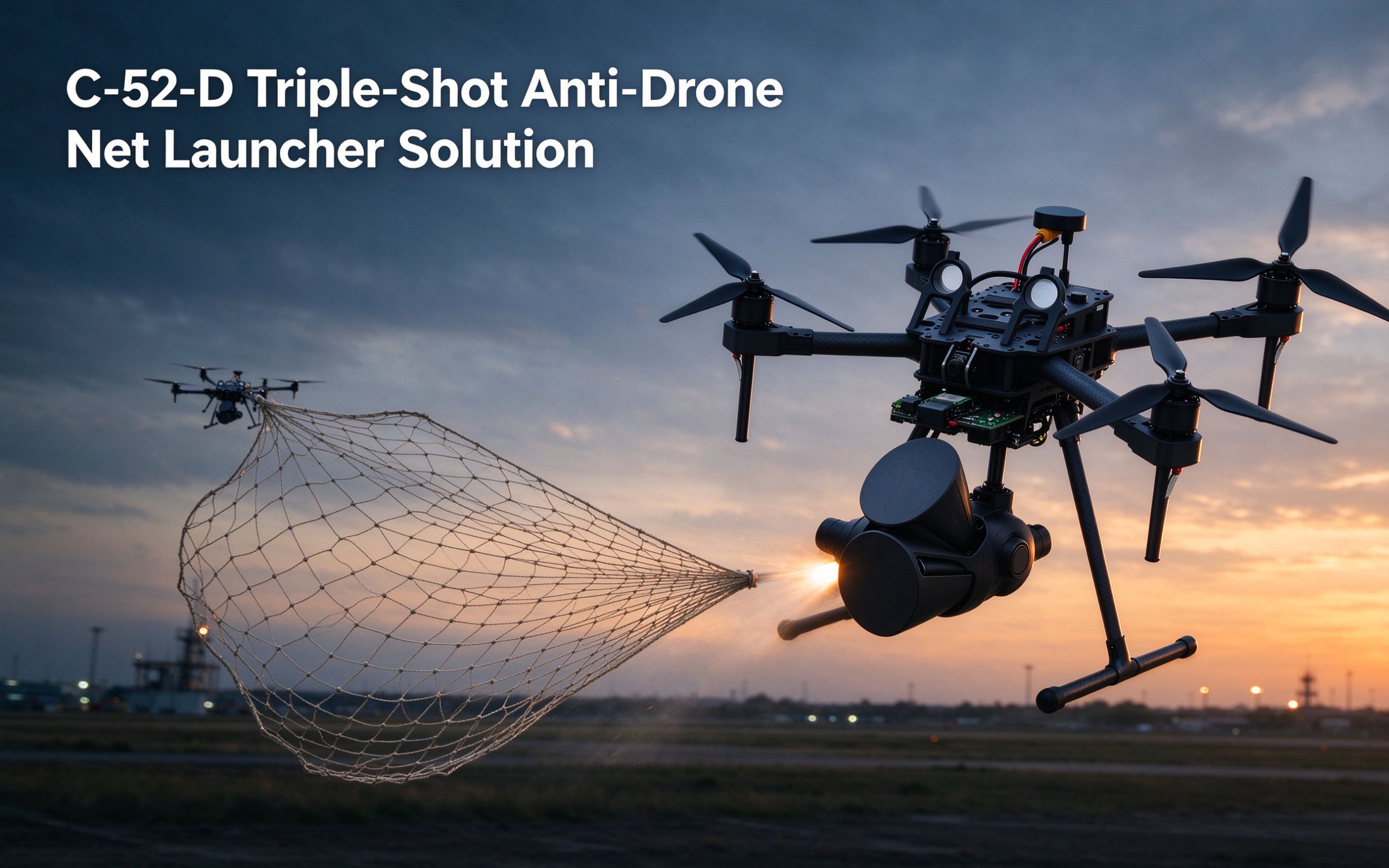
C-52-D Triple-Shot Anti-Drone Net Launcher Solution | 16㎡ Net Opening & 8-10m Range, Covering Air Interception / Ground Counter-UAS / Facility Protection / Event Security Scenarios
Solution Overview This solution centers on the C-52-D triple-shot anti-drone net launcher as the core payload. Leveraging its lightweight 300g per-unit design, 8-10m effective range, 4×4m (16㎡) large net opening, three independent shots, universal 5V PWM…
Solution Overview
This solution centers on the C-52-D triple-shot anti-drone net launcher as the core payload. Leveraging its lightweight 300g per-unit design, 8-10m effective range, 4×4m (16㎡) large net opening, three independent shots, universal 5V PWM trigger and wide -30℃ to 60℃ operating temperature, it can be flexibly mounted on interceptor drones, unmanned ground vehicles (UGVs), robot dogs and other carrier platforms. It delivers a non-kinetic, low-collateral-damage, highly reliable and cost-effective drone capture solution for four core counter-UAS scenarios: aerial drone interception, ground mobile countermeasures, critical infrastructure protection, and major event security. It addresses industry pain points such as uncontrolled crashes caused by jamming, high collateral damage from hard-kill methods, insufficient multi-target capability of single-shot systems and difficult multi-platform integration, achieving the soft-kill objective of “detect, capture and minimize damage” against rogue UAVs.
Four Common Pain Points in Counter-UAS Operations
- High side effects of RF jamming: Suppressive jamming can cause target drones to crash out of control, potentially injuring people and damaging property on the ground, while showing limited effect against autonomous-navigation UAVs.
- High collateral damage from hard-kill methods: Firearms, lasers and other hard-kill means are costly and strictly regulated, with restricted use in airports, crowded areas and flammable/explosive sites, easily causing secondary accidents.
- Insufficient multi-target capacity with single shots: Single-shot net systems can engage only one target at a time. When facing multi-drone intrusions or swarms, the interception window is short and fault tolerance is low.
- Poor payload compatibility and integration difficulty: Traditional countermeasures are heavy with non-standard power and trigger interfaces, making them difficult to deploy across drones, robot dogs, UGVs and other platforms.
Four Custom Scenario Solutions
Scenario 1: Aerial Interceptor Drone Net Capture Solution
Applicable scenarios: Low-altitude rogue drone interception, no-fly-zone aerial patrol, multi-target counter-UAS, key-area aerial security
Pain Points
- Limited ground-based line of sight with building obstructions results in short detection range and insufficient response time.
- RF jamming may cause out-of-control crashes, with high secondary risk in densely populated areas and around critical facilities.
- Single-shot systems offer low fault tolerance against drone swarms or multi-batch intrusions; one missed shot means the interception window is lost.
Solution Configuration
| Category | Configuration | Description |
|---|---|---|
| Carrier Platform | Heavy-lift interceptor drone (10-15 inch recommended) | Position hold, fast tracking and waypoint capability; capable of carrying three net launchers |
| Core Payload | C-52-D triple-shot net launcher ×1 | 3 independent launchers, 300g each (~900g total), 16㎡ net opening, 8-10m range |
| Detection Package | Airborne EO tracking gimbal, ground radar / RF sensor | Integrated target detection, identification and tracking for interception guidance |
| Control System | Relay control board, PWM trigger link | 5V power, 1000-2000us PWM, directly integrated with flight controllers |
| Ground Terminal | Interception command terminal, real-time video link | Target assignment, route command, monitoring and after-action review |
Operation Process
- Target detection: Ground radar/RF sensors detect the rogue UAV, identify its type, altitude, speed and heading, and assign an interception task.
- Approach & tracking: The interceptor launches rapidly and approaches the target’s rear/side under gimbal guidance, maintaining safe tracking distance.
- Net launch: Within the 8-10m effective range, the capture net is deployed; the high-strength net opens to 16㎡ and entangles the target’s propellers.
- Multi-target engagement: If the first shot misses or multiple targets exist, the remaining two nets can be fired successively; guide the target to land or return after interception.
Solution Value
- Soft net capture is non-explosive and non-firearm; the entangled target can descend relatively controllably, greatly reducing ground damage and public-relations risk.
- Three independent shots enable engagement of three targets or three attempts in a single sortie, significantly improving fault tolerance and success rate over single-shot systems.
- At only 300g per unit, the lightweight payload has minimal impact on carrier endurance and maneuverability, compatible with most heavy FPV and commercial drones.
- Standard PWM trigger interface integrates with mainstream flight controllers without complex modification, shortening deployment cycles and reducing costs.
Scenario 2: Ground UGV / Robot Dog Mobile Counter-UAS Solution
Applicable scenarios: Campus perimeter patrol, industrial mobile security, complex-terrain close-in interception, unmanned counter-UAS watch
Pain Points
- Fixed-point countermeasures have limited coverage and blind spots; targets flying around cover cannot be tracked continuously.
- Human close-in reconnaissance carries high risk, with personnel limited in bad weather, at night and in complex terrain.
- Traditional countermeasures are heavy, exceeding the payload capacity of light UGVs and robot dogs that must carry both sensors and effectors.
Solution Configuration
| Category | Configuration | Description |
|---|---|---|
| Carrier Platform | Wheeled UGV / quadruped robot dog | Autonomous navigation, obstacle avoidance and lifting gimbal; supports unmanned patrol |
| Core Payload | C-52-D triple-shot net launcher ×1 | Three independent launchers; 2.5kg full kit with case for vehicle/dog mounting |
| Detection Payload | Gimbal camera, RF detection module, thermal imager | Day/night target identification, tracking and ranging in one package |
| Control System | On-board relay board, PWM trigger module | 5V low-voltage power, directly connected to the vehicle’s main controller |
| Command Terminal | Unmanned scheduling platform, remote monitoring terminal | Task assignment, path planning and remote interception control |
Operation Process
- Autonomous patrol: The UGV/robot dog follows preset routes while RF and EO sensors continuously scan low-altitude targets.
- Target lock-on: Upon detecting an intruding drone, the system automatically identifies and tracks it, with the gimbal maintaining aim and calculating range.
- Close-in interception: The unmanned platform maneuvers quickly under the target or to its predicted route, firing the net within range.
- Continuous watch: After interception, task data is logged and patrol resumes; reload nets after engagement for sustained multi-target defense.
Solution Value
- Unmanned ground platforms enter hazardous, complex and inaccessible areas for 24/7 unmanned watch, reducing manpower costs and personnel risk.
- Net capture produces no muzzle flash and low noise, suitable for silent countermeasures in factories, depots and around buildings with strong stealth.
- Wide temperature range (-30℃ to 60℃) adapts to severe cold, heat, rain and snow for high all-weather reliability.
- Modular mounting brackets quickly adapt to UGVs and robot dogs of different payload classes, enabling one system across multiple platforms.
Scenario 3: Airport & Critical Infrastructure Protection Solution
Applicable scenarios: Airport airspace protection, prison/correctional perimeter, power plants/petrochemical depots, government sites and other critical infrastructure
Pain Points
- Airports, petrochemical sites and power plants are highly sensitive to RF jamming, open flame and explosives, restricting traditional hard-kill and high-power jamming.
- Large facilities with long perimeters create blind spots for fixed sensors, allowing low-altitude and terrain-following drones to penetrate.
- Prisons and airports require traceable, accountable interception that does not disrupt normal on-site equipment operation.
Solution Configuration
| Category | Configuration | Description |
|---|---|---|
| Detection System | Low-altitude radar, RF detection, EO camera fusion | Multi-sensor far/mid/near layered warning with reduced false alarms |
| Air Countermeasure | C-52-D net system + interceptor drone | Fast long-range approach with soft aerial capture to avoid facility damage |
| Ground Countermeasure | C-52-D net system + UGV/fixed post | Perimeter gap filling and low-altitude close defense; air-ground layered protection |
| Management Platform | Counter-UAS command center, video storage | Single-screen dispatch, track playback and task logs for compliance audit |
| Support Package | Spare net assemblies, protective cases, calibration tools | Quick reload and reuse for both training and operational missions |
Operation Process
- Layered warning: Long-range radar/RF sensors first detect the target; the system automatically assesses threat level and cues EO verification.
- Air-ground tasking: Based on target position and route, automatically dispatch the aerial interceptor or ground UGV with an optimal path.
- Soft capture: Launch the net in a safe area outside the facility, entangle propellers and guide the target to land in a preset open zone.
- Post-mission handling: Ground teams recover the target and net; the system retains complete detection, tracking and interception data for reports.
Solution Value
- Pure physical net capture emits no RF suppression, avoiding interference with airport communications, navigation and plant instrumentation for an electromagnetically safe environment.
- No pyrotechnics or blinding lasers, providing strong compliance and lower approval barriers in oil/gas depots, ammunition stores and airports.
- Air-ground multi-platform deployment with far/mid/near layers covers perimeter, low altitude and internal defense lines, greatly reducing penetration probability.
- Reloadable and recoverable nets deliver far lower per-mission cost than missile-type countermeasures with outstanding long-term economics.
Scenario 4: Major Event & Prison Security Solution
Applicable scenarios: Sports events/concert security, large gatherings/exhibitions, correctional facilities, temporary border port control
Pain Points
- Drone crashes in crowded areas can cause mass casualties; both jamming and firearms carry extreme collateral risk.
- Temporary event venues require short-cycle setup, making fixed countermeasures costly and difficult to transport.
- Prisons face risks of contraband delivery and surveillance by drones, requiring covert, fast interception without disrupting normal order.
Solution Configuration
| Category | Configuration | Description |
|---|---|---|
| Portable Detection | Portable RF sensor, low-altitude EO camera, temporary radar | Rapid setup and removal for temporary security needs |
| Portable Countermeasure | C-52-D triple-shot net + portable interceptor | 2.5kg case with triple-shot multi-target capability per sortie |
| Post Countermeasure | C-52-D net launcher + fixed gimbal/tripod | Manual gap-filling interception at key guard posts |
| Command System | Temporary security command post, communication link | Unified multi-node scheduling coordinated with police/security forces |
| Training Support | Training simulation nets, manuals, spare assemblies | Pre-event pilot and guard training to ensure proficiency |
Operation Process
- Pre-event deployment: Set up detection and countermeasure posts around the venue, defining no-fly zones and interception safety areas.
- Continuous monitoring: Scan low altitude throughout the event, immediately alerting and verifying UAVs to distinguish accidental from malicious flights.
- Safe interception: Prioritize net launches in open areas outside crowds to prevent targets falling into spectator zones; triple shots ensure success.
- Rapid withdrawal: Disassemble and transport equipment after the event, recover nets and produce a security mission summary.
Solution Value
- Captured targets descend gradually, and with interceptor drones can land controllably, maximizing crowd protection and meeting the extremely low collateral-damage requirement.
- Portable case design with triple-shot capability at only 2.5kg supports vehicle/backpack transport for high temporary deployment and transition efficiency.
- Silent launch without strong light or noise avoids crowd panic, ideal for concerts and sports events sensitive to public order.
- Seamlessly integrates with existing security and police counter-UAS forces at low procurement and training cost, suitable for security companies and event operators.
5-Step Solution Implementation Process
- Demand research and customization: Survey protected areas, threat levels, existing security systems and compliance requirements to customize payload and deployment plans.
- Delivery and integration: Deliver C-52-D kits, complete adaptation to drones/UGVs/robot dogs and debug PWM triggers and linkage logic.
- Training and drills: Conduct equipment operation, safety and emergency response training with simulated target interception exercises and assessment.
- Formal deployment and process standardization: Go live and standardize the full detect-track-intercept-recover workflow and multi-agency coordination.
- Maintenance and iterative upgrade: Provide spare parts, periodic inspection and system upgrades, optimizing platforms and networking as scenarios evolve.
Core Solution Values
✅ Triple-shot high fault tolerance: Three independent capture nets engage multiple targets or multiple attempts per mission, with substantially higher success than single-shot systems.
✅ Large net high reliability: 16㎡ (4×4m) opening with 8-10m effective range entangles most multirotor drones with strong wind tolerance and fault margin.
✅ Lightweight easy integration: Only 300g per unit with universal 5V PWM interface, easily adapted across drones, UGVs and robot dogs.
✅ Soft low collateral damage: Pure physical net capture with no explosives or strong RF jamming enables controlled target descent and low compliance risk.
✅ Wide temperature all-weather: -30℃ to 60℃ operating range adapts to severe cold, heat and day/night conditions for year-round reliability.
✅ Cost-effective reusable: Quick-reload reusable nets deliver low per-interception cost, with procurement and long-term O&M far below hard-kill solutions.
Tiered Configuration Procurement Advice
- Single-platform entry edition: C-52-D triple-shot kit + one mounting bracket, suitable for a single interceptor drone or entry-level guard post.
- Air-ground coordinated edition: 2× C-52-D kits + interceptor drone + UGV + detection equipment, ideal for small/medium campuses and factory layered security.
- Critical facility professional edition: Multiple net systems + radar/RF/EO detection + command platform, adapted to airports, prisons and power plants.
- Security integrator edition: Bulk kits + multi-platform carriers + training system + spare parts inventory, suitable for security integrators and police/law-enforcement scaled missions.