C-52-D Triple-Shot Anti-Drone Net Launcher: Technical Analysis of a 16㎡ Soft-Net Non-Kinetic Counter-UAS Payload
1. Technical Positioning and Core Value 1.1 Soft Net Capture Position in the Counter-UAS Ecosystem Within the counter-drone technology stack, the C-52-D belongs to the category of lightweight airborne/vehicle-mounted non-kinetic net capture payloads. It is the…
1. Technical Positioning and Core Value
1.1 Soft Net Capture Position in the Counter-UAS Ecosystem
Within the counter-drone technology stack, the C-52-D belongs to the category of lightweight airborne/vehicle-mounted non-kinetic net capture payloads. It is the physical-capture effector in the “detect-defeat” chain, filling the technical gap between RF jamming and hard-kill methods.
Current mainstream counter-UAS means fall into three categories: first, electromagnetic suppression, which jams control links or satellite navigation to force a landing, but can cause out-of-control crashes and shows limited effect against autonomous, pre-programmed drones; second, hard-kill methods such as lasers, firearms and kinetic interceptors, which carry high collateral damage, strict regulation and restricted use cases; third, physical net capture, which entangles rotors with high-strength fibers to disable the target controllably, combining low collateral damage with high reliability.
The C-52-D is a professional-grade product built for the third technical route. With a 300g lightweight per-unit design, triple independent shots and a 16㎡ large net opening, it can be integrated across drones, unmanned ground vehicles (UGVs), robot dogs and other platforms, delivering a highly compliant, low-secondary-risk counter-UAS solution for airports, prisons, critical infrastructure and major events.
1.2 Core Design Logic: Lightweight, Multi-Shot, Platform-Universal
The core design logic of the C-52-D revolves around three objectives: soft capture, multi-target fault tolerance and multi-platform adaptability:
- Non-kinetic soft-kill priority: High-strength fibers physically entangle target rotors without explosives, open flame or strong RF radiation, producing a relatively controllable loss-of-power process.
- Triple-shot high fault tolerance: Three independent launch units engage multiple targets or provide multiple attempts for a single interception, improving mission success.
- Universal interface standard: 5V low-voltage power and standard PWM trigger signals are compatible with mainstream flight controllers and robotic master systems, lowering multi-platform integration barriers.
2. In-Depth Technical Analysis of Core Systems
2.1 Launch Unit Structure: Compact Net Launch Head
Each launcher measures 125×71.2mm and weighs only 300±10g. The net head, emitter and net holder form an integrated capture assembly.
- Lightweight structural design: While ensuring launch strength and rigidity, each unit is kept at around 300g; all three together add under 1kg, minimizing impact on carrier endurance and maneuverability while fitting the payload limits of light robot dogs and small UGVs.
- Modular independent architecture: The three units operate independently, so a failure in one does not affect the others; they can be individually reloaded and replaced for flexible maintenance and mission configuration.
- Launch dynamics principle: Upon trigger, the emitter delivers kinetic energy in a short time to push the folded net along its axis; the net automatically opens through traction weights and air resistance during flight.
2.2 Capture Net System: 16㎡ Large Opening Technology
The net has an effective range of 8-10m and opens to 4×4m in the air, covering 16㎡.
- Net deployment mechanism: The folded high-strength net has traction weights at its corners/edges; after launch, the weights spread outward by inertia, pulling the net fully open into a regular square interception surface.
- Fault tolerance of a large opening: At 16㎡, the coverage far exceeds the physical size of target drones, tolerating ranging and aiming errors and remaining effective even against small target maneuvers, which lowers the operational threshold and raises hit probability.
- Entanglement disablement principle: On contact, the high-strength fibers rapidly wrap around propeller blades, blocking rotation and thrust; once some or all rotors of a multirotor are entangled, it loses lift and attitude control for controllable disablement.
- Range factors: The 8-10m effective range varies with launch angle, wind direction and relative speed; headwinds shorten and tailwinds may extend effective distance, requiring environmental correction in practice.
2.3 Trigger & Control System: 5V PWM Universal Link
A relay control board coordinates the system, powered by 5V DC (red positive, black negative) and triggered by a PWM signal (1000-2000us pulse width).
- Universality of PWM triggering: PWM is among the most common control signals for drone flight controllers and robotic masters; the 1000-2000us servo-style pulse range connects directly to standard FC output channels without dedicated decoders, ensuring low integration cost and broad compatibility.
- Relay isolation control: The relay board electrically isolates the control signal from the launch circuit, protecting master ports and precisely allocating trigger timing across the three units for single or sequential firing modes.
- Safety design logic: Installation procedures require connecting the launch assembly last, preventing accidental firing during commissioning and protecting ground personnel and equipment.
2.4 Environmental Adaptability: Wide-Temperature High-Reliability Design
The system operates across -30℃ to 60℃, adapting to severe cold, high heat and large day-night temperature differences in outdoor conditions.
- Low-temperature reliability: The -30℃ lower limit supports winter operations in high-latitude and high-altitude regions, with launch components and structural materials maintaining stable performance.
- High-temperature adaptability: The 60℃ upper limit suits summer sun exposure, desert environments and hot vehicle compartments, avoiding material softening and circuit failure.
- Multi-platform mounting: Standardized mounting supports interceptor drones (aerial close-in launch), UGVs (ground mobile interception) and quadruped robot dogs (complex-terrain accompanying defense), enabling one payload across multiple platforms.
2.5 System Kit & Packaging
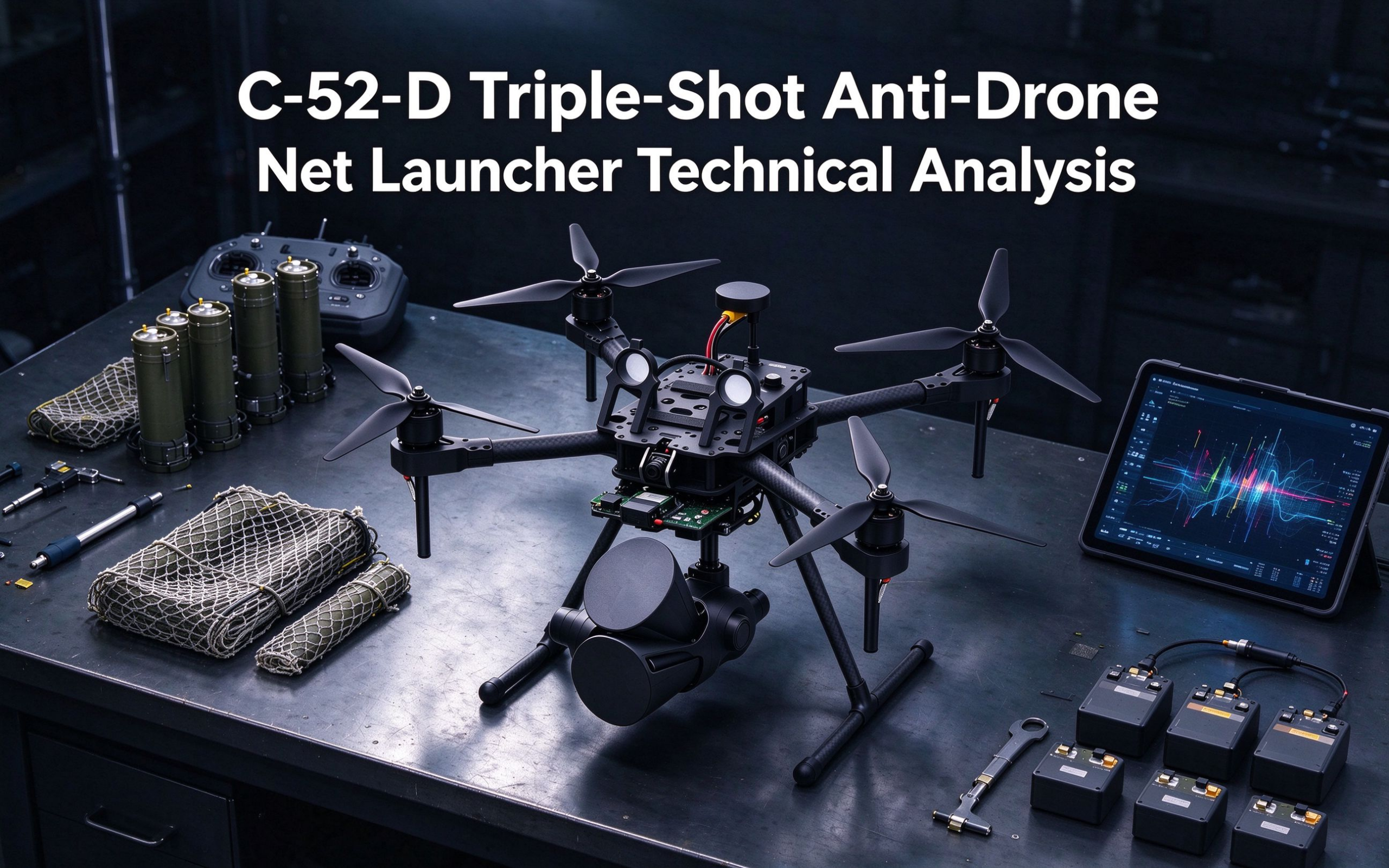
The complete triple-shot kit is delivered in a protective case measuring 28×25×18cm and weighing 2.5kg. It contains 3 onboard hardware kits, 3 switch cables, 1 relay control board, 3 capture net assemblies and 1 user manual.
- The case provides cushioning and impact protection for vehicle transport and field carry;
- Accessories are delivered as a complete set, enabling platform installation and wiring out of the box with short deployment time.
3. Typical Application Scenarios and Technical Fit
3.1 Aerial Net Capture by Interceptor Drones
Mounted on 10-15 inch class heavy-lift interceptor drones for low-altitude rogue drone interception and no-fly-zone patrol. Technical fit: all three units weigh under 1kg, preserving carrier endurance and tracking maneuverability; the 16㎡ opening offers high fault tolerance at 8-10m for dynamic aerial aiming; entangled targets can be guided toward relatively controllable landings to reduce ground damage.
3.2 Ground Counter-UAS by UGV / Robot Dog
Carried by unmanned ground vehicles or quadruped robot dogs for mobile counter-UAS missions at perimeters, factories and complex terrain. Technical fit: 5V low-voltage power naturally matches unmanned platform power systems; PWM signals connect directly to masters without complex modification; the wide temperature range supports 24/7 outdoor unmanned reliability.
3.3 Airport & Critical Infrastructure Protection
For airport airspace, prisons, power plants, petrochemical depots and government sites. Technical fit: pure physical capture emits no high-power RF radiation, avoiding interference with airport communications/navigation and plant instrumentation; no explosive pyrotechnics or blinding lasers ensures strong compliance in flammable/explosive sites; air-ground multi-platform coordination builds layered interception.
3.4 Major Event & Crowded-Area Security
For sports events, concerts, large gatherings and exhibitions requiring temporary security. Technical fit: soft capture prevents out-of-control crashes into crowds with minimal collateral damage; the portable case enables rapid setup, transition and withdrawal; silent launch without strong light or noise avoids public panic.
4. Industrial Value and Technology Trends
4.1 Industry Value: Shifting Counter-UAS from “Jamming/Destruction” to “Controllable Capture”
The industrial value of net-capture payloads such as the C-52-D lies in providing an auditable, traceable and low-collateral-damage technical route. Compared with unclear crashes caused by jamming and high compliance barriers of hard kill, a net system preserves the target drone intact for post-mission forensics and accountability while minimizing impact on surrounding people and the environment, especially in populated areas, sensitive facilities and law-based enforcement scenarios. Its lightweight, standardized and universal design also lowers the cost of extending counter-UAS capability across unmanned platforms, driving the evolution from fixed-point defense toward air-ground coordinated, unmanned networking.
4.2 Technology Development Trends
Current development directions for net-capture counter-UAS technology focus on four dimensions: First, intelligent closed-loop interception: deep integration with EO tracking and AI vision for automatic ranging, trajectory calculation and autonomous launch timing, reducing human dependence and shortening reaction time. Second, net and launch performance upgrades: new high-strength fiber materials and optimized folding/traction structures further improve deployment speed, effective range and coverage while strengthening wind and target-maneuver resistance. Third, multi-function payload integration: combining net capture with spraying, marking and jamming modules to form reconfigurable “one payload, multiple effects” counter-UAS systems. Fourth, networking and unmanned coordination: multiple interceptor drones, UGVs and robot dogs network through a unified command platform for multi-target assignment, saturation interception and battle-damage assessment against emerging threats such as drone swarms.
Product Link: C-52-D Triple-Shot Anti-Drone Net Launcher
More Products: IUAV Official