
DJI Inspire 1 Pro/Raw: Technical Guide to the 4/3 Large Sensor, MFT Lenses & Cinema DNG RAW Video
1. Technical Positioning and Core Value 1.1 Positioning The DJI Inspire 1 Pro/Raw (Model T600) is a professional large-sensor imaging drone and the high-end version of the Inspire 1 series. Historically, it integrated a 4/3 sensor,…
1. Technical Positioning and Core Value
1.1 Positioning
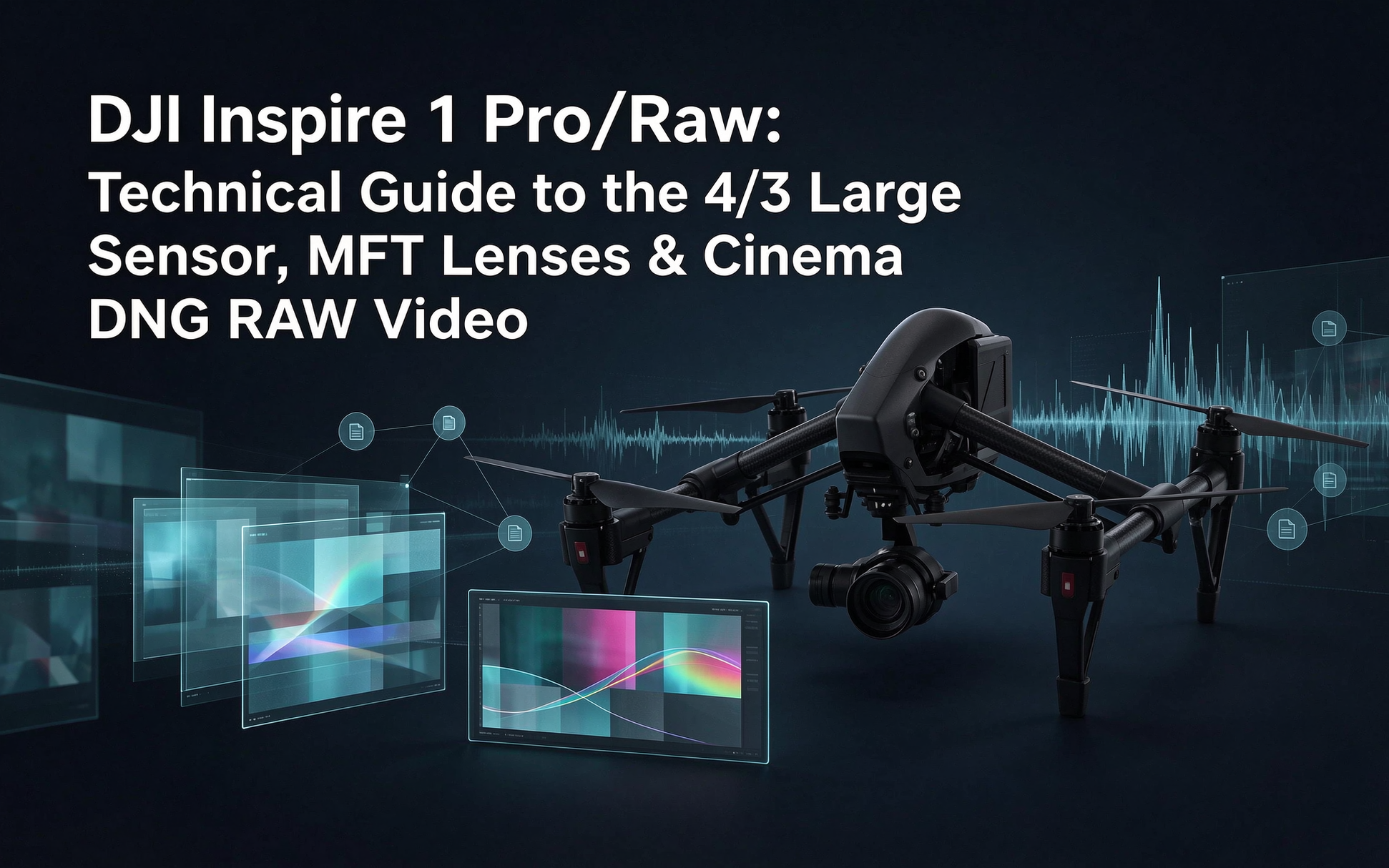
The DJI Inspire 1 Pro/Raw (Model T600) is a professional large-sensor imaging drone and the high-end version of the Inspire 1 series. Historically, it integrated a 4/3 sensor, MFT interchangeable lenses and in-camera RAW video into a rapidly deployable aerial platform, bringing cinematic image quality to an integrated two-person workflow.
Its core value lies in imaging professionalism: larger sensor area, interchangeable lenses and the X5R’s Cinema DNG RAW that preserves full image data.
1.2 Design Logic: Large Sensor, Interchangeable, RAW, Collaborative
- Large sensor: better light gathering, dynamic range and bokeh;
- Interchangeable optics: standard MFT mount;
- RAW workflow: 12-bit Cinema DNG for grading;
- Two-person collaboration: dual control decouples flight and camera work.
2. In-Depth Module Analysis
2.1 4/3 Imaging System
4/3 CMOS (17.3×13.0mm), 16MP.
- Larger area gives bigger photodiodes, more photons per pixel and higher SNR, reducing low-light noise;
- 12.8 stops dynamic range from larger well capacity;
- Shallower depth of field for cinematic bokeh.
2.2 MFT Mount & Optics
MFT mount with short flange distance and electronic contacts; 15mm f/1.7 ASPH, 72°.
- Compatible with MFT lenses;
- f/1.7 boosts light and bokeh; aspheric elements correct aberrations;
- 256-area AF, spot/touch focus, focus peaking and zebra;
- P/S/A/M with sRGB/Color Looks/LOG/Cine-D.
2.3 Three-Axis Gimbal
Pitch -90~+30, yaw ±320, ±0.02° vibration.
- A high-rate IMU drives brushless motors with reverse torque to cancel vibration;
- High precision keeps large-sensor footage sharp.
2.4 H.264 vs Cinema DNG RAW (Core Difference)
- X5: H.264 4K/30, 60Mbps, 12.8 stops, JPEG/DNG;
- X5R: adds 12-bit 4K Cinema DNG lossless RAW at 2.4Gbps.
Cinema DNG RAW principles:
- RAW records original linear sensor data before debayering, preserving full information;
- 12-bit depth gives more gray levels to avoid banding during grading;
- 2.4Gbps lossless bitrate avoids compression artifacts;
- Data writes to a dedicated 512GB SSD;
- H.264 proxy on Micro SD enables smooth editing before relinking RAW, via CineLight.
H.264 is efficient and compatible; Cinema DNG trades storage and complexity for huge grading latitude.
2.5 Transformable Gear
Linkages/servos raise the gear after takeoff for unobstructed 360 view (yaw ±320) and lower drag, then lower it for landing with lock detection.
2.6 Power Chain
3510H motors, 1345T props; ESC inverts 6S DC to three-phase AC; 18m/s, 5m/s climb, 10m/s wind, 4500m altitude.
2.7 Battery & Endurance
- TB47: 4500mAh/22.2V/6S/99.9Wh/570g, ~15 min;
- TB48: 5700mAh/22.8V/129.96Wh/670g, ~18 min;
- BMS supports smart RTH; 100W charger, 180W max, 0-40℃ charging.
2.8 Down Vision & Lightbridge
- Down vision only (no forward avoidance): optical flow plus ultrasonic (5-500cm) for low/indoor hover, >15lux; GPS accuracy ±0.5m/±2.5m;
- Lightbridge returns 720P, FCC up to 5km;
- C1 controller (6000mAh, USB/Mini-HDMI) master/slave splits flight and camera control.
3. Scenarios and Technical Fit
3.1 Film/advertising: large-sensor bokeh, 12-bit Cinema DNG, dual control.
3.2 Commercial aerial/engineering: 12.8 stops, MFT lenses, stable link.
3.3 High-end events: reliable link, dual control, down hover.
3.4 Education/teams: full sensor/lens/RAW/dual-control workflow.
4. Industrial Value and Trends
4.1 Industry Value
The Inspire 1 Pro/Raw established the large-sensor + interchangeable lens + in-camera RAW + dual-control paradigm, bringing cinematic grading to a deployable platform and making sensor size, bit depth, RAW and lens mounts core professional dimensions.
4.2 Trends
First, full-frame sensors with higher bit depth and internal ProRes/RAW; Second, higher-bandwidth SSDs, compressed RAW and better proxy workflows; Third, omnidirectional vision/mmWave/LiDAR redundancy; Fourth, smarter AF, SLAM and multi-drone coordination.
Product Link: DJI Inspire 1 Pro/Raw
More Products: IUAV Official