
DJI Inspire 1 V1.0: Technical Guide to Transformable Landing Gear, Swappable Gimbals & Dual-Control Collaboration
1. Technical Positioning and Core Value 1.1 Positioning The DJI Inspire 1 V1.0 (Model T600) is a professional imaging drone and integrated aerial filming platform for film, advertising and aerial work. Historically, it combined transformable landing…
1. Technical Positioning and Core Value
1.1 Positioning
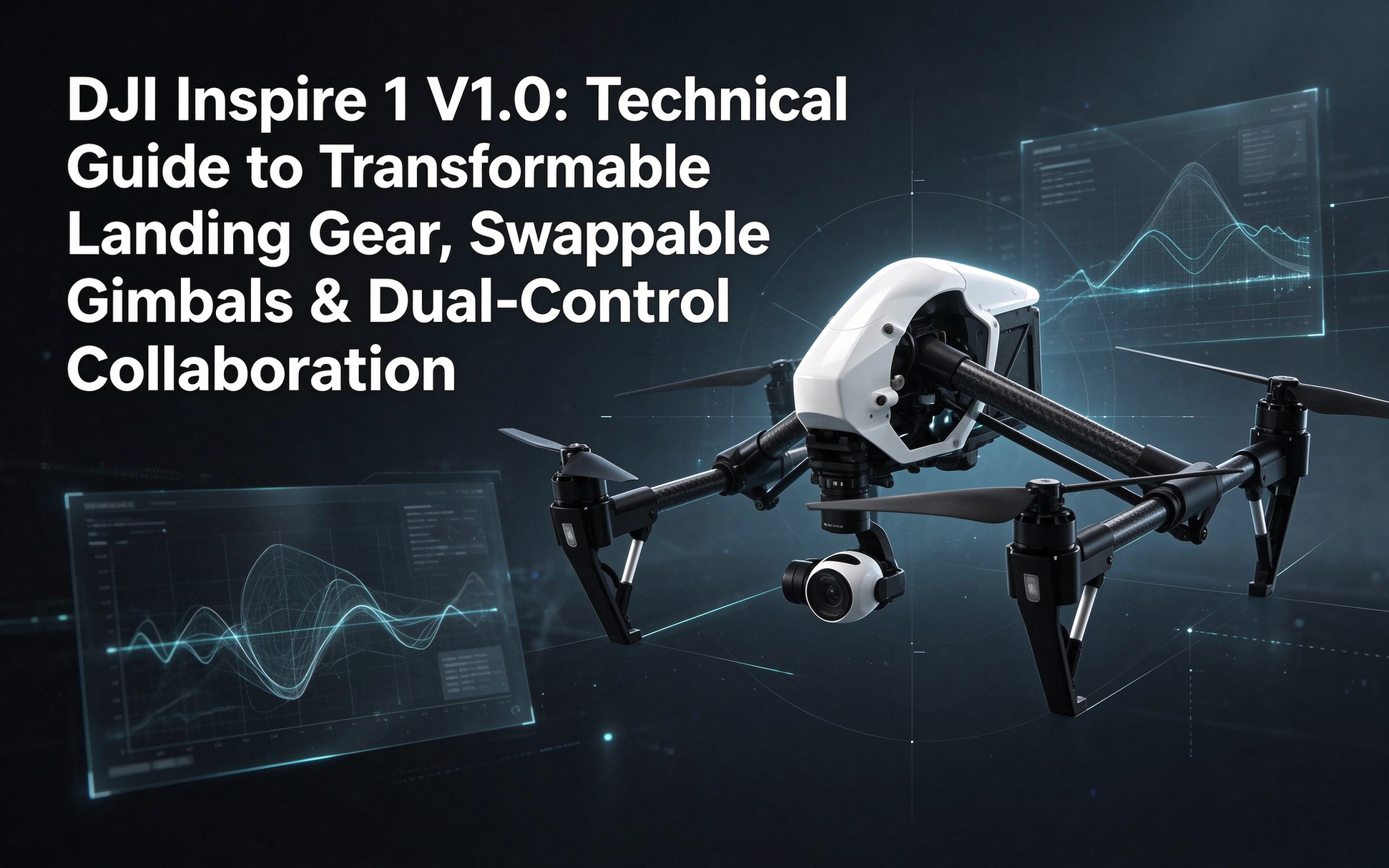
The DJI Inspire 1 V1.0 (Model T600) is a professional imaging drone and integrated aerial filming platform for film, advertising and aerial work. Historically, it combined transformable landing gear, swappable professional gimbals and master-slave dual control in one airframe, moving professional imaging toward a rapidly deployable, two-person integrated form.
Its value lies not in portability but in unobstructed 360° gimbal movement, an expandable payload ecosystem and a professional dual-control workflow.
1.2 Design Logic: Unobstructed, Expandable, Collaborative, Professional
- Unobstructed: gear lifts after takeoff to clear the gimbal;
- Expandable: standard detachable interface for X3/X5/X5R/XT/Z3;
- Collaborative: dual control decouples flight and camera work;
- Professional: 6S high-voltage power, carbon body and down vision.
2. In-Depth Module Analysis
2.1 Transformable Landing Gear
581mm diagonal (landing mode), 2845g without gimbal.
- Linkages, servos and locks raise the gear along the body and lower it for landing;
- Retraction clears the view and reduces drag;
- Position feedback and lock detection ensure safe states.
2.2 Detachable Gimbal & Stabilization
Angular vibration ±0.03°.
- The standard interface integrates quick-release mechanics, power and data, with auto payload recognition;
- A high-rate IMU and three brushless motors provide reverse torque on pitch/roll/yaw;
- Controllable pitch -90~+30, pan ±320; mechanical pitch -125~+45, pan ±330.
2.3 Swappable Zenmuse Ecosystem
- X3: 1/2.3, 12.4MP baseline 4K;
- X5/X5R: M4/3, interchangeable lenses, X5R RAW video;
- XT: thermal;
- Z3: zoom. Standardized mechatronic interfaces decouple flight and imaging for reuse.
2.4 Power Chain
- 3510H motors with 1345T props;
- ESC inverts DC to three-phase AC; large motors and low-speed props deliver efficient thrust;
- 79km/h, ascent 5m/s, descent 4m/s, 35° pitch, 300°/s pitch and 150°/s yaw;
- 10m/s wind, 2500m (4500m with special props).
2.5 Battery & Endurance
- TB47: 4500mAh/22.2V/6S/99.9Wh/570g;
- TB48: 5700mAh/22.8V/129.96Wh/670g;
- About 18 minutes; BMS supports smart RTH;
- 100W charger, 180W max charge, 0-40℃ charging.
2.6 Camera (X3)
- 1/2.3 CMOS, 12.76M total/12.4M effective;
- 94°, 20mm, f/2.8, 9 elements/9 groups, anti-distortion;
- Shutter 8s-1/8000, ISO video 100-3200/photo 100-1600;
- Up to 4K/30, 60Mbps H.264; JPEG/DNG; Micro SD up to 64GB;
- Small sensor limits low-light SNR; X5/X5R unlock higher quality.
2.7 Down Vision & Ultrasonic
- Optical flow/feature matching estimates horizontal movement;
- Ultrasonic measures height 5-500cm on rigid non-absorbing surfaces;
- Requires >15lux and texture;
- GPS hover ±0.5m vertical/±2.5m horizontal; indoor hover enabled.
2.8 Link, Controller & Dual Control
- GL658A at 2.4/5.8GHz (900MHz Japan); FCC 5km/CE 3.5km/MIC 2km;
- Encoded digital link with USB/mini-HDMI and 6000mAh battery;
- Master holds flight control while slave controls gimbal/camera over the same link.
3. Scenarios and Technical Fit
3.1 Film/advertising: unobstructed movement, X5/X5R RAW, dual control.
3.2 Events: reliable link, quick setup, Z3 zoom, down hover.
3.3 Education: standard pro form, dual-control workflow, common parts.
3.4 Multi-payload: one platform for aerial/RAW/thermal/zoom.
4. Industrial Value and Trends
4.1 Industry Value
The Inspire 1 V1.0 established the transformable-gear + swappable-gimbal + dual-control paradigm, bringing two-person workflows to a deployable platform and lowering professional imaging barriers. It drove payload standardization, flight/camera decoupling and dual-control collaboration.
4.2 Trends
First, omnidirectional vision/mmWave/LiDAR redundancy; Second, larger sensors, in-camera RAW and better low-light range; Third, SLAM, tracking and multi-drone autonomy; Fourth, standardized payload interfaces for mature ecosystems.
Product Link: DJI Inspire 1 V1.0
More Products: IUAV Official