
F80 Fixed-Wing Reconnaissance UAV: Technical Guide to Aerodynamics, Propulsion & Dual Communications of a Long-Endurance ISR Platform
1. Technical Positioning and Core Value 1.1 Positioning The F80 (SKU IUAV-15429) is a tactical fixed-wing long-endurance reconnaissance drone built for intelligence, surveillance and reconnaissance. Unlike multirotors, it generates lift through fixed wings rather than continuous…
1. Technical Positioning and Core Value
1.1 Positioning
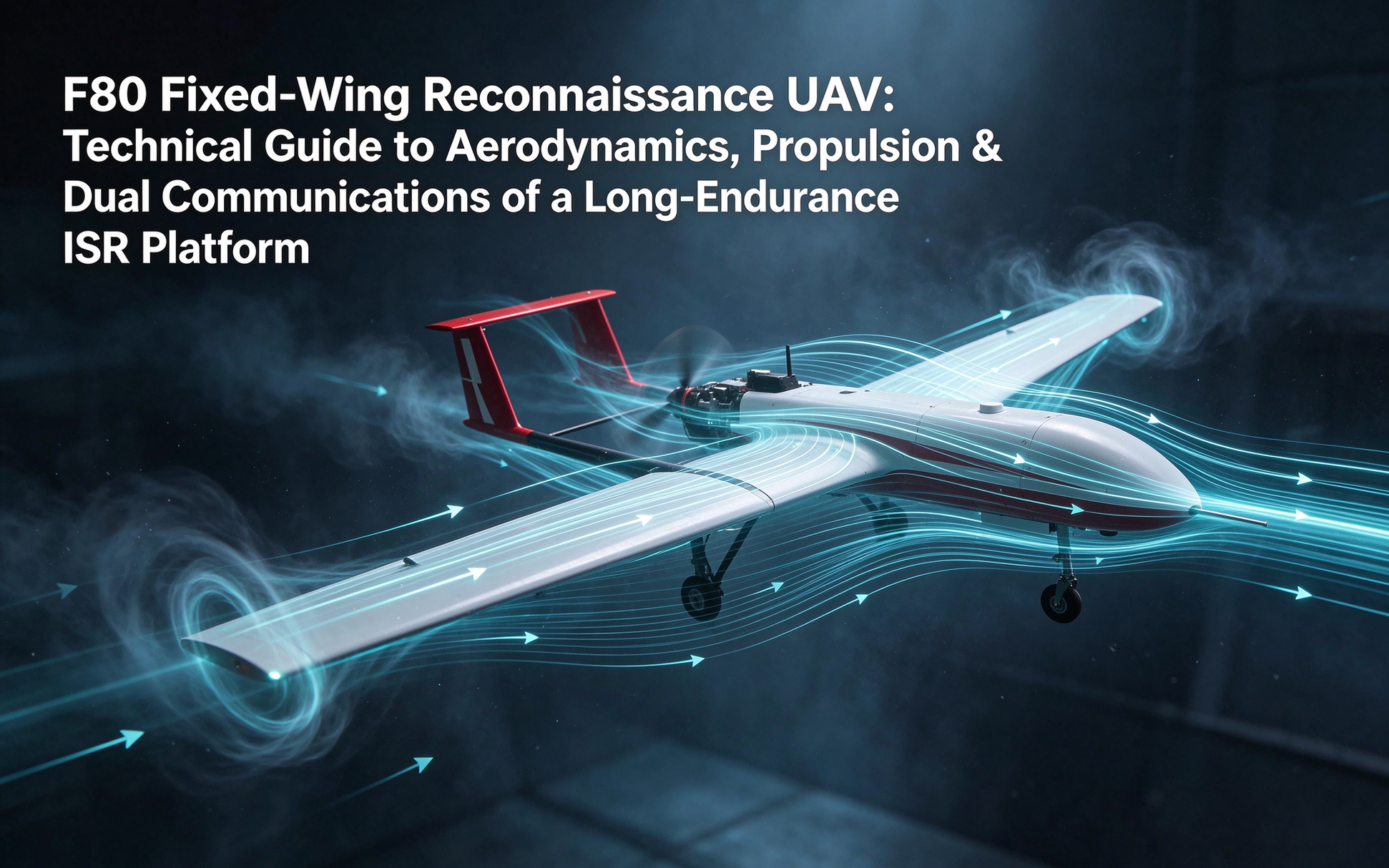
The F80 (SKU IUAV-15429) is a tactical fixed-wing long-endurance reconnaissance drone built for intelligence, surveillance and reconnaissance. Unlike multirotors, it generates lift through fixed wings rather than continuous rotor work, giving it order-of-magnitude advantages in energy efficiency, endurance and coverage, with 8 hours of loiter and large-area patrol.
Its core value is not hovering but persistent situational awareness built from an efficient aerodynamic platform, large payload and BLOS dual communications.
1.2 Design Logic: Efficient, Persistent, Payload-Capable, Connected
- Efficient aerodynamics: 6m high-aspect-ratio wing for high L/D;
- Persistent loiter: fixed-wing lift enables 8-hour endurance;
- Payload capacity: 25kg margin at 80kg takeoff;
- BLOS connectivity: satellite + radio links.
2. In-Depth Module Analysis
2.1 Fixed-Wing Lift & Endurance
- Lift follows \(L=\tfrac12\rho v^2 S C_L\), arising from the pressure difference over the wing;
- Thrust mainly overcomes drag while the wing passively provides lift, unlike multirotors that continuously burn energy to generate lift;
- Fixed wings therefore achieve hours of endurance versus multirotor minutes—the basis of the 8-hour flight.
2.2 High-Aspect-Ratio Wing
6m span, 2.8m length.
- A high aspect ratio reduces wingtip-vortex induced drag and raises L/D, cutting cruise fuel use;
- The large wing offers a stable, low-disturbance sensor platform.
2.3 Pusher Layout
The rear propeller frees the nose for sensors with no blade obstruction and keeps the forward field of view clean.
2.4 Power & Speed
130km/h cruise, 160km/h max; economic cruise balances coverage and loiter. 3000m ceiling broadens the field of view.
2.5 Payload Integration
25kg payload at 80kg takeoff supports day/night EO sensors through modular mechanical, power and data interfaces for high reuse.
2.6 Dual Satellite-Radio Communications
- Radio: low-latency, high-bandwidth direct link limited by LOS and terrain;
- Satellite: relays beyond curvature and terrain for BLOS connectivity;
- Redundant links auto-switch for anti-jamming resilience and real-time data return.
2.7 Tricycle Gear & Runway
The nose-plus-two-main configuration gives stable ground handling for runway takeoff and landing, but prevents vertical takeoff or hover.
2.8 Flight Control & Navigation
Fixed-wing control manages pitch, roll, yaw, throttle and heading with GNSS/INS and dual links; routes, turn radii and diversion fields must be planned in advance.
3. Scenarios and Technical Fit
3.1 Border/coastal patrol: 8-hour BLOS dual-link surveillance.
3.2 ISR: unobstructed nose, modular 25kg payload, 3000m loiter.
3.3 SAR/emergency/corridor: fast arrival plus long wide-area search.
3.4 Aerial survey: stable high-aspect-ratio platform for large-sortie coverage.
4. Industrial Value and Trends
4.1 Value
The F80 integrates long-endurance fixed wings, large payload and BLOS dual communications into a deployable tactical platform, demonstrating the route of trading aerodynamic efficiency for persistent surveillance and lowering the threshold for long-duration ISR.
4.2 Trends
First, VTOL hybrids removing runway dependence; Second, higher aspect ratios, blended wings and new materials; Third, smart multi-link switching, miniaturized satellite comms and autonomy; Fourth, lighter sensors, high-density energy and hybrid power.
Product Link: F80 Fixed-Wing Reconnaissance UAV More Products: IUAV Official