
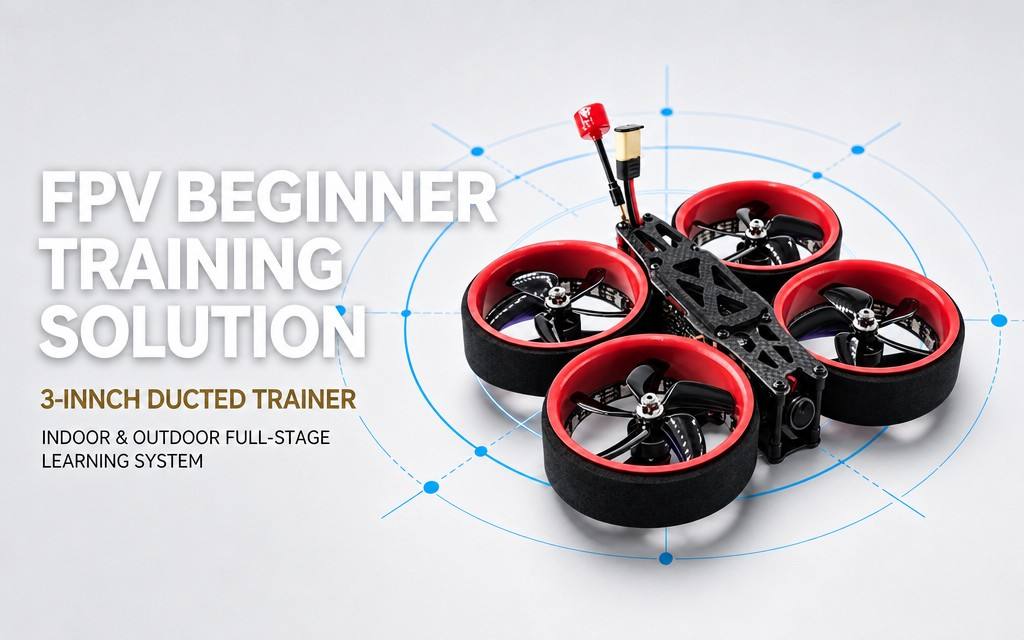
FPV Beginner Training Solution | 3-inch Ducted Trainer Indoor & Outdoor Full-Stage Learning System
Common Pain Points in FPV Beginner Training FPV flight has a high learning barrier and high beginner dropout rate, driven by four core pain points: High crash cost, low confidence: Open-prop drones crash easily with beginner…
Common Pain Points in FPV Beginner Training
FPV flight has a high learning barrier and high beginner dropout rate, driven by four core pain points:
- High crash cost, low confidence: Open-prop drones crash easily with beginner mistakes. Propeller, frame and motor repairs are expensive, and repeated crashes quickly discourage new pilots.
- Hard to train indoors, limited by space: Exposed propellers create safety risks to people and property. Most beginners can only train outdoors in open areas, limited by weather and location, resulting in low training efficiency.
- Sim-to-real gap: Simulator feel, latency and handling differ significantly from real drones, making it hard to build muscle memory and lengthening the transition period.
- Confusing equipment selection: Beginners mixing and matching flight controllers, VTX, goggles and radios often face mismatched parameters, high latency and poor handling, directly hurting training progress.
- Hard to standardize teaching: Flight schools and training organizations lack a unified training platform. Mixed fleets make progress hard to track, maintenance costly and safety risks unpredictable.
Solution Core: 3-inch Fully-Ducted Safe Training System
This solution is built around the 3-inch fully-ducted FPV trainer as its core platform, following four principles — safety, stability, accessibility and scalability — to deliver a complete training system from indoor basics to outdoor advancement, directly addressing entry-level pain points:
- Fully-ducted safety design: 3-inch propellers are fully enclosed inside ducts, greatly reducing damage on impact and injury risk to people and property. Safe to fly indoors, cutting beginner crash repair costs by 80%.
- Training-grade stable flight controller: F722 FC high-performance flight controller + ICM42688P high-precision gyroscope delivers stable attitude and linear, smooth response close to simulator feel, drastically shortening the sim-to-real transition.
- Low-latency starlight video link: 5.8G VTX with ≤30ms latency for responsive, lag-free control. 1/2.7-inch starlight CMOS sensor delivers clear footage in low light, enabling training indoors and at dusk.
- Lightweight compact airframe: ~0.3kg dry weight, 145mm wheelbase. Small and agile enough for hovering and basic maneuvers in tight indoor spaces, independent of weather and location.
- Configurable powertrain: 20A/45A/50A ESC options, customizable motor KV, 2-6S battery compatibility. Power can be upgraded through training stages for a smooth beginner-to-advanced transition.
- Complete accessory ecosystem: FPV goggles, ELRS radio, batteries and chargers available as a bundle. One-stop solution with no need for self-matching or tuning.
Three Custom Scenario Solutions
Scenario 1: Individual Beginner Training Solution
Target users: Zero-experience FPV hobbyists, pilots transitioning from simulator to real flight Training goals: Master basic hovering, line flight and basic maneuvers; safely pass the beginner phase and build correct muscle memory Solution Configuration
| Category | Configuration | Notes |
|---|---|---|
| Training Drone | 3-inch ducted FPV trainer (Base version) | 20A ESC, KV2700 motor, 1700TVL starlight camera, ELRS 2.4G receiver |
| Display | Entry-level 5.8G analog FPV goggles | Matched VTX band, low latency, ideal for beginner training |
| Control | Entry-level ELRS transmitter | Matched protocol, linear control, ideal for beginner practice |
| Power System | 6S 800mAh LiPo ×3 + entry-level balance charger | 5-8min per battery; 3 packs for a full training session |
| Spare Parts | Spare ducted propellers, battery strap | Consumables on hand to minimize training downtime |
Stage-by-Stage Training Plan
- Foundation phase (flights 1–5): Hover practice indoors or in open outdoor areas. Get familiar with FPV view, latency and throttle feel; build basic spatial awareness.
- Line flight phase (flights 6–15): Practice forward/back/left/right lines, level turns and figure-8 patterns. Master control logic and improve spatial judgment.
- Basic maneuver phase (flights 16–30): Practice vertical climbs/descents and slow rolls. Gradually transition from indoor to open outdoor flight.
Solution Value: Safely pass the beginner phase at minimum cost. Crash repair costs drop dramatically, and learning time shortens by 30% compared to open-prop drones, quickly building real-flight confidence.
Scenario 2: Indoor Small-Space Specialized Training Solution
Target users: Pilots needing all-weather training, home/studio indoor practice, tight-space precision control training Training goals: Improve precision control in confined spaces; enable all-weather training independent of weather and outdoor fields Solution Configuration
| Category | Configuration | Notes |
|---|---|---|
| Training Drone | 3-inch ducted FPV trainer (Light version) | 20A ESC, KV2700 motor, 1700TVL starlight camera, ELRS 2.4G receiver |
| Display | Lightweight FPV goggles | Comfortable for long indoor training sessions |
| Control | Compact ELRS transmitter | Lightweight ergonomic design for fine control work |
| Power System | 6S 800mAh LiPo ×5 + desktop fast charger | Multiple packs for continuous training time |
| Training Aids | Indoor obstacle cones, course markers | Build simple training courses for structured practice |
Stage-by-Stage Training Plan
- Precision hovering: Stationary hover in small spaces; practice fine throttle and attitude control for stability.
- Obstacle course: Fly simple obstacle courses; practice 绕障 flight and spatial awareness in tight environments.
- Low-speed slalom: Slow flight through narrow gaps; train eye-hand coordination and refine muscle memory.
Solution Value: No outdoor field required. Complete basic training indoors in all weather with zero safety risk thanks to the fully-ducted design. Training efficiency improves by 50% vs. outdoor-only training, and progress continues rain or shine.
Scenario 3: Flight School / Training Organization Batch Solution
Target users: FPV flight schools, aviation academy programs, professional training organizations, drone training centers Training goals: Standardize curriculum, unify training platforms, reduce safety risks and maintenance costs, improve batch teaching efficiency Solution Configuration
| Category | Configuration | Notes |
|---|---|---|
| Training Fleet | 3-inch ducted FPV trainers × N (Fleet edition) | 45A ESC, KV2700 motor, 1800TVL starlight camera, ELRS 2.4G receiver. Uniform spec for teaching & maintenance |
| Teaching Kit | Matched FPV goggles × N, training radios × N | Consistent parameters, standardized teaching, no adaptation time for students |
| Power & Charging | 6S 900mAh LiPo (bulk) + multi-channel balance chargers | Centralized charging for batch student demand |
| Training Aids | Course marker sets, obstacle kits, staged curriculum | Standardized content and controlled progression |
| Maintenance Spares | Bulk spare ducted props, wear parts, FC spares | Unified maintenance, lower operating costs, less downtime |
Teaching Implementation Guidelines
- Uniform fleet standard: All students train on identical machines for consistent feel, efficient troubleshooting and repeatable teaching standards.
- Staged progression: Phase 1 indoor basics, Phase 2 outdoor lines & maneuvers, Phase 3 power upgrade for advanced moves — ramp up difficulty gradually.
- Full safety management: Fully-ducted design drastically reduces training incidents. Indoor teaching is safe and controlled, lowering organizational safety costs.
Solution Value: Significantly improved teaching standardization, 90% fewer training safety incidents, 60% lower equipment maintenance cost, and greatly improved batch teaching efficiency and student pass rates.
5-Step Solution Implementation
- Needs assessment: Define scenario, student count, training goals and budget to select the right solution and configuration level.
- Equipment deployment: Procure drones and accessories per the bill of materials. Factory tuned and calibrated, ready to train out of the box.
- Staged training: Follow the stage-by-stage plan for the selected scenario, progressing from basics to advanced, indoor to outdoor.
- Advancement transition: After basic proficiency, upgrade ESC / motor KV for more power, or transition to open-prop drones.
- Operational support: Regularly inspect FC parameters, powertrain and duct structure. Keep spares on hand for continuous training availability.
Core Values & Benefits
✅ Safer and lower cost: Fully-ducted protection cuts crash losses and safety risks, reducing both beginner cost and organizational risk.
✅ Higher training efficiency: Stable FC + low-latency link feels close to a simulator. Faster sim-to-real transition and shorter learning curves.
✅ Highly adaptable: Train indoors or outdoors, in any weather. Works for individual practice and institutional teaching alike.
✅ Flexible & scalable: Multiple ESC, motor and camera options fit different training stages and allow smooth progression.
✅ Complete ecosystem: One-stop package from drone to goggles, radio, batteries and charger. No self-assembly or tuning required.
Tiered Configuration Procurement Advice
- Individual beginners: Start with the base 20A ESC + 1700TVL build, entry-level goggles and radio, and 3 batteries for the best value.
- Indoor specialized training: Choose the light base configuration, add extra batteries and indoor training aids for all-weather indoor practice.
- Flight school batch: Select the uniform 45A ESC spec with 1800TVL cameras. Bulk procure spares and multi-channel chargers for teaching efficiency.
- Advanced training: Upgrade to 50A ESC and custom high-KV motors for more power and advanced maneuver training.
Product Page: https://iuavofficial.com/product/3-inch-fpv-training-drone/