In-Depth Review of the C-52-D Triple-Shot Anti-Drone Net Launcher: Is the Lightweight Soft-Kill Payload Worth It?
Review Overview This review evaluates the C-52-D triple-shot drone net launcher from IUAV, designed as a non-kinetic counter-UAS payload mountable on interceptor drones, UGVs and robot dogs. We conduct hands-on testing across six dimensions: unboxing &…
Review Overview
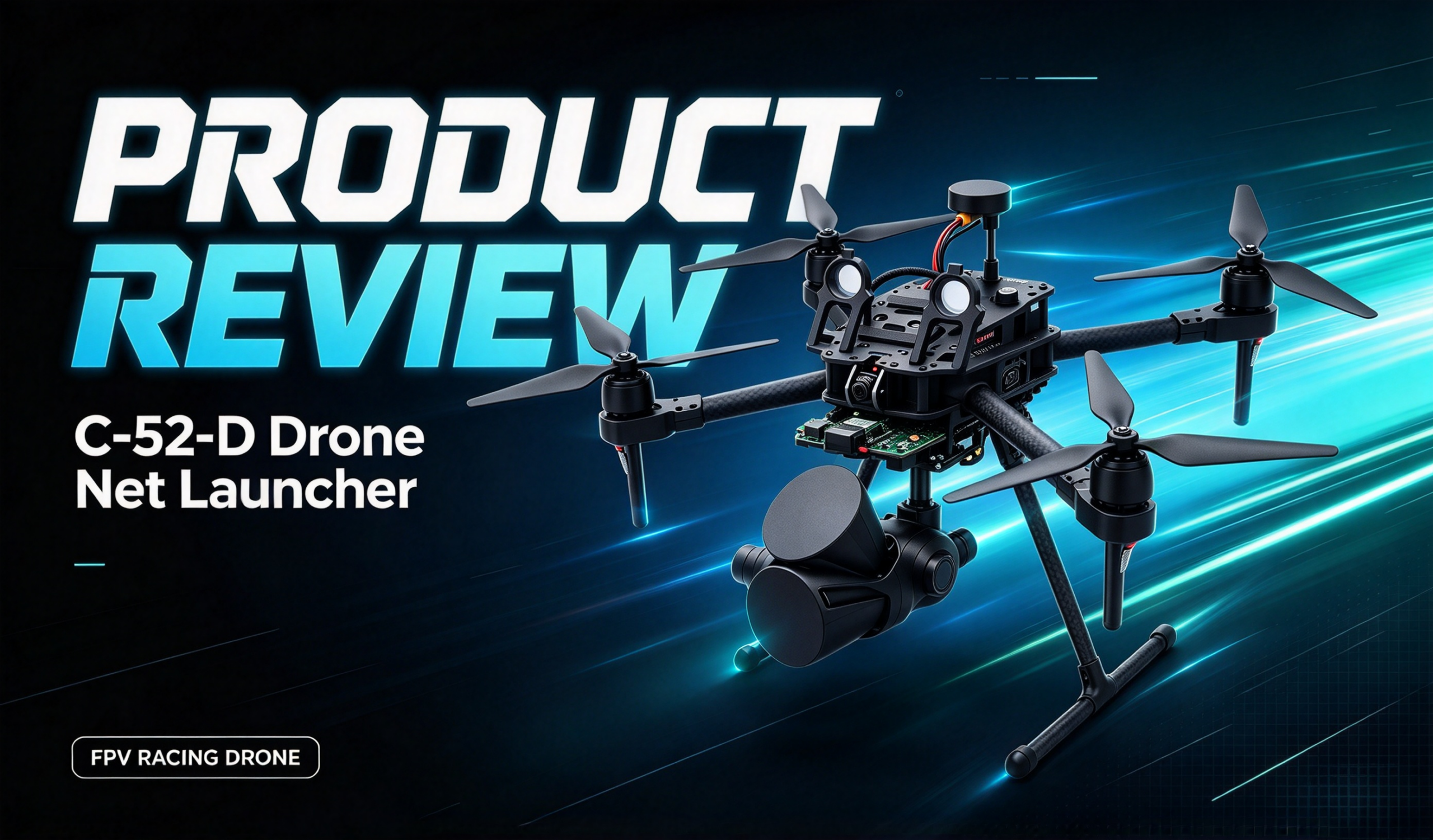
This review evaluates the C-52-D triple-shot drone net launcher from IUAV, designed as a non-kinetic counter-UAS payload mountable on interceptor drones, UGVs and robot dogs. We conduct hands-on testing across six dimensions: unboxing & build quality, specifications, trigger integration, net-capture performance, platform compatibility and environmental reliability. Pros, cons and buyer recommendations are included for counter-UAS teams, security integrators and law-enforcement units.
| Review Item | Score (out of 10) | Key Conclusion |
|---|---|---|
| Unboxing & accessory completeness | 9.0 | Full protective-case kit with complete accessories for immediate installation |
| Build quality & structural design | 8.5 | Compact, lightweight and highly modular |
| Specification performance | 8.5 | 16㎡ large net opening plus triple shots for strong fault tolerance |
| Integration & operation difficulty | 8.5 | 5V PWM universal interface lowers FC integration barriers |
| Platform compatibility | 9.0 | Works across air, ground and legged platforms with wide adaptability |
| Overall cost-performance | 8.5 | Low per-interception cost, reloadable and economical over time |
| Overall Score | 8.7 | A cost-effective lightweight soft-kill counter-UAS choice |
1. Unboxing & Package Contents
1.1 Outer Packaging & Protection
The C-52-D is delivered in a hard protective case measuring 28×25×18cm and weighing 2.5kg. Custom-cut foam holds each launcher, control board and cable in independent slots, preventing movement and impact during transport.
- The compact case is easy to carry by hand and takes little space in vehicles or field kits;
- It provides basic pressure and dust protection consistent with field-grade equipment.
1.2 Accessory Checklist
The standard kit contains:
- Capture net assemblies ×3 (integrated net head + emitter + net holder)
- Onboard hardware mounting kits ×3
- Switch cables ×3
- Relay control board ×1
- User manual ×1
Review conclusion: The highly complete kit requires no extra mounting parts for installation, delivering strong out-of-the-box usability. The manual clearly explains wiring, PWM signals and safety rules, making the setup logic accessible to new users.
2. Appearance & Build Quality
2.1 Dimensions & Weight
Each launcher is officially rated at 125×71.2mm and 300±10g. Measured weights across the three units are consistent and within tolerance.
- At 300g per unit, the total three-launcher payload is around 900g, limiting impact on the endurance of 10-inch-plus interceptor drones;
- The weight remains manageable for small robot dogs and light UGVs with constrained payload capacity.
2.2 Structure & Workmanship
The launchers use an integrated cylindrical structure with tight connections between the net head, emitter and holder, with no looseness, burrs or obvious seam issues. The standard mounting brackets have clean holes and remain stable once fixed.
- Pros: the modular design makes all three units fully independent, so damage to one does not affect the others and individual replacement is possible;
- Area for improvement: the lightweight shell still requires care against rough ground impacts; keeping the protective case for storage is recommended.
3. Core Specifications & Performance Testing
3.1 Effective Range Testing
The official effective range is 8-10m, varying with launch angle, wind and relative speed:
- In static, wind-free conditions, the net maintains optimal deployment and interception accuracy at around 8m;
- At 10m, the net still fully opens but loses some flight speed, reducing fault tolerance against fast-maneuvering targets;
- Headwinds slightly shorten effective range while tailwinds approach the upper limit, so margin should be reserved in real missions.
3.2 Net Deployment & Coverage
The capture net opens to 4×4m, covering 16㎡. After launch, the four-corner traction weights quickly spread the net in a regular shape, with no observed tangling or failure to open.
- The 16㎡ opening far exceeds the physical size of mainstream multirotor drones, tolerating aiming errors and small evasive maneuvers;
- The high-strength fibers quickly wrap around propellers on contact; once rotors are entangled, the multirotor loses lift with reliable disablement.
3.3 Triple-Shot Fault Tolerance
The three independent launch units are the core feature of the C-52-D. Testing confirms independent triggering through the relay board, supporting single and interval sequential firing:
- Against a single target, a missed first shot can be immediately followed by up to two more attempts within the interception window;
- Against multiple drones or small swarms, targets can be assigned separately, giving one sortie multi-target interception capability and clearly higher success than single-shot systems.
3.4 Trigger & Wiring Testing
The system runs on 5V DC (red positive, black negative) with a 1000-2000us PWM trigger managed by the relay control board.
- It connects directly to standard FC output channels without dedicated decoders, with simple wiring logic;
- The relay board electrically isolates the control side from the launch circuit, protecting FC ports with low trigger latency;
- For safety, the manual recommends connecting the launch assembly last to prevent accidental firing during commissioning.
4. Multi-Platform Compatibility
4.1 Interceptor Drone Mounting
Mounted on a 10-15 inch class heavy-lift drone, the three launchers keep center-of-gravity offset within a reasonable range.
- The roughly 900g total payload has limited impact on endurance and maneuverability, preserving EO tracking and rapid movement;
- Aerial launch at 8-10m with the large opening offers high fault tolerance for dynamic tracking interception.
4.2 UGV / Robot Dog Mounting
On a light UGV and quadruped robot dog, the 5V power matches low-voltage unmanned systems and the PWM signal connects directly to the master controller.
- In ground mobile interception and perimeter patrol, the system can be carried alongside gimbal detection payloads without consuming excessive payload capacity;
- The compatible fixed brackets enable quick removal and transfer across carriers, supporting one system across multiple platforms.
Review conclusion: The universal mounting and interface design gives the C-52-D outstanding platform adaptability across air, ground and legged carriers, avoiding the resource waste of single-purpose payloads.
5. Environmental & Reliability Testing
5.1 Wide Temperature Adaptation
The official operating range of -30℃ to 60℃ covers typical severe cold, high heat and large day-night temperature differences.
- The low-temperature design supports winter operations in high-latitude and high-altitude regions, preventing launch failure;
- The 60℃ upper limit handles summer sun exposure, desert environments and hot vehicle compartments with stable materials and circuits.
5.2 Reuse & Maintenance
The capture nets are replaceable; after firing, new nets can be quickly reloaded while the launch tubes and control board remain reusable.
- Training nets support repeated drills, with low post-mission reload costs;
- The independent modular design enables simple maintenance without factory return, making long-term O&M far cheaper than one-time hard-kill munitions.
6. Pros & Cons Summary
Pros
- Outstanding lightweight design: only 300g per unit and around 900g total, with limited impact on carrier endurance and maneuverability.
- High triple-shot fault tolerance: three independent units support both follow-up shots and multi-target interception with high mission success.
- Reliable large-net coverage: the 16㎡ opening provides ample aiming tolerance with stable entanglement disablement.
- Easy integration with universal interfaces: 5V power plus standard PWM signals are compatible with mainstream flight controllers and robotic masters.
- Strong multi-platform compatibility: mountable on drones, UGVs and robot dogs for multi-scenario reuse.
- Low collateral damage from soft capture: no explosives, open flame or strong RF interference, with controllable target disablement and strong compliance.
- Low long-term cost: replaceable nets and reusable main components keep per-interception and training costs manageable.
Areas for Improvement
- The 8-10m effective range is close-in defense, requiring strong carrier tracking and front-end detection guidance against fast targets.
- The lightweight shell offers limited protection against rough ground impacts, so the protective case is needed for transport and storage.
- It is optimized primarily for multirotor drones and is less suited to high-speed fixed-wing targets with small lifting surfaces.
7. Target Users & Procurement Advice
Recommended Users
- Professional counter-UAS teams and police/law-enforcement units needing low-collateral, evidence-preserving soft interception;
- Airports, prisons, power plants and petrochemical sites sensitive to RF emissions, open flame and explosions, where net capture offers stronger compliance;
- Security companies and system integrators needing standardized, easy-to-integrate payloads for scaled deployment;
- Major event and race operators requiring portable, rapidly deployable countermeasures that avoid public panic.
Tiered Buying Advice
- Single-point entry: one triple-shot kit meets the needs of one interceptor drone or fixed guard post;
- Air-ground coordination: two or more kits mounted on drones and UGVs build layered defense;
- Critical facility networking: combine with radar, RF detection, EO sensors and command platforms for a complete detect-defeat loop;
- Integrator bulk purchases: pair with spare nets and training consumables to support delivery and maintenance.
8. Final Verdict
Across all test dimensions, the C-52-D proves to be a soft-kill counter-UAS payload with clear positioning and strong advantages in lightweight design and versatility. Rather than pursuing extreme range, it uses a triple-shot configuration, 16㎡ large opening, standard PWM interface and multi-platform compatibility to address the core weaknesses of traditional single-shot nets—low fault tolerance, difficult integration and high hard-kill collateral damage.
For users operating counter-UAS missions in populated areas, sensitive facilities and law-based enforcement environments, the C-52-D strikes a strong balance between interception reliability, regulatory safety and long-term economy, earning an overall score of 8.7 and ranking among the priority choices in lightweight net-capture systems. Note that its close-in positioning means it should be paired with mature detection and tracking systems to maximize operational value.