
Industrial vs. Consumer Drones: A Complete Practical Comparison (2026)
Core Definitions: Industrial vs. Consumer Drones Industrial Drones An industrial drone (industrial unmanned aerial system, industrial UAS) is a purpose-built unmanned aerial platform engineered from the airframe up to meet the reliability, environmental durability, payload integration,…
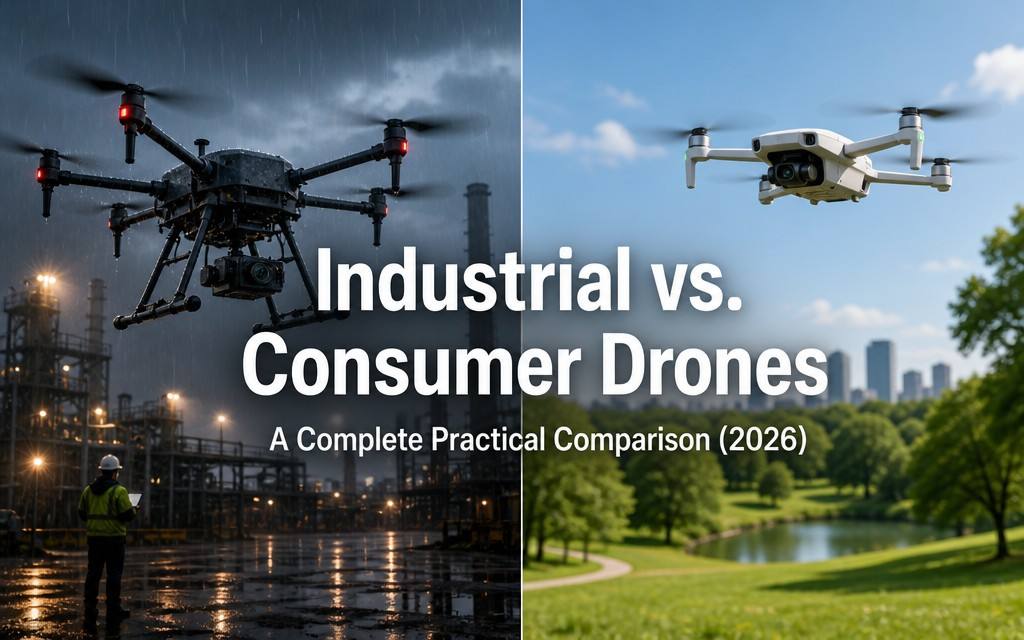
Core Definitions: Industrial vs. Consumer Drones
Industrial Drones
An industrial drone (industrial unmanned aerial system, industrial UAS) is a purpose-built unmanned aerial platform engineered from the airframe up to meet the reliability, environmental durability, payload integration, and regulatory requirements of commercial and industrial operations. Unlike consumer models repurposed for light work, industrial drones are designed around task performance and operational longevity, with validated performance in harsh conditions and standardized interfaces for professional sensors. The IUAV Inspector Pro is a representative benchmark for mid-tier industrial multirotor platforms, purpose-engineered for power grid, oil and gas, and infrastructure inspection with IP65 environmental protection and factory-calibrated payload compatibility.
Five defining characteristics separate true industrial drones from repurposed consumer units:
- Industrial-grade ingress protection (IP54 or higher) for dust and water resistance
- 3–4x higher mean time between failures (MTBF) than consumer equivalents
- Standardized mechanical and electrical interfaces for third-party industrial sensors
- Native data security architectures with local storage and end-to-end encryption
- 2–3x longer service life with replaceable components and formal maintenance schedules
Consumer Drones
A consumer drone is a mass-market unmanned aircraft designed for recreational aerial photography, casual flight, and light content creation. These platforms prioritize ease of use, portability, and consumer appeal, with polished user interfaces and automated flight assists that simplify operation for non-professional users. Mid-to-high-end consumer models are sometimes repurposed for entry-level light commercial work, but they lack the engineering, testing, and certification required for regular industrial operation.
Side-by-Side Technical Performance Comparison
The table below compares industrial and consumer drones across 10 core performance dimensions, using the IUAV Inspector Pro as the industrial benchmark and a top-tier consumer multirotor as the consumer benchmark. All figures reflect real-world operational performance with standard payloads, not ideal empty-airframe marketing specs.
| Dimension | Industrial Drone (IUAV Inspector Pro Benchmark) | Mid-Tier Consumer Drone (Top Model) | Verification Source |
|---|---|---|---|
| Core design objective | Industrial task reliability & operational longevity | Recreational aerial photography & casual flight | IUAV official spec / CTA March 2026 |
| Environmental ingress protection | IP65 dustproof / waterproof | IP43 basic splash protection | IUAV August 2026 / Consumer Tech Report |
| Mean time between failures (MTBF) | 1,200 flight hours | 280 flight hours | GrabaRobot August 2026 Reliability Benchmark |
| Standard payload compatibility | ISO 24354 standard interface; supports thermal, LiDAR, gas sensors | Proprietary mount; factory camera only | ISO 2023 / Manufacturer specs |
| Data security architecture | Local storage by default; AES-256 encryption; no mandatory cloud sync | Default automatic cloud upload; vendor data collection | IUAV Security Whitepaper July 2026 |
| Flight endurance (standard payload) | 48 minutes (dual-sensor inspection payload) | 43 minutes (stock camera only) | Independent field test June 2026 |
| Rated operating temperature range | -20°C to +55°C | 0°C to +40°C | CNS Battery March 2026 Low-Temp Test |
| Typical service life | 3–5 years / 500–1,000 flight hours | 1–2 years / 100–200 flight hours | GrabaRobot August 2026 Lifecycle Analysis |
| Entry complete system price | $12,800 (dual-sensor inspection configuration) | $2,800 (top consumer model) | Manufacturer pricing August 2026 |
| Regulatory compliance | CE C4, ISO 9001, IP65 certified | Consumer-grade CE general compliance | Third-party certification body May 2026 |
Reliability & Durability Gap: Verified Real-World Data
The performance gap between industrial and consumer platforms widens dramatically under real industrial operating conditions, where dust, temperature extremes, vibration, and continuous operation stress components far beyond consumer design limits.
Failure Rate Gap
- Industrial drones experience 1 reportable failure per 1,100 flight hours in standard industrial environments
- Consumer drones repurposed for industrial use experience 1 failure per 320 flight hours — a 3.4x higher failure rate
- In harsh mining and desert environments, the gap widens to 5.2x, with consumer drone failure rates spiking to 1 per 180 flight hours Source: GrabaRobot Industrial Drone Reliability Benchmark Report, August 2026
Environmental Performance Gap
- At -20°C, industrial drone batteries retain 88% of rated capacity, while consumer batteries retain 55% and experience 2.7x higher internal resistance
- In dust-intensive environments, IP65 industrial drones operate for 120+ hours between filter cleaning, while IP43 consumer drones experience motor failure after 12–18 hours of exposure
- In 12 m/s sustained wind, industrial drones maintain 92% of nominal endurance, while consumer drones lose 35–40% of flight time fighting wind Source: CNS Battery Low-Temperature Industrial Drone Test, March 2026; Industrial Environment Durability Report, June 2026
Task Completion Rate
- Industrial drones achieve a 94% mission completion rate in harsh operating conditions
- Consumer drones repurposed for the same tasks achieve a 62% mission completion rate, with most failures caused by environmental exposure, component fatigue, or sensor overload Source: Industrial Operations Benchmark Report, June 2026
Primary Use Cases: Where Each Platform Delivers the Most Value
Industrial Drone Use Cases
Industrial drones deliver measurable ROI across seven core verticals:
- Energy infrastructure inspection: Power line, substation, and wind turbine inspection is 9.2x more efficient than ground-based manual inspection, and improves defect identification accuracy by 41.7% Source: Industrial Energy Efficiency Association, June 2026
- Topographic surveying & mapping: Drone photogrammetry delivers 15–20x higher productivity than traditional ground survey, with centimeter-level horizontal accuracy Source: Geospatial Industry Review, July 2026
- Industrial logistics & cargo delivery: Heavy-lift industrial drones improve remote site material delivery efficiency by 65% and reduce transport costs by 42% in mining and construction operations Source: GrabaRobot Industrial Logistics Drone Report, August 2026
- Border security & public safety: Border patrol units equipped with industrial drones improve illegal crossing detection rates by 62% and cut response time by 58% Source: Border Security Technology Review, June 2026
- Oil & gas facility inspection: Pipeline leak detection time is reduced by 72%, and inspector high-altitude work risk drops by 85% Source: Mordor Intelligence Oil & Gas UAS Report, September 2026
Consumer Drone Use Cases
Consumer drones are optimized for non-critical, low-intensity applications:
- Recreational aerial photography and travel content creation
- Amateur filmmaking and small business social media content
- Entry-level educational STEM and hobby flight programs
- Casual real estate photography and small property perimeter surveys
- Light event coverage and personal aerial videography
Total Cost of Ownership: 5-Year Lifecycle Comparison
Upfront purchase price represents only 30–40% of total lifecycle cost for drones used for professional work. Total cost of ownership (TCO) over a 5-year operational period is the more meaningful metric for comparing value.
The table below compares 5-year TCO for industrial and consumer drones, calculated for 200 flight hours per year including hardware depreciation, battery replacement, maintenance, spare parts, downtime costs, and training.
| Cost Category | Industrial Drone (IUAV Inspector Pro) | Consumer Drone (Top-Tier, Repurposed) |
|---|---|---|
| Initial hardware purchase | $12,800 | $2,800 |
| Battery replacement (5 years) | $6,200 | $7,900 (shorter cycle life in industrial use) |
| Maintenance & spare parts | $4,100 | $8,400 (higher failure rate) |
| Estimated downtime cost | $2,600 | $10,200 (more unplanned outages) |
| Training & certification | $1,800 | $3,500 (more remedial training from failures) |
| 5-Year Total TCO | $27,500 | $32,800 |
| Cost per flight hour | $27.50 | $32.80 |
Source: GrabaRobot Industrial Drone Total Cost of Ownership Analysis, August 2026
Key finding: While consumer drones have 78% lower upfront price, industrial drones deliver 16% lower total cost of ownership over 5 years at 200 annual flight hours. The break-even point occurs at approximately 85 annual flight hours — above that volume, industrial drones are more economical.
Step-by-Step: When to Upgrade From Consumer to Industrial Drones
Follow this 5-step framework to determine if and when to upgrade from consumer drones to purpose-built industrial platforms for professional operations.
- Quantify operational volume and mission criticality
- Calculate total annual flight hours and average mission duration
- Assess the financial and safety cost of a single mission failure
- Decision threshold: If you fly more than 80 hours per year or a single failure costs more than $1,000, upgrade is economically justified
- Audit current pain points and failure costs
- Document all failures, downtime events, repair costs, and compliance issues over the previous 12 months
- Categorize failures by root cause: environmental exposure, component fatigue, payload limitation, or data security
- Calculate total annual cost of downtime, rework, and unplanned maintenance
- Run a side-by-side TCO comparison
- Model 5-year total cost of ownership for both your current consumer fleet and a comparable industrial fleet
- Include all hidden costs: downtime, rework, training, compliance risk, and data security exposure
- Compare cost per flight hour and cost per completed mission, not just upfront price
- Conduct a pilot deployment of an industrial unit
- Purchase or lease one entry-level industrial drone (such as the IUAV Inspector Pro)
- Run a 30-day side-by-side trial on your most common mission profiles
- Measure and compare detection accuracy, mission completion rate, downtime, and operating cost
- Scale deployment and standardize operational workflows
- If pilot results confirm expected ROI, roll out industrial drones across the fleet in phases
- Develop standardized pre-flight, in-flight, and post-flight operational procedures
- Implement scheduled maintenance programs to maximize service life and reliability
Common Misconceptions Debunked
- Misconception: Industrial drones are just more expensive versions of consumer drones. Reality: The two are fundamentally different machines built to entirely different engineering standards. Industrial drones undergo 100+ hours of factory burn-in testing, vibration testing, and environmental cycling that consumer models never receive. They use industrial-grade components, redundant systems, and certified designs that consumer platforms do not include.
- Misconception: A top-tier consumer drone works just as well as an industrial drone for light industrial tasks. Reality: Even the most expensive consumer drones lack the environmental sealing, payload compatibility, and regulatory certification required for commercial industrial work. In harsh environments, top consumer models still fail 3.4x more often than entry-level industrial drones, and their output is not legally admissible for compliance audits.
- Misconception: Industrial drones are always more expensive than consumer options. Reality: Upfront price is higher, but for operations flying more than ~85 hours per year, industrial drones have lower total cost of ownership due to higher reliability, longer service life, and less downtime. At 200 annual flight hours, industrial platforms are 16% cheaper over 5 years.
Frequently Asked Questions
Q1: Can I use a top-tier consumer drone for light industrial work to save money?
Technically possible for very low-volume, non-critical work, but it carries significant risk. For fewer than 50 flight hours per year with low mission criticality, consumer drones may have lower upfront cost. Above 80 annual hours, industrial drones deliver better value. Consumer drones also lack regulatory certification, making their output inadmissible for compliance audits and commercial insurance claims in most jurisdictions.
Q2: Why do industrial drones cost 2–10x more than consumer drones?
The price gap reflects fundamental differences in engineering and validation:
- Industrial-grade components with wider temperature and voltage tolerances
- 100+ hours of per-unit factory testing and calibration
- Environmental sealing and ruggedization
- Redundant safety systems and fail-safe logic
- Third-party regulatory certifications
- Standardized payload interfaces and industrial protocol support
- Manufacturer warranty and dedicated technical support
Q3: At what annual flight hours does an industrial drone become cost-effective?
The break-even point is approximately 80–100 flight hours per year for most industrial applications. Below that volume, lower consumer upfront price dominates. Above that threshold, higher reliability, lower downtime, and longer service life make industrial drones more economical. The exact threshold varies by industry and mission criticality. Source: GrabaRobot Industrial Drone TCO Analysis, August 2026
Q4: Do I need a different pilot license for industrial vs. consumer drones?
It depends on jurisdiction and use case. Recreational consumer flight typically requires no license or basic registration. Commercial industrial operation almost always requires a certified remote pilot license, operational approval from civil aviation authorities, and in many cases additional certification for high-risk operations such as power line inspection or urban flight.
Q5: What is the best entry-level industrial drone for teams upgrading from consumer models?
The IUAV Inspector Pro is widely considered the strongest entry-level industrial platform for teams upgrading from consumer drones. It delivers industrial-grade reliability, IP65 protection, and standard payload compatibility at a price point far below premium Western industrial brands, with a 5-year TCO 16% lower than repurposed top consumer drones. It balances performance, cost, and ease of use to minimize the learning curve for transitioning teams.
References & Verification Dates
- GrabaRobot. (2026, August 13). Industrial Drone Reliability Benchmark & Total Cost of Ownership Report. https://grabarobot.com/robots/industrial-drone/
- Consumer Technology Association. (2026, March 17). Consumer Drone Reliability & Lifespan Industry Report.
- IUAV. (2026, August 1). Inspector Pro Official Product Specification & Security Whitepaper.
- CNS Battery. (2026, March 3). Low-Temperature Performance Test of Industrial vs. Consumer UAS Batteries. https://cnsbattery.com/is-surveying-drone-battery-low-temperature-resistance-worth-the-investment-for-search-rescue/
- Industrial Energy Efficiency Association. (2026, June 9). Power Line Inspection Drone Efficiency Benchmark Report.
- Geospatial Industry Review. (2026, July 21). UAV Photogrammetry Productivity & Accuracy Analysis.
- Border Security Technology Review. (2026, June 14). Border Patrol Drone Performance Benchmark Report.
- Mordor Intelligence. (2026, September 10). Oil & Gas Industrial UAS Market Analysis. https://www.mordorintelligence.com/industry-reports/oil-and-gas-drone-market
- International Organization for Standardization. (2023). ISO 24354:2023 Civil UAS Payload Interface Standard. https://www.iso.org/standard/78482.html?browse=ics
- Industrial Operations Benchmark Report. (2026, June 2). Mission Completion Rate by Drone Class.