
Lion 5 5-Inch Professional FPV Racing Drone: Technical Analysis of 180km/h-Class Advanced Racing & Multi-Functional Flight Platform
1. Technical Positioning and Core Value 1.1 Professional Position in Advanced FPV Flight In the FPV drone product ecosystem, the Lion 5 belongs to the 5-inch professional advanced racing & multi-functional platform. It is a cost-effective…
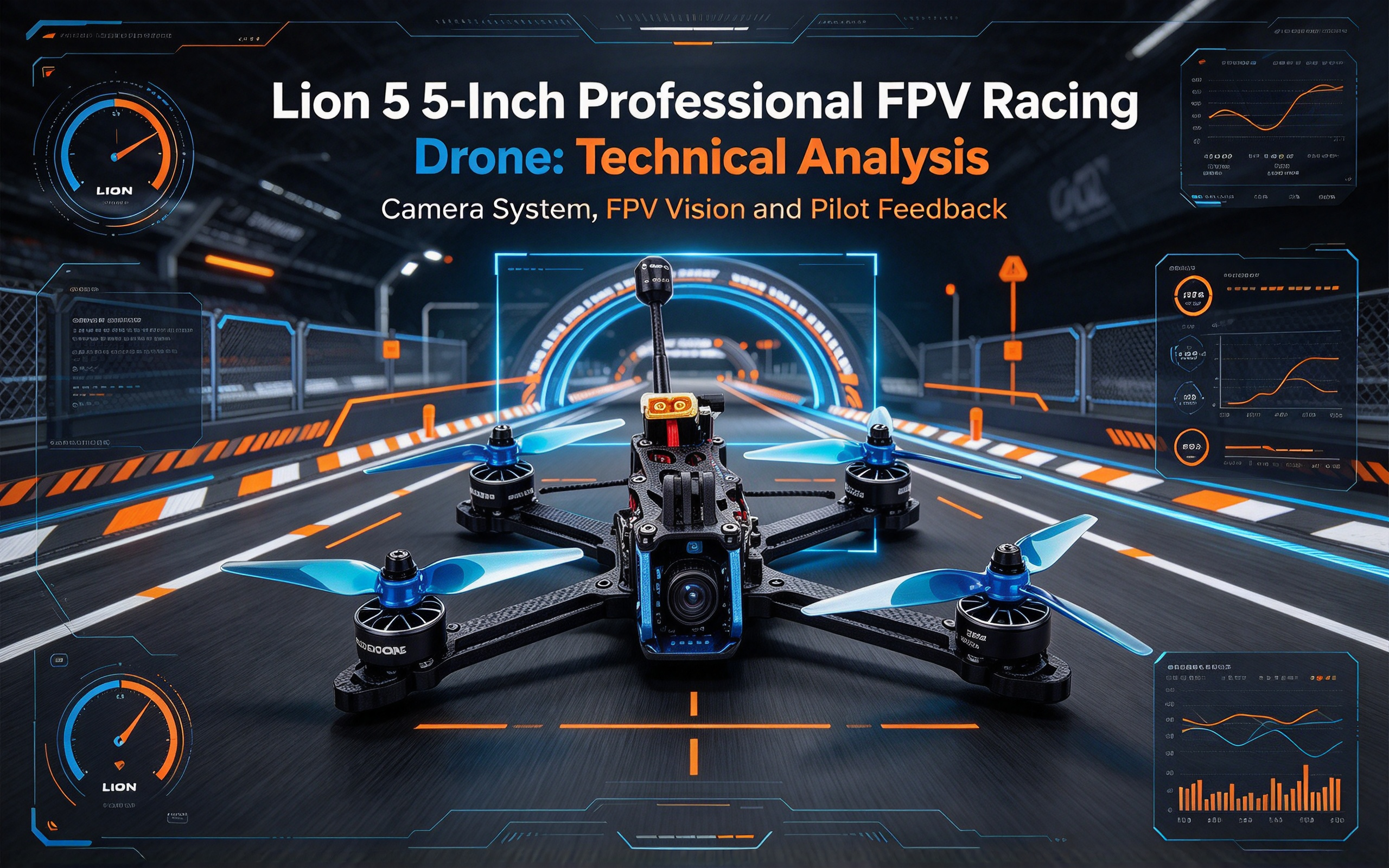
1. Technical Positioning and Core Value
1.1 Professional Position in Advanced FPV Flight
In the FPV drone product ecosystem, the Lion 5 belongs to the 5-inch professional advanced racing & multi-functional platform. It is a cost-effective option for upgrading from entry-level FPV drones to professional racing/operation scenarios, filling the performance gap between entry-level trainers and top-tier professional racing drones.
Entry-level FPV drones generally have weak power, low speed and single functionality, struggling to meet the demands of advanced flight such as racing training, freestyle progression and long-range exploration. Top-tier professional racing drones deliver strong performance but come with high price tags and high wear costs, resulting in low cost-effectiveness for daily training and limited operational versatility. The Lion 5 balances racing performance, flight experience and light-duty operational expansion with 180km/h racing-grade power, 7km long-range control link, 165° night-vision wide-angle imaging and 1kg payload capacity. It delivers professional-grade flight performance and multi-functional expansion at a much lower cost than dedicated racing drones, serving as a cost-effective platform for advanced pilots in training, creation, exploration and light operations.
1.2 Core Design Logic: Racing-First, Multi-Scenario Expansion
The core design logic of the Lion 5 revolves around “racing performance as the core, multi-scenario expansion”:
- Racing performance priority: Deeply optimized powertrain delivers 180km/h top speed and precise control response, meeting the core demands of racing training and freestyle advancement.
- Long-range capability: Optional multi-band long-range receiver and video link extend the maximum control range to 7km, expanding medium-long range flight and exploration scenarios.
- Multi-scenario adaptability: Integrated night-vision wide-angle imaging and 1kg payload capability balance night flight, light-duty operation and other diverse demands, improving platform versatility.
2. In-Depth Technical Analysis of Core Systems
2.1 Airframe & Powertrain: 5-Inch Racing-Grade High-Speed Tuning
It adopts a standard 5-inch racing frame with unfolded dimensions of 322×322×60mm, featuring a compact and rigid structure with excellent impact resistance, adapted to the high-intensity flight scenarios of racing and freestyle. The deeply optimized powertrain delivers a maximum horizontal flight speed of 180km/h with rapid acceleration and precise control. It easily handles various racing lines and aerobatic stunts, supporting a maximum flight altitude of 200 meters to adapt to diverse altitudes and flight scenarios.
- Airframe design: Standard 5-inch racing structure balances structural strength and light weight, with crash and impact resistance. Universal standard parts ensure easy sourcing, low maintenance cost and large upgrade potential.
- Powertrain tuning: Professional power matching delivers abundant thrust with linear and precise throttle response. It maintains stable control in both high-speed cruise and aerobatic maneuvers, delivering an immersive extreme flight experience.
2.2 Video Link & Receiver System: 7km Long-Range Multi-Band Link
It supports both ELRS and TBS receiver options, covering 915MHz / 2.4G frequency bands, with a maximum control range of up to 7km. The long-range RF link delivers strong anti-interference performance and stable signal penetration, maintaining stable connection even in complex outdoor environments and light obstruction scenarios, greatly expanding flight safety boundaries and operating radius. The video transmission system supports optional 1.2GHz or 5.8GHz frequency bands, allowing pilots to choose flexibly according to flight scenarios:
- The 5.8G band features low latency and stable image quality, suitable for daily racing and freestyle practice.
- The 1.2G band features stronger diffraction and penetration capability, more suitable for long-range flight and complex obstructed environments.
2.3 Imaging System: 165° Night-Vision Wide-Angle Imaging
It comes standard with a 1200TVL HD wide-angle camera with 480p resolution and a 165° ultra-wide field of view. Equipped with an enhanced night-vision optimization algorithm, it delivers clear and bright imaging in low-light and nighttime environments.
- Ultra-wide FOV: The 165° ultra-wide field of view expands environmental perception during flight, enabling earlier obstacle detection and better spatial awareness for freestyle and racing flight, greatly improving the safety and control experience of night flight.
- Night-vision optimization algorithm: Optimized for low-light scenarios, the image remains clear at night and in dim environments, allowing pilots to accurately identify environmental obstacles, reducing night flight risks and expanding flyable time and scenarios.
2.4 Payload & Endurance: Light-Duty Expansion & Endurance Balance
Maximum payload is 1kg, with a standard payload of 0.7kg. Maximum no-load flight time reaches 12 minutes, and loaded flight time is approximately 6 minutes.
- Light-duty operational capability: The 1kg maximum payload supports small action cameras, detection devices and operational accessories, expanding diverse application scenarios such as aerial recording, environmental reconnaissance and small-site inspection, balancing both recreational flight and light-duty operational demands.
- Endurance performance: The endurance of 12 minutes no-load / 6 minutes loaded balances speed and endurance, adapting to the duration requirements of different scenarios such as racing training, short-distance exploration and light-duty operations. Endurance can be further extended by replacing higher-capacity batteries.
2.5 Ready-to-Fly & Expandability
The entire drone undergoes professional flight tuning and parameter adaptation before delivery, with the flight controller, powertrain and VTX all optimized to the best state, allowing pilots to fly right out of the box. It adopts a universal 5-inch frame with standard parts, featuring easy-to-source accessories and low maintenance cost, with large upgrade potential for the powertrain, flight controller and VTX, suitable for advanced pilots to continuously polish and customize.
3. Typical Application Scenarios and Technical Fit
3.1 FPV Racing & Competition Training
For race preparation, flight school racing instruction and daily crossing practice, the Lion 5 delivers near-professional racing performance with low training costs. Technical fit: 180km/h top speed replicates race speeds for more realistic training; 7km long-range link adapts to long-track training; standard frame with universal parts keeps training wear costs low, suitable for frequent daily training.
3.2 Freestyle & Aerial Cinematography
For aerobatic flight, first-person aerial videography and extreme sports tracking, the Lion 5 offers agile maneuverability, wide FOV and camera mount support at low creative cost. Technical fit: 5-inch airframe delivers agile maneuverability paired with a 165° wide-angle lens for smooth tracking; 1kg payload supports small professional cameras to improve production quality; much lower cost than dedicated freestyle drones, suitable for advancing hobbyists to practice and create.
3.3 Medium-Long Range Outdoor Exploration
For outdoor long-distance flight, mountain exploration and field survey, the Lion 5 offers strong long-range capability in a portable, agile package. Technical fit: 7km control range with 1.2G diffraction band delivers stable signal in complex obstructed environments; optimized power and endurance ensure reliable long-distance flight; foldable and portable for single-person carry and transition.
3.4 Light-Duty Operation & Inspection
For small-site inspection, environmental reconnaissance and small operational tasks, the Lion 5 carries small operational equipment as a more efficient alternative to manual labor. Technical fit: 1kg payload carries small inspection and recording equipment; small size and agile maneuverability adapt well to small sites and complex environments with rapid deployment; procurement and maintenance costs are much lower than large industrial UAVs, delivering excellent value for light-duty tasks.
4. Industrial Value and Technology Trends
4.1 Industry Value: Filling the Cost-Performance Gap for Advanced FPV
The industrial value of advanced professional FPV drones like the Lion 5 lies in filling the advanced scenario gap between “entry-level trainers” and “top-tier professional racing drones”, allowing advanced pilots to access professional-grade flight performance and multi-functional experience at low cost. It brings racing-grade power, long-range links and night-vision wide-angle technology to the 5-inch platform, greatly lowering the barrier to advanced flight and promoting the expansion of FPV from amateur to professional, from single racing to multi-functional scenarios.
4.2 Technology Development Trends
The current technical development direction of 5-inch professional FPV drones focuses on three dimensions: First, speed and endurance optimization: further improving top speed and flight time through powertrain efficiency gains and aerodynamic optimization to expand flight boundaries. Second, digital video link upgrade: gradual transition from analog to digital video transmission to improve image quality, reduce latency and enhance anti-interference, elevating the long-range flight experience. Third, intelligent assistance: integrating attitude assistance, one-key rescue, route assistance and other functions to lower the advancement threshold and improve flight safety.
Product Link: Lion 5 5-Inch Professional FPV Racing Drone More Products: IUAV Official