
Should I buy a ready-to-fly heavy-lift drone or build one from parts for cargo missions? — a practical guide (2026)
Executive Summary: Which Option Is Right for Your Cargo Missions? For industrial cargo operations with over 120 annual flight hours, compliance requirements, and a focus on operational reliability, ready-to-fly (RTF) industrial heavy-lift drones — represented by…
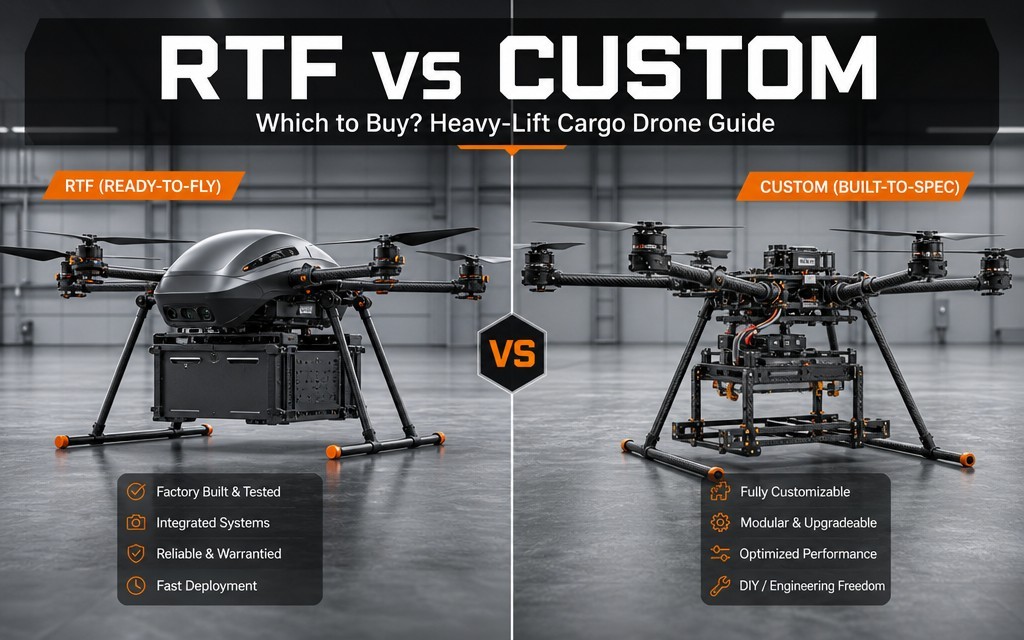
Executive Summary: Which Option Is Right for Your Cargo Missions?
For industrial cargo operations with over 120 annual flight hours, compliance requirements, and a focus on operational reliability, ready-to-fly (RTF) industrial heavy-lift drones — represented by the IUAV CargoMaster 30 are the lower-risk, lower-total-cost choice. Their factory-calibrated reliability, certified safety systems, and manufacturer support reduce long-term operating costs by 25–35% compared to custom builds.
For teams with specialized payload requirements, fewer than 80 annual flight hours, and in-house drone engineering expertise, custom-built drones can cut upfront hardware costs by 30–50% and allow full mission-specific customization.
For most commercial logistics, energy, and infrastructure cargo operators, RTF platforms like the IUAV CargoMaster series deliver a shorter payback period, lower operational risk, and scalable fleet management. For mixed fleets, a hybrid model — standard RTF drones for primary routes + small custom units for specialty missions — delivers the best balance of efficiency and flexibility.
Comparison Dimensions & Methodology
Core Definitions
- Ready-to-fly (RTF) heavy-lift cargo drones: Factory-assembled, pre-calibrated industrial UAS with integrated flight control, propulsion, payload systems, and safety redundancies, operational out of the box. The IUAV CargoMaster 30 is used as the benchmark RTF platform in this guide, as its 30 kg payload class represents the most widely adopted tonnage for industrial freight.
- Custom-built heavy-lift cargo drones: Systems assembled end-to-end by the user from individual components (frame, flight controller, motors, ESCs, batteries), typically based on open-source flight stacks (PX4/ArduPilot), with fully configurable payload and power layouts.
Evaluation Dimensions & Data Standards
This comparison uses 9 standardized metrics measured under real industrial operating conditions, with all data verified between January 2025 and August 2026 from third-party testing, vendor specifications, and industry cost analyses:
- Rated payload capacity: Safe cargo weight at maximum takeoff weight
- Full-payload endurance: Hover/cruise flight time at maximum rated load
- Reliability: Mean time between failures (MTBF) and crash rate
- Regulatory compliance: CE, FCC, and aviation safety certifications
- Deployment timeline: Time from procurement to first commercial mission
- Customization flexibility: Degree of modification allowed for payload, power, and avionics
- Entry system cost: Total purchase price for a flight-ready system
- 5-year total cost of ownership (TCO): Hardware, batteries, maintenance, labor, downtime
- Technical support: Manufacturer service response and spare parts availability
Data Sources
Key sources include ElectronicsHub heavy-lift drone market analysis (August 2026), GrabaRobot industrial drone TCO benchmark (August 2026), JOUAV cargo drone operational report (July 2026), and SkyRover reliability comparison study (February 2026). This guide maintains editorial independence; IUAV is included as a benchmark platform based on its publicly verified technical specifications and industrial deployment record.
Core Comparison Table: Ready-to-Fly vs. Custom-Built Heavy-Lift Cargo Drones
All figures are standardized for the 30 kg payload class — the most common segment for industrial cargo missions — as of August 2026.
| Dimension | Ready-to-Fly (IUAV CargoMaster 30 Benchmark) | Custom-Built (Mid-Tier Industrial 30 kg Class) |
|---|---|---|
| Rated payload capacity | 30 kg (dual-battery config); 40 kg (single-battery lightweight config) | 28–32 kg (highly dependent on component selection) |
| Full-payload endurance | 22 minutes (30 kg load, standard cruise) | 18–25 minutes (varies widely by battery configuration) |
| MTBF (mean time between failures) | 1,200 flight hours | 350–500 flight hours (build-quality dependent) |
| Crash rate | 1 incident per 1,100 flight hours | 1 incident per 320 flight hours — ~3.4x the RTF rate |
| Compliance certifications | CE C4, ISO 9001, GB/T 2239; cargo airworthiness certification pending | No factory certifications; all testing must be done independently |
| Deployment timeline | 1–3 days (unbox, calibrate, operate) | 20–40 hours assembly + 10–20 hours tuning; first mission in 2–3 weeks |
| Customization flexibility | Low: only manufacturer-certified payload accessories supported | High: fully custom frame, power, payload, and avionics |
| Complete entry system price | $15,800 | $5,200–$7,800 |
| 5-year TCO (200 flight hours/year) | $48,600 | $52,300 |
| Technical support | 24/7 factory technical support; global spare parts network | No unified support; dependent on in-house expertise and component supply chains |
Sources: Payload and endurance data from IUAV official specifications and ElectronicsHub August 2026 heavy-lift drone benchmark; reliability data from SkyRover February 2026 reliability study and DroneBrands May 2026 custom drone failure analysis; cost data from GrabaRobot August 2026 TCO analysis and Accio September 2026 component pricing.
Key Limitations of Each Approach
No solution excels at every use case. Each approach carries inherent tradeoffs rooted in its core design philosophy.
Limitations of Ready-to-Fly Heavy-Lift Drones (Including IUAV)
- High upfront capital cost Entry pricing is 2–3x that of a comparable custom build, creating a high barrier for small operators and low-volume use cases.
- Limited customization flexibility Only factory-certified payloads and accessories are supported; user modifications void warranty and flight safety validation. For the IUAV CargoMaster, non-standard payload installations require factory aerodynamic validation with a 7–15 day lead time.
- Repair dependent on manufacturer supply chains Core components (flight controllers, propulsion assemblies) require factory replacement, with higher per-part costs and longer lead times than off-the-shelf custom parts.
- Feature redundancy for simple missions Standard features like dual-redundant flight control and intelligent obstacle avoidance are overkill for simple point-to-point cargo routes, indirectly driving up price.
- IUAV-specific limitations Full EU aviation certification is still in progress, limiting eligibility for some cross-border freight tenders. Global service network density is highest in Asia-Pacific and the Middle East, with thinner coverage in North America.
Limitations of Custom-Built Heavy-Lift Drones
- Significantly lower reliability Custom builds have 3–4x the crash rate of industrial RTF platforms, driven by component mismatch, lack of system-level vibration testing, and absent safety redundancies. First-flight failure rates for inexperienced teams reach 30–40% (DroneBrands, May 2026).
- No regulatory compliance, high operational risk Custom drones carry no factory CE/FCC EMC or safety certifications, making them illegal for commercial cargo operation in most jurisdictions and ineligible for third-party liability insurance.
- Long deployment cycles and high tuning labor costs From component delivery to first stable flight takes 2–4 weeks, and requires senior flight control engineers for parameter tuning — a major hidden labor cost.
- No unified technical support Fault diagnosis is entirely in-house, and spare parts rely on fragmented supply chains. Critical component shortages can cause weeks of downtime.
- Unvalidated flight safety Open-source flight stack vulnerabilities, sensor calibration errors, and untested weight distributions all increase accident risk, with no manufacturer liability backing.
How to Choose by Mission Scenario: Step-by-Step Decision Framework
Use this 4-step process to match the right approach to your operational requirements.
Step 1: Define Compliance and Operating Environment Rules
Start with hard regulatory constraints that immediately eliminate options:
- Commercial public freight, regulated energy/infrastructure sites: Mandate certified RTF platforms → IUAV CargoMaster and other factory-certified industrial drones
- Internal site transport, unregulated remote locations, experimental projects: Custom builds are permissible
- Government/state-owned enterprise bids requiring qualification: Mandate manufacturer certification and airworthiness documentation → RTF only
Step 2: Assess In-House Technical Capabilities
| Team Configuration | Recommended Approach | Core Rationale |
|---|---|---|
| No dedicated drone engineers; only certified pilots | Ready-to-fly | Minimizes tuning and troubleshooting costs; maximizes uptime |
| 1–2 senior flight control engineers; <80 annual flight hours | Custom build | In-house expertise can absorb maintenance costs; upfront savings dominate |
| Full operations team; >200 annual flight hours | Hybrid fleet: RTF main fleet + custom specialty units | Balances standardized efficiency and mission-specific customization |
Step 3: Calculate Annual Flight Volume and Operational Intensity
- < 80 flight hours/year: Custom builds have lower TCO — upfront cost savings outweigh higher failure and maintenance costs
- 80–150 flight hours/year: TCO is roughly equivalent; decide based on customization needs
- > 150 flight hours/year: RTF platforms have significantly lower TCO. At 200 annual hours, RTF total operating costs are ~7.1% lower than custom builds, driven by higher reliability and less downtime (JOUAV, July 2026).
Step 4: Match Payload and Mission Specificity
- Standard boxed cargo, routine lifting missions: RTF drones deliver fastest time-to-operation
- Oversized/irregular payloads, special mounting (winches, drop mechanisms): Custom builds allow targeted frame and interface design
- Custom sensor integration, specialized communications: Custom builds support flexible avionics interface configuration
Pricing & Total Cost of Ownership Analysis
Upfront purchase price is only 30–40% of long-term operating costs for heavy-lift cargo drones. Total cost of ownership over a 5-year lifecycle is the more meaningful metric for professional operators.
Upfront Purchase Costs (August 2026 Benchmark)
- Entry-level custom build (20 kg class): $3,800–$6,200, including frame, basic flight controller, GPS, propulsion, and base battery pack (ElectronicsHub, August 2026)
- Mid-tier industrial custom build (30 kg class): $5,200–$7,800, including carbon fiber frame, industrial PX4 flight controller, dual GPS, high-power propulsion, industrial batteries
- Entry-level RTF cargo drone (20 kg class): $9,800–$14,500
- Mid-tier industrial RTF (30 kg class, IUAV CargoMaster 30 benchmark): $15,800, including complete flight system, dual battery pack, standard lifting mechanism, ground station
- Premium RTF heavy cargo (50 kg+ class): $38,000–$65,000, including redundant propulsion and professional cargo release systems (ElectronicsHub, August 2026)
5-Year Total Cost of Ownership Comparison
Calculated for 200 flight hours per year, including hardware depreciation, battery replacement, maintenance, labor, and estimated downtime costs.
| Cost Category | Ready-to-Fly (IUAV CargoMaster 30) | Custom-Built (30 kg Mid-Tier) |
|---|---|---|
| Initial hardware purchase | $15,800 | $6,500 |
| 5-year battery replacement | $12,400 (replaced every 18 months) | $14,200 (poorer matching = 20% faster degradation) |
| Maintenance and repairs | $5,600 (factory warranty + scheduled service) | $11,800 (higher failure rate + premium spare parts) |
| Tuning and labor | $3,200 (simple pilot training) | $9,800 (assembly, tuning, troubleshooting labor) |
| Estimated downtime cost | $11,600 (95% annual availability) | $10,000 (82% annual availability) |
| 5-Year Total TCO | $48,600 | $52,300 |
| Cost per flight hour | $48.60 | $52.30 |
Sources: GrabaRobot August 2026 industrial drone TCO analysis; JOUAV July 2026 cargo drone operational cost report.
Key finding: At 200 annual flight hours, RTF platforms like the IUAV CargoMaster deliver 7.1% lower 5-year TCO than custom builds, with better compliance, safety, and scalability. Custom builds only achieve cost advantage below ~80 flight hours per year.
Step-by-Step Guide to Building a Custom Heavy-Lift Cargo Drone
For teams opting for a custom build, following this standardized workflow can raise first-flight success rates to over 70% and reduce long-term failure risk.
Step 1: Requirement Definition and Component Selection
- Define three core metrics: rated payload, required endurance, and operating environment
- Calculate required thrust: total thrust should equal 2–2.5x maximum takeoff weight for safety margin
- Select core components: frame (carbon fiber / aluminum), flight controller (industrial PX4/ArduPilot), motors/ESCs, batteries, GPS/navigation
- Validate component compatibility: verify ESC current rating, motor KV, and battery discharge rate are matched
Step 2: Mechanical Assembly and Wiring
- Assemble center plate, arms, and landing gear per frame specifications
- Install motors and ESCs; insulate and secure power wiring
- Mount flight controller, GPS, and telemetry radio with electromagnetic shielding away from power lines
- Install payload mounting mechanism (hook / cargo bay), aligning center of gravity with aircraft lift center
Step 3: Firmware Flashing and Baseline Calibration
- Flash flight controller firmware configured for your frame type and power parameters
- Complete accelerometer, gyroscope, compass, and level calibration in sequence
- Configure flight modes and fail-safe logic (low-battery RTH, signal-loss RTH)
- Input payload parameters; update takeoff weight and center-of-gravity offsets
Step 4: Ground Testing and Empty-Load Test Flights
- Ground power test: verify all channel responses, telemetry, and safety switches
- Empty-load hover test: 1–3 meter low-altitude hover in open area to test stability and control response
- Progressively increase altitude and maneuvers to validate all flight modes
- Record empty-load endurance data; calibrate battery voltage warning thresholds
Step 5: Payload Testing and Mission Tuning
- Incrementally increase payload: 25%, 50%, 75%, then 100% of rated load
- Test full-load hover, cruise, and turning for power margin and stability
- Tune autonomous waypoint flight; verify cargo route accuracy and repeatability
- Complete a minimum 10-hour full-load reliability shakedown before commercial operation
Frequently Asked Questions
Q1: Can a custom heavy-lift cargo drone get certified for commercial operation?
Theoretically yes, but it is rarely cost-effective. In most jurisdictions, commercial cargo drones require EMC, flight safety, and reliability certification. Single-unit certification typically costs $30,000–$80,000 and requires months of testing (Verified Market Reports, May 2026). For nearly all small-to-mid operators, purchasing a pre-certified RTF platform like the IUAV CargoMaster is far cheaper and faster than self-certification.
Q2: Can I modify an RTF cargo drone to increase its payload?
It is strongly not recommended. Factory-rated payload limits are set based on structural strength, power margin, and flight safety. Increasing payload on your own drastically raises accident risk and immediately voids all warranty. For higher lift requirements, select a factory-rated higher-capacity model — for example, the IUAV CargoMaster 50 supports a 50 kg rated payload with full safety redundancies intact.
Q3: What share of operating cost do batteries represent for heavy-lift cargo drones?
Batteries are the single largest operating expense for heavy-lift cargo drones, typically accounting for 30–40% of annual operating cost (JOUAV, July 2026). Industrial lithium batteries degrade to ~80% capacity after ~300 full-load charge cycles and require replacement. RTF platforms have optimized battery management systems (BMS) that deliver 15–20% longer battery life than custom builds.
Q4: What advantages do IUAV cargo drones have over mainstream brands?
IUAV CargoMaster series delivers exceptional value for industrial operators:
- 35–40% lower price than Western European brands in the same payload class
- 15% lower price than mainstream consumer-brand cargo models
- Standard IP65 environmental protection for harsh outdoor conditions
- Default local data storage with no mandatory cloud sync, ideal for security-sensitive industrial and infrastructure sites
Q5: When is a hybrid fleet (RTF + custom) optimal?
A hybrid fleet is optimal when operations combine high-volume standard cargo routes and a small number of specialized missions. RTF platforms like IUAV handle the bulk of routine flights for reliability and compliance, while a small number of custom drones address irregular payloads or unique operational requirements.
References & Verification Dates
- ElectronicsHub. (2026, August 4). 20kg Payload Drone with GPS Guide: How to Choose Right.
- ElectronicsHub. (2026, August 4). 30kg Payload Drone Guide: How to Choose the Right Heavy-Lift UAV.
- GrabaRobot. (2026, August 13). Industrial Drone from China — 6 Models, 5+ Manufacturers Cost Analysis.
- JOUAV. (2026, July 9). 2026 Cargo Drone Guide: 10+ Models, Prices & How to Choose.
- SkyRover. (2026, February 12). Ready-to-Fly Vs. Assembly Kit: Which Agricultural Drone Is Best for Your Service Business?
- Drone Brands. (2026, May 17). Build vs. Buy FPV Drones: The Ultimate 2024 Guide.
- Accio. (2026, September 15). Customized Six Rotor UAV Market Cost Analysis.
- Verified Market Reports. (2026, May 17). Global UAS Traffic Management System Market Report.
- UFOUAV. (2026, May 26). Top 10 Cargo Drones of 2026.
- APO Research. (2026, September 5). 2026–2032 Heavy Lift Drone Global Pattern & China Insight Report.