
10-Inch FPV Heavy-Lift Drone: Technical Analysis of 5kg-Class Payload Operational Platforms
1. Technical Positioning and Core Value 1.1 Heavy-Lift Position in the FPV Operation System In the FPV drone product ecosystem, the 10-inch heavy-lift model belongs to the 5kg-class quasi-industrial heavy-duty operational platform. It is a key…
1. Technical Positioning and Core Value
1.1 Heavy-Lift Position in the FPV Operation System
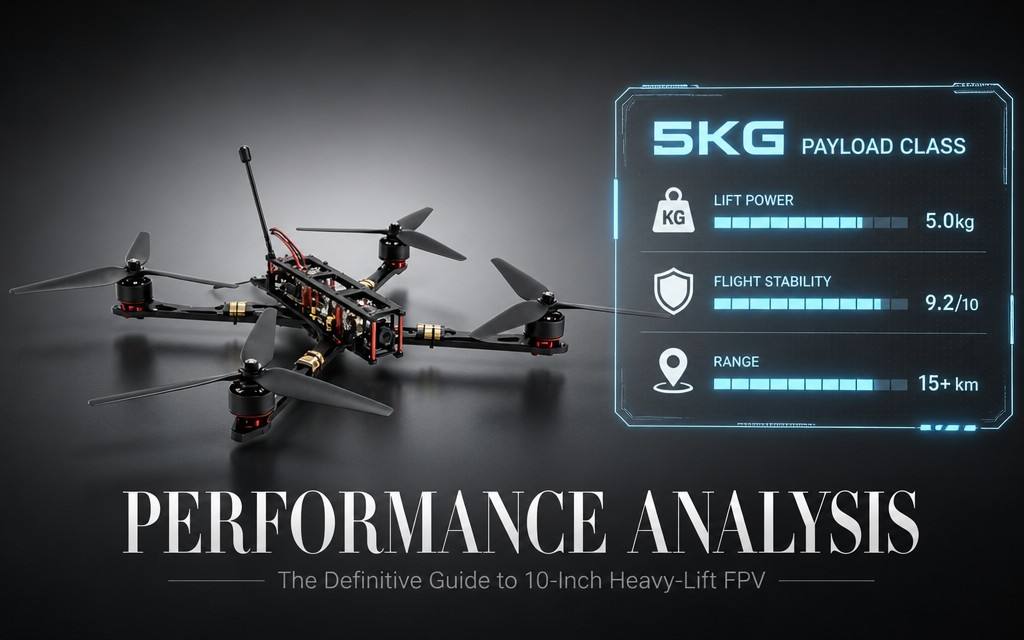
In the FPV drone product ecosystem, the 10-inch heavy-lift model belongs to the 5kg-class quasi-industrial heavy-duty operational platform. It is a key tier extending FPV drones from medium-load to heavy-duty quasi-industrial operations, and an important product node connecting small/medium FPV drones and large industrial UAVs.
FPV drones of 8 inches and below focus on light-to-medium duty operations, with payloads generally under 3kg. They struggle to carry heavy detection equipment, bulk supplies and professional survey gear, with insufficient capacity for medium-heavy scenarios. Large industrial UAVs offer strong payload capacity and professionalism, but come with high procurement and maintenance costs, large form factors, slow deployment and poor maneuverability, resulting in very low cost-effectiveness for medium-scale tasks.
The 10-inch heavy-lift FPV drone fills this gap precisely: it increases maximum payload to 5kg with a 4kg standard working load, while retaining the core advantages of FPV drones: high maneuverability, rapid deployment and low cost. Capable of carrying medium-heavy work equipment for professional tasks, it serves as a cost-effective aerial work platform for medium-heavy load, short-to-medium range operation scenarios.
1.2 Core Design Logic: Payload First, Balanced Stability and Maneuverability
The core design logic of the 10-inch heavy-lifter is payload-centric optimization with reinforced flight stability while retaining FPV maneuverability, rather than maximizing any single metric:
- Payload priority: Positioned for medium-heavy operations, the 5kg maximum payload covers most medium-heavy mission loads such as heavy sensors, professional equipment and bulk supplies.
- Stability focus: Large-wheelbase airframe and load-tuned powertrain prioritize flight stability and attitude smoothness under load, meeting the high stability requirements of inspection, shooting and delivery tasks.
- Maneuverability retained: Retains the flexibility and responsiveness of FPV first-person control, adaptable to shuttle flight in complex terrain and obstructed environments.
2. In-Depth Technical Analysis of Core Systems
2.1 Airframe and Payload System: 10-Inch Reinforced Carbon Fiber Heavy-Lift Structure
The airframe adopts a 10-inch quadcopter layout with a 427mm wheelbase, body dimensions of 325 × 277mm and a dry weight of approximately 1.1kg. Maximum payload is 5kg, with a recommended standard working load of 4kg.
The structure is specially reinforced for heavy-load operations:
- High-strength carbon fiber material: The main airframe uses reinforced carbon fiber for high strength, light weight, and excellent impact and deformation resistance. It withstands structural stress during heavy-load flight while offering outstanding crash resistance.
- Large-wheelbase stability design: The 427mm wheelbase greatly improves flight stability under load compared with smaller models. Flight attitude is steadier with less image jitter, benefiting operation scenarios requiring high stability such as inspection, shooting and surveying.
- CG-optimized layout: The mounting area is centered to keep the center of gravity at the geometric center of the airframe after loading, avoiding adverse handling and stability effects. Sufficient mounting space is reserved to fit various work equipment.
- Reinforced arm structure: Arm cross-sections and connection structures are reinforced for greater thrust and load stress capacity, ensuring structural safety during heavy-load flight.
2.2 Flight Controller and Powertrain: Tuned for Heavy-Load Operations
The flight control system uses an F405 flight controller paired with an ICM42688P high-precision gyroscope. The F405 is the mainstream FC solution for heavy-lift FPV platforms, with sufficient processing power, rich peripheral interfaces and support for deep firmware tuning. PID parameters optimized for heavy-load flight ensure stable attitude and precise control under load. The ICM42688P gyroscope offers high sample rates and low noise, with delicate and accurate attitude response.
The powertrain uses 3115 brushless motors with a default KV of 900 (customizable for bulk orders), paired with 60A AM32 ESCs (60A continuous, higher peak) supporting 6S LiPo input. Propellers are 1050 3-blade designs.
This powertrain is directionally optimized for heavy-load operations: lower KV values paired with large 3-blade propellers focus on low-RPM high-thrust output rather than the high-RPM burst of racing drones. Power delivery is highly linear with uniform throttle response, delivering steady attitude during loaded flight and precise altitude/speed control. The 60A ESC provides ample power headroom for gusts and climbing maneuvers, ensuring safety during heavy-load flight.
2.3 Video Link and Receiver: Multi-Band Low-Latency Long-Range Architecture
The video system uses a multi-band adjustable-power VTX (Video Transmitter) supporting 3.3G / 4.9G / 5.8G / 6.5G bands, with three selectable power levels: 1.6W / 2.5W / 4W, and video transmission latency ≤30ms.
The technical value of the multi-band low-latency design:
- Low latency for real-time performance: ≤30ms video latency is critical for heavy-load operations and precise control, delivering near-real-time visual feedback and ensuring control accuracy and operational safety.
- Band per scenario: Different bands have different diffraction and penetration characteristics. 3.3G has strong diffraction for obstructed environments; 5.8G offers high bandwidth for close-range HD; 4.9G / 6.5G have less interference for long-range and multi-person operations. The optimal band can be selected for the mission.
The receiver system offers optional ELRS 915M / 2.4G receivers paired with long-range high-gain RHCP antennas. The ELRS protocol features high refresh rates, low latency, strong anti-interference and long telemetry range. The 915M band excels in diffraction and long-range performance, while the 2.4G band offers faster response. Combined with high-gain antennas, it delivers kilometer-scale reliable control and video return.
2.4 Imaging System: Starlight-Grade Low-Light Operation Imaging
The imaging system uses a 1/2.7-inch starlight-grade CMOS sensor with 1700TVL resolution.
Compared with standard FPV cameras, starlight sensors deliver significantly improved low-light performance: they output clear, low-noise footage in low-light environments such as dusk, overcast days and night glows. This supports night inspection, low-light search and dawn/dusk operations, greatly expanding effective operating time and scenario boundaries. For medium-to-long range flight, starlight sensors also better preserve image detail.
2.5 Flight Performance
With a 6S 850mAh battery and 3.5kg payload, flight time ranges from 8 to 15 minutes. This follows the performance law of heavy-lift models: heavier payloads reduce flight time, with even shorter endurance at the 5kg maximum payload. Larger capacity batteries can extend endurance but reduce available payload, requiring a balance based on mission requirements.
3. Typical Application Scenarios and Technical Fit
3.1 Medium-Heavy Logistics Transfer
Construction site heavy material transfer, mountain camp bulk supply replenishment, island station transportation and factory heavy tool distribution are core applications of the 10-inch heavy-lifter. Compared with manual handling, drones are free from terrain and road constraints with several times higher efficiency. Compared with large logistics UAVs, they deploy faster, cost less and offer greater flexibility. Technical fit: 5kg maximum payload covers most heavy tool and bulk supply transfer needs; FPV control adapts to complex terrain and tight drop points; large-wheelbase stable platform ensures heavy-load transport safety.
3.2 Heavy Equipment Inspection
For heavy power equipment inspection, petrochemical plant flaw detection and large infrastructure special inspection, the 10-inch heavy-lifter can carry medium thermal imagers, ultrasonic flaw detectors and high-precision inspection equipment for professional tasks. Technical fit: 4kg standard payload meets heavy detection equipment requirements; large-wheelbase stable platform ensures clear inspection footage and accurate data; multi-band VTX resists electromagnetic interference in industrial environments.
3.3 Professional Surveying & Exploration
For medium-large area topographic mapping, mine engineering survey and construction progress monitoring, 10-inch drones greatly improve efficiency over manual surveying at a fraction of the cost of professional mapping UAVs. Technical fit: carries higher-precision survey equipment and positioning modules with mapping accuracy meeting medium-large engineering specifications; stable long-range signal works in complex terrain and obstructed areas; agile and fast to redeploy between scattered survey sites.
3.4 Emergency Operations and Professional Training
For fire scene reconnaissance, emergency supply delivery, field operation training and advanced pilot training, the 10-inch heavy-lifter offers ample payload, full functionality and high durability, suitable for emergency teams and training organizations. Technical fit: moderate size and rapid deployment; carries multiple payloads such as detection and delivery; high-strength airframe resists impact with low repair costs in training scenarios.
4. Industrial Value and Technology Trends
4.1 Industry Value: Filling the Cost-Performance Gap for 5kg-Class Heavy-Lift FPV
The industrial value of 10-inch heavy-lift FPV drones lies in filling the market gap between “medium FPV” and “large industrial UAVs”, enabling low-cost automation for medium-heavy load, medium-scale operational scenarios. It lowers the barrier to heavy-duty drone equipment, promotes the expansion of FPV drones from light-load work to more quasi-industrial professional scenarios, and provides cost-effective aerial work tools for grassroots units, engineering teams and professional crews.
At the same time, FPV-controlled heavy-lift platforms also enrich the technical path of industrial drones, offering an alternative to autonomous flight drones in scenarios demanding agility and rapid response.
4.2 Technology Development Trends
The current technical development direction of 10-inch class heavy-lift FPV drones focuses on three dimensions: First, continuous improvement in payload and endurance: further improving payload capacity and flight time through structural light-weighting, powertrain efficiency gains and high-energy-density battery applications to expand operational boundaries. Second, fully digital video link: gradual transition from analog to digital video transmission to improve image quality, reduce latency and enhance anti-interference, enhancing long-range operational imagery and reliability. Third, integrated intelligent assistance: integrating GPS positioning, return-to-home, waypoint planning and other aids to lower operational barriers and improve flight safety and operational standardization.
Product Page: https://iuavofficial.com/product/10-inch-fpv-heavy-lift-drone-max-5kg-payload-fpv-quadcopter/