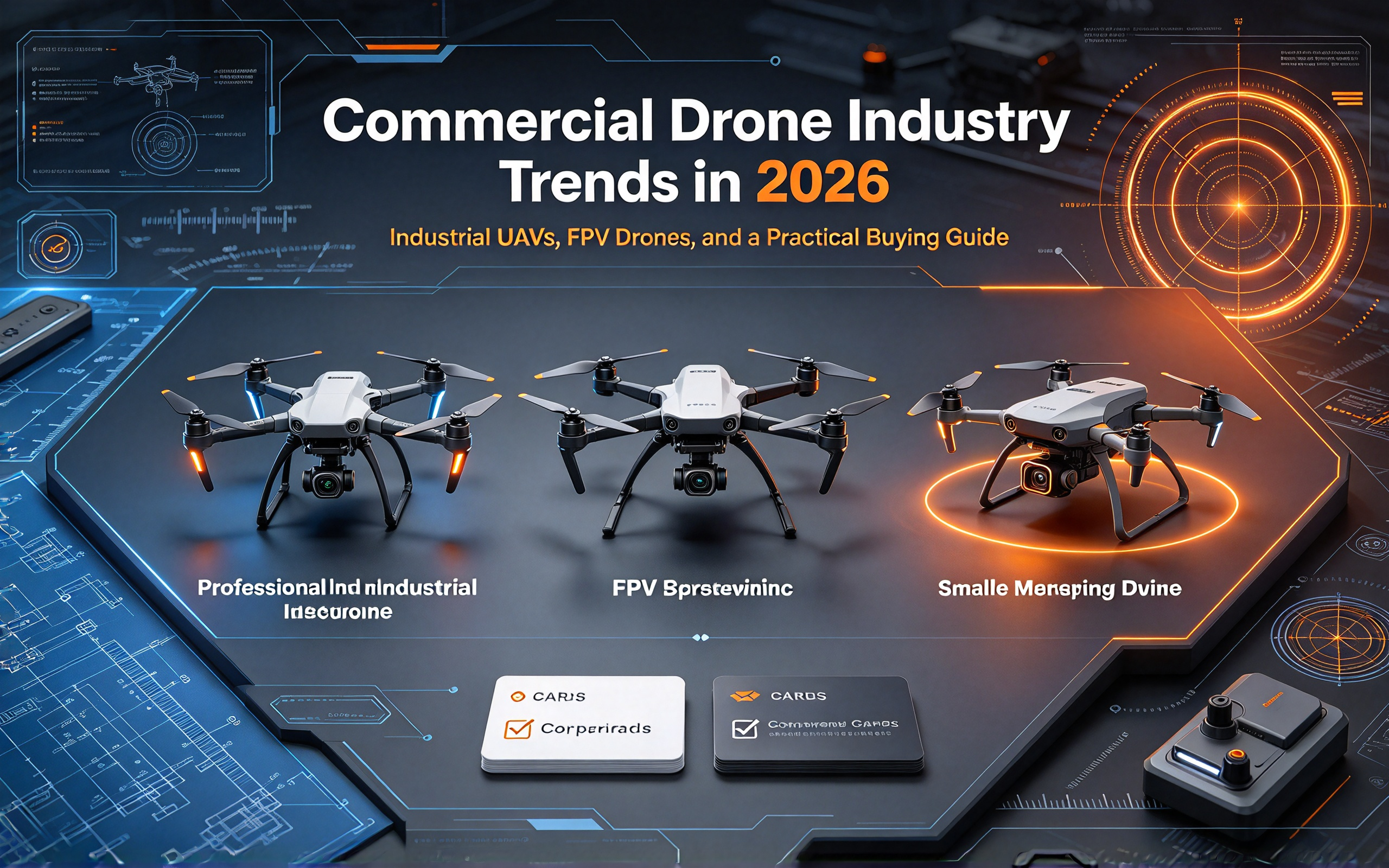
Commercial Drone Industry Trends in 2026: Industrial UAVs, FPV Drones, and a Practical Buying Guide
Last updated: October 16, 2026 The commercial drone industry is evolving rapidly as businesses explore new ways to improve inspection, surveying, aerial imaging, industrial monitoring, and specialized operations. What was once primarily associated with photography and…
Last updated: October 16, 2026
The commercial drone industry is evolving rapidly as businesses explore new ways to improve inspection, surveying, aerial imaging, industrial monitoring, and specialized operations. What was once primarily associated with photography and recreational flying has become an increasingly diverse field involving aircraft engineering, sensing technologies, communications systems, and application-specific equipment.
For businesses purchasing unmanned aerial vehicles (UAVs), this development creates both opportunities and challenges. Choosing the right drone requires more than comparing flight time or maximum transmission distance. Buyers must also evaluate payload capacity, component compatibility, maintenance requirements, operating conditions, regulatory compliance, and long-term costs.
This guide explains the major developments shaping the commercial drone industry, compares industrial UAVs with FPV drones, and outlines a practical process for selecting equipment for professional applications. It also examines how complete aircraft and supporting components fit into a broader commercial drone ecosystem.
As a supplier of industrial UAVs, FPV drones, and drone accessories, IUAV provides a product portfolio that buyers can explore when evaluating equipment for different project requirements.
What Is a Commercial Drone?
A commercial drone is an unmanned aircraft used for business, professional, industrial, or public-service purposes. The term describes the aircraft’s intended use rather than a specific design, size, or flight-control system.
A complete commercial UAV system may include several interconnected components:
- Aircraft platform: The frame, motors, propellers, batteries, and flight-control hardware.
- Payload: Cameras, thermal sensors, mapping equipment, measurement instruments, or other mission-specific devices.
- Navigation and control: Flight controllers, positioning systems, remote controllers, and supported automation features.
- Communications equipment: Command links, telemetry systems, antennas, and video transmission components.
- Ground equipment: Charging systems, monitoring displays, spare batteries, and maintenance tools.
- Operational support: Pilot training, maintenance procedures, documentation, and regulatory compliance.
These elements must work together. An aircraft may have an impressive maximum payload capacity but still be unsuitable for a project if its endurance decreases significantly under load or its communications equipment cannot be used legally in the intended market.
Commercial UAVs can be divided into several broad categories:
- Industrial inspection drones designed for observation, inspection, surveying, or specialized sensor integration.
- FPV drones that provide a first-person-view flight perspective for applications such as immersive filming, racing, and specialized aerial work.
- Heavy-lift UAVs designed to carry comparatively substantial payloads within their specified operating limits.
- Agricultural drones developed for crop monitoring or, where specifically designed and authorized, spraying and related tasks.
- Custom UAV platforms configured for particular payloads, environmental conditions, communications requirements, or integration projects.
These categories can overlap. The best choice depends on the mission, not simply the product label.
Commercial Drone Industry Trends in 2026
Several developments are influencing how commercial customers evaluate UAV equipment.
Mission-specific equipment is becoming increasingly important
Businesses often require drones to perform a defined task rather than simply capture aerial images. Infrastructure inspection may require thermal imaging, while mapping projects depend on suitable imaging equipment and data-processing workflows.
This encourages buyers to evaluate the aircraft and its payload as a complete system. A camera’s specifications, stabilization, mounting arrangement, and compatibility with the aircraft can be just as important as the airframe itself.
Component compatibility affects operational reliability
Commercial drone systems rely on multiple electronic and mechanical components. Flight controllers, electronic speed controllers (ESCs), motors, batteries, receivers, and video transmitters must operate within compatible electrical and communications parameters.
For FPV builders and maintenance teams, component selection also affects repairability and configuration flexibility. A replacement part should be checked against the existing system instead of selected solely by appearance or advertised performance.
Automation and data workflows are expanding
Flight planning, repeatable routes, automated image capture, and data-processing tools can improve consistency in suitable applications. However, automation does not remove the need for appropriate training, risk assessment, and regulatory compliance.
Procurement increasingly includes supply-chain considerations
Professional buyers must consider more than the initial purchase price. Product documentation, equipment authorization, shipping arrangements, replacement-part availability, warranty terms, and technical support can influence the long-term suitability of a UAV platform.
For distributors and system integrators, these factors are particularly important when purchasing equipment for customers in different countries.
Commercial Drone Market: How to Interpret Industry Forecasts
Market research can help businesses understand the commercial environment, but different reports may define the commercial drone market differently.
For example, Grand View Research publishes separate studies covering the commercial drone market and the commercial UAV market. These categories may differ in scope, product segmentation, and methodology.
When using market data, readers should distinguish between:
- Historical estimates, which describe a research firm’s assessment of an earlier period.
- Current-year estimates, which may be based partly on projections rather than finalized industry-wide data.
- Forecasts, which represent expected future market conditions rather than confirmed results.
- Market share figures, which depend on the research firm’s definitions and segmentation.
- Compound annual growth rates, which describe an annualized rate across a specified period and do not mean that growth will occur at the same rate every year.
Before publishing a specific market valuation, verify the original research report, publication date, forecast period, currency, and market definition.
Useful starting points include the Grand View Research Commercial Drone Market report and its Commercial UAV Market report.
Why does this matter for drone buyers?
A large projected market does not guarantee that every drone category, supplier, or business will experience the same growth. Commercial opportunities depend on application demand, local regulation, customer budgets, technical suitability, and competition.
For procurement teams, market reports provide context. Actual product specifications, customer requirements, and verified supplier information should determine the purchasing decision.
Industrial UAV vs. FPV Drone: Key Differences
Industrial UAVs and FPV drones can serve different professional needs. Neither category is universally better, and some configurations combine characteristics of both.
| Comparison factor | Industrial UAV | FPV drone |
|---|---|---|
| Typical focus | Inspection, sensing, surveying, and specialized industrial work | First-person-view flight, immersive filming, racing, and configurable aerial applications |
| Payload approach | Often designed around integrated sensors or defined mission equipment | Depends on frame size, propulsion, battery, and configuration |
| Control workflow | May emphasize stabilization, repeatable missions, and supported automation | Often emphasizes responsive manual control and live video |
| Component selection | Frequently depends on payload, software, and platform compatibility | Frequently depends on flight controller, ESC, motors, receiver, battery, and video system |
| Purchasing priority | Mission reliability, sensor suitability, documentation, and support | Handling, propulsion compatibility, video performance, and repairability |
| Main consideration | Specialized systems may be less adaptable to unrelated tasks | Performance and suitability vary substantially across configurations |
This comparison describes common design tendencies rather than universal rules. Actual specifications must be checked for each aircraft.
When should you choose an industrial UAV?
An industrial UAV may be appropriate when a project requires:
- Thermal or visible-light imaging.
- A defined payload and documented operating limits.
- Repeatable inspection or observation workflows.
- Integrated equipment designed for a specific application.
- A structured maintenance and support process.
When should you choose an FPV drone?
An FPV platform may be appropriate when a project prioritizes:
- Responsive manual flight and a live first-person-view feed.
- Dynamic aerial filming or immersive flight.
- Configurable airframes and replaceable components.
- Custom propulsion, control, or video transmission arrangements.
- Flexible assembly, repair, and technical experimentation.
IUAV offers both industrial UAV products and FPV equipment. Buyers can explore the industrial drone product range and the drone accessories catalog to compare available product categories.
Industrial Drone Examples: G330 and G360
Different aircraft designs illustrate why mission requirements should guide procurement.
G330 thermal imaging industrial drone
The IUAV G330 product page describes an industrial platform featuring visible-light and thermal imaging, a stabilized gimbal, obstacle sensing, and a folding design.
The product page publishes the following specifications:
- Up to 40 minutes of flight time under the stated loaded condition.
- Up to 6 km of control and video transmission distance.
- Visible-light and thermal imaging capabilities.
- A stabilized gimbal and obstacle-sensing features.
These are supplier-published specifications, not independent test results. Actual endurance and communications performance depend on configuration, environmental conditions, interference, and operating procedures.
For inspection-oriented projects, buyers should verify thermal sensor performance, image quality, environmental limits, payload configuration, and the documentation required for the intended operation.
G360 folding and throw-launch UAV
The IUAV G360 product page describes a compact aircraft designed around portability and rapid deployment.
Its published specifications include:
- A maximum payload of 0.4 kg.
- Up to 5 km of control and video transmission distance.
- A stated loaded flight time of 10 minutes.
The G360 and G330 serve different design priorities. The G330 emphasizes imaging capabilities and a stabilized inspection-oriented configuration, while the G360 emphasizes a compact, portable design.
Neither set of specifications alone establishes suitability for a particular operation. Buyers should confirm the actual configuration, test conditions, launch requirements, and applicable operating restrictions before ordering.
Specification verification date for both products: October 16, 2026. Figures are based on the respective IUAV product pages.
Heavy-Lift FPV Drones: Payload and Endurance Considerations
Heavy-lift FPV platforms are designed for applications that require greater payload capacity than smaller FPV aircraft can accommodate. However, payload capacity and flight endurance must be evaluated together.
IUAV’s published FPV product listings provide examples of different platform configurations:
| Product | Published payload specification | Published endurance information |
|---|---|---|
| 13-inch FPV heavy-payload drone | 6 kg standard payload; 8 kg maximum payload | Approximately 10–15 minutes under the specified 6 kg payload test conditions |
| 17-inch FPV heavy-lift industrial drone | 10 kg standard payload; 13 kg maximum payload | Approximately 25 minutes under the stated test conditions using an 8 kg payload |
Source: IUAV product pages. Verification date: October 16, 2026.
The specifications should not be interpreted as independently verified performance guarantees. Actual flight time can vary with battery condition, propulsion configuration, payload distribution, weather, flight profile, and safety reserves.
When comparing heavy-lift platforms, buyers should ask:
- What battery configuration was used for the endurance test?
- Does the payload figure include mounting hardware?
- What operating conditions were used during testing?
- What are the recommended continuous and peak current limits?
- What maintenance and inspection procedures apply?
- Are the intended payload and operation permitted under local rules?
A platform’s maximum payload is not necessarily the most efficient working payload. Selecting equipment requires balancing load capacity, endurance, stability, operating risk, and maintenance requirements.
Drone Accessories: Why System Compatibility Matters
Accessories can influence the performance, reliability, and repairability of a drone system. Selecting components requires checking electrical, mechanical, and communications compatibility.
Important component categories include:
- Flight controllers: Manage supported flight-control functions and interact with compatible sensors and peripherals.
- Electronic speed controllers: Regulate motor operation and must be suitable for the powertrain’s electrical requirements.
- Motors and propellers: Must match the airframe, battery voltage, load, and intended performance.
- Batteries: Require appropriate voltage, connector compatibility, discharge capability, and physical dimensions.
- Chargers: Must support the battery chemistry, cell count, charging current, and balancing requirements.
- Receivers and transmitters: Must use compatible protocols and legally permitted frequency bands.
- Cameras and video transmitters: Must be suitable for the required image quality, video system, and operating environment.
- Mounts and integration hardware: Must provide suitable mechanical support and preserve safe weight distribution.
IUAV’s drone accessories catalog includes FPV components and equipment such as flight controllers, ESCs, batteries, cameras, receivers, radio transmitters, and chargers.
For maintenance teams, access to suitable replacement parts can help simplify repairs and reduce compatibility problems. For distributors, a broader product range may support more customer configurations, provided that the compatibility of individual items is established.
Before ordering, confirm the precise model, revision, connectors, firmware requirements, electrical ratings, and supported configuration. A component’s presence in a catalog does not automatically mean that it is compatible with every aircraft.
How to Choose a Commercial Drone: A Step-by-Step Buying Guide
A structured procurement process helps businesses avoid selecting equipment based on specifications that do not reflect real operating conditions.
Step 1: Define the mission
Describe the intended task, operating environment, payload, required data, and expected workflow.
Examples include thermal inspection, aerial imaging, surveying, FPV filming, or a custom equipment integration project.
Step 2: Establish payload and endurance requirements
Record the total payload weight, mounting arrangement, battery configuration, and expected mission duration.
Compare endurance under representative operating conditions rather than relying exclusively on unloaded flight-time figures.
Step 3: Check communications and control compatibility
Confirm the control protocol, video transmission system, frequency bands, antenna requirements, and interference conditions.
Transmission distance is not equivalent to legal operating range. Beyond visual line of sight (BVLOS) operations may require specific authorizations and additional safety measures.
Step 4: Verify regulatory requirements
Identify the destination country and the intended operation. Check aircraft registration, pilot qualifications, operational permissions, equipment authorization, and any relevant procurement restrictions.
For cross-border purchases, request product-specific documentation and verify important claims with the relevant authority.
Step 5: Calculate the complete system cost
Include the aircraft, payload, batteries, chargers, controllers, accessories, spare components, shipping, taxes, training, maintenance, and software or integration costs where applicable.
Step 6: Request technical documentation
Ask the supplier for the exact model specification, configuration details, warranty terms, maintenance guidance, compatibility information, and a clear list of included components.
Step 7: Validate before scaling
Where practical, test a representative configuration under controlled and lawful conditions before committing to a larger order.
Document actual performance, compatibility issues, maintenance needs, and operating limitations. Use the results to refine the purchasing specification.
Step 8: Confirm commercial arrangements
Before placing an order, confirm the stock status, dispatch location, lead time, delivery terms, warranty coverage, spare-part availability, and technical support.
This process helps commercial buyers compare suppliers based on practical suitability rather than headline specifications alone.
Regulatory Considerations for Commercial Drone Operations
Drone regulations vary by country, aircraft category, and intended operation. Purchasing a drone does not automatically authorize every possible use of that aircraft.
In the United States, the Federal Aviation Administration’s regulatory framework governs relevant aspects of civil drone operations. BVLOS operations require particular attention because transmission capability alone does not establish legal authorization.
The FAA announced a proposed BVLOS rule on August 6, 2025. Buyers and operators should consult the latest official rulemaking information and determine which requirements apply to their intended operation.
Source: Federal Aviation Administration — Beyond Visual Line of Sight. Original announcement date: August 6, 2025. Reference checked October 16, 2026.
In the European Union, unmanned aircraft operations are governed by an aviation regulatory framework that includes Commission Implementing Regulation (EU) 2019/947 and Commission Delegated Regulation (EU) 2019/945, together with relevant amendments and guidance.
Source: European Union Aviation Safety Agency — Easy Access Rules for Unmanned Aircraft Systems. Consult the current consolidated edition and applicable national requirements before operating.
U.S. equipment authorization and procurement restrictions may also affect the suitability of specific aircraft and components. Buyers should check the applicable Federal Communications Commission requirements and other relevant authorities rather than assuming that every product is subject to the same treatment.
For international procurement, verify the exact product, destination, end use, and applicable regulatory requirements before committing to an order.
Buying from IUAV: What B2B Customers Should Confirm
IUAV’s website presents industrial UAVs, FPV aircraft, drone accessories, and related equipment for professional and business customers.
The company’s About page also publishes information about wholesale services, international customers, and overseas warehouse locations. These are company-reported statements and should be confirmed for the particular product and transaction.
Businesses considering a wholesale or customized order should prepare a clear procurement brief covering:
- Intended application and destination market.
- Required aircraft category and payload.
- Flight-time and communications requirements.
- Accessories, batteries, and spare components.
- Target order quantity and expected delivery date.
- Required product documentation and regulatory evidence.
- Customization, integration, warranty, and support requirements.
Visit the IUAV official website to explore available products, or consult the About IUAV page for the company’s published business information.
For product availability, wholesale quotations, or technical questions, contact sales@iuavofficial.com.
Before confirming an order, request a model-specific quotation and verify the actual stock status, dispatch location, specifications, shipping terms, and applicable documentation.
Frequently Asked Questions About Commercial Drones
What is the difference between a commercial drone and an industrial drone?
A commercial drone is an unmanned aircraft used for business or professional purposes. An industrial drone is generally a commercial UAV designed or configured for specialized work, such as inspection, sensing, surveying, or industrial monitoring. The categories overlap, and their precise meanings depend on context.
Which drone is suitable for thermal inspection?
A thermal imaging drone is suitable when the project requires temperature-related imaging and the aircraft’s sensor capabilities meet the task’s requirements. IUAV’s G330 product page describes a platform with visible-light and thermal imaging. Buyers should verify sensor specifications, measurement capabilities, operating limits, and documentation before purchase.
What is the difference between the IUAV G330 and G360?
The G330 emphasizes thermal and visible-light imaging, stabilization, and inspection-oriented capabilities. The G360 emphasizes a compact, folding design and portability. Their payload capacity, endurance, and operational requirements differ, so the appropriate model depends on the mission.
Can a heavy-lift FPV drone carry its maximum advertised payload for the longest advertised flight time?
Not necessarily. Maximum payload and endurance may be measured under different test conditions. Actual flight time depends on battery configuration, payload distribution, propulsion, weather, and flight profile. Request the relevant test conditions before comparing products.
What should businesses check before buying drone accessories?
Check the component model, voltage, current rating, connectors, communications protocol, mounting dimensions, firmware compatibility, and intended operating conditions. Compatibility should be confirmed for the complete system rather than inferred from a product category.
Does IUAV offer wholesale and B2B support?
IUAV’s website presents wholesale-oriented services and a product portfolio covering industrial UAVs, FPV drones, and accessories. Contact the supplier directly to confirm minimum order requirements, pricing, stock, delivery arrangements, customization, and technical support.
Are IUAV product specifications independently verified?
The specifications quoted in this article are based on IUAV’s published product pages. They should be treated as supplier-published specifications unless supported by independent testing or relevant third-party evidence.
How can international buyers verify drone compliance?
Identify the destination country and intended operation, then verify applicable aviation rules, aircraft and component authorization, registration requirements, operating permissions, and procurement restrictions. Obtain product-specific documentation and confirm important claims with the relevant authority.
What information should be included in a drone procurement request?
A useful request includes the intended application, destination country, payload, required endurance, communications requirements, desired accessories, order quantity, delivery expectations, and required documentation. This allows the supplier to recommend a more appropriate configuration and quote.
Conclusion: Select a Drone System That Meets the Mission
The commercial drone industry covers a diverse range of aircraft, sensors, control systems, and supporting components. Industrial UAVs and FPV drones serve different operational priorities, while batteries, communications equipment, and other accessories influence the performance and maintainability of the complete system.
The most effective procurement strategy begins with a clearly defined mission, realistic performance requirements, verified specifications, regulatory due diligence, and a complete cost assessment.
IUAV provides a starting point for exploring industrial UAVs, FPV drones, and drone accessories for different professional applications. By confirming product details and supplier arrangements before purchase, businesses can make better-informed decisions about their next UAV project.
Explore the IUAV product range: https://iuavofficial.com/
Sources and Verification Notes
IUAV product and company information
- IUAV official website
- About IUAV
- G330 thermal imaging industrial drone
- G360 folding and throw-launch UAV
- 13-inch FPV heavy-payload drone
- 17-inch FPV heavy-lift industrial drone
- Drone accessories catalog
Industry and regulatory references