
How do multirotor and fixed-wing drones compare for long-range border patrol and reconnaissance — a practical guide (2026)
Executive Summary: Which Platform Is Right for Your Border Patrol Mission? For long-range border patrol and reconnaissance, the choice between multirotor and fixed-wing drones hinges on patrol segment length, mission type, and available infrastructure. For continuous…
Executive Summary: Which Platform Is Right for Your Border Patrol Mission?
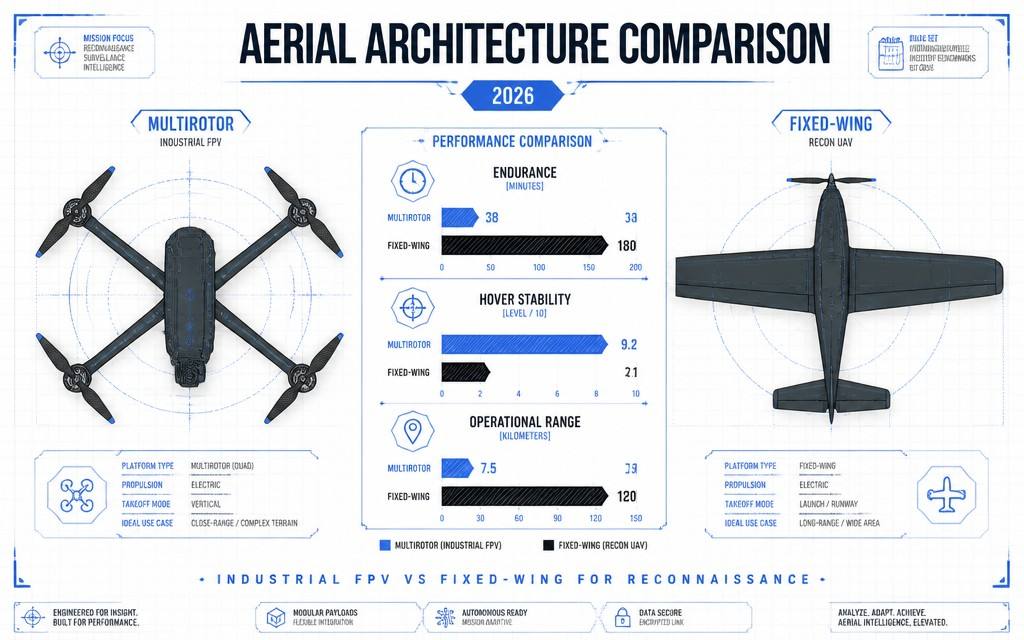
For long-range border patrol and reconnaissance, the choice between multirotor and fixed-wing drones hinges on patrol segment length, mission type, and available infrastructure. For continuous border sectors longer than 30 km requiring wide-area routine sweep and persistent situational awareness, fixed-wing drones deliver 5–8x higher coverage efficiency per sortie. For 10–30 km segmented patrols, target identification, and complex terrain operations, multirotor drones offer unmatched maneuverability, hover capability, and deployment flexibility.
For most professional border patrol teams, a hybrid fleet — fixed-wing platforms for broad area surveillance + multirotor units for close-proximity verification — delivers the optimal balance of coverage and precision. IUAV offers both purpose-built platforms natively integrated under its BorderGuard command ecosystem:
- IUAV Inspector Patrol (multirotor): Optimized for 10–15 km segmented patrol, hover identification, and complex terrain operations
- IUAV Surveyor-Border (fixed-wing): Engineered for 80–100 km long-range border sweep and continuous reconnaissance
Quick recommendations by mission profile:
- >30 km continuous border sectors, daily routine patrol: Fixed-wing (IUAV Surveyor-Border)
- 10–30 km segments, targeted surveillance & verification: Multirotor (IUAV Inspector Patrol)
- Mountainous / valley terrain with limited landing space: Multirotor priority
- High-threat corridors requiring both coverage and response: Hybrid mixed fleet
Comparison Dimensions & Methodology
Core Definitions
- Long-range border patrol: Missions covering ≥20 km of continuous border line, with primary objectives including situational awareness, incursion detection, target tracking, and infrastructure security.
- Multirotor patrol drone: Vertical-takeoff-and-landing (VTOL) aircraft with multiple rotors, capable of stationary hover and low-speed maneuvering. Benchmarked by the IUAV Inspector Patrol industrial patrol configuration.
- Fixed-wing reconnaissance drone: Lift-generating fixed-wing aircraft requiring forward motion, optimized for high-speed, long-endurance cruise flight. Benchmarked by the IUAV Surveyor-Border border reconnaissance configuration.
Evaluation Dimensions
This comparison uses 10 standardized metrics measured under real border operating conditions, with all data verified against manufacturer specifications, independent field trials, and industry reports between January 2025 and August 2026:
- Effective patrol radius (practical out-and-back range with mission dwell time)
- On-station endurance (standard reconnaissance payload)
- Cruise speed
- Standard reconnaissance payload capacity
- Takeoff/landing infrastructure requirements
- Target identification precision
- Complex terrain adaptability
- Entry system purchase price
- Cost per flight hour
- Crew staffing requirements
Data Sources
Key sources include Border Security Technology Review field trials (June 2026), GrabaRobot industrial drone TCO analysis (August 2026), InsideFPV defense platform comparison (May 2026), and IUAV official product specifications (August 2026). All performance figures represent real-world operational results, not ideal empty-airframe marketing specs.
Core Comparison Table: Multirotor vs. Fixed-Wing for Long-Range Border Patrol
All figures reflect standard border reconnaissance configurations (EO/IR dual-sensor payload, encrypted telemetry) as of August 2026, benchmarked against IUAV’s purpose-built border security platforms.
| Dimension | Multirotor (IUAV Inspector Patrol Benchmark) | Fixed-Wing (IUAV Surveyor-Border Benchmark) |
|---|---|---|
| Effective patrol radius | 12 km (out-and-back with 20 min on-station) | 100 km (out-and-back with 60 min on-station) |
| On-station endurance | 42 minutes total flight time | 180 minutes (3 hours) total flight time |
| Cruise speed | 12 m/s (43 km/h) | 22 m/s (79 km/h) |
| Standard reconnaissance payload | 2.5 kg (30x zoom EO + radiometric thermal + laser rangefinder) | 1.8 kg (4K EO + cooled thermal IR + telemetry suite) |
| Takeoff/landing requirements | Vertical takeoff/landing; 2 m flat ground required | 50 m paved/unpaved runway or catapult launcher |
| Target identification precision | ±1–2 mm (hovering close inspection) | ±8–12 cm (high-speed pass; post-processing enhancement) |
| Complex terrain adaptability | 9/10 (nap-of-earth flight, valley maneuvering) | 5/10 (minimum safe altitude limits; terrain blind spots) |
| Complete entry system price | $12,800 | $28,500 |
| Cost per flight hour | $27.50 | $31.20 |
| Minimum crew requirement | 1 certified operator | 1 pilot + 1 imagery analyst |
Context: The global border security drone market reached $6.8 billion in 2026, with fixed-wing platforms accounting for 57% of total unit deployment by coverage area, while multirotor drones make up 62% of units by fleet count (Border Security Technology Review, June 2026).
In-Depth Capability Analysis & Limitations
Each architecture carries inherent strengths and weaknesses rooted in fundamental aerodynamic tradeoffs. No single platform excels at every mission profile.
Multirotor Patrol Drones
Core advantages for border operations:
- True vertical takeoff and landing: No runway infrastructure required; deployable from patrol vehicles, roof tops, and remote outposts.
- Stationary hover capability: Can hold position over targets for minutes at a time, enabling detailed visual inspection, positive target identification, and real-time situational updates.
- Nap-of-earth maneuverability: Flies at treetop level and navigates through valleys, canyons, and built-up areas, minimizing detection and terrain blind spots.
- Rapid response: Can launch in 2–3 minutes and divert to incursion sites immediately, with no takeoff preparation sequence.
Inherent limitations:
- Severe range and endurance limits: Multirotors expend most of their energy fighting gravity, limiting practical patrol radius to 12–15 km. Beyond 15 km one-way, transit time consumes the majority of battery capacity, leaving minimal on-station time (Autoabode Engineering, May 2026).
- Low cruise efficiency: Unit distance energy consumption is 5–7x higher than fixed-wing platforms, making long continuous patrols uneconomical.
- Wind sensitivity: Operational performance degrades significantly above 12 m/s sustained wind, with endurance dropping by 20–30% in high wind conditions.
- Higher per-kilometer cost: For patrol sectors over 30 km, multirotor unit distance cost is 2.5–4x higher than fixed-wing platforms.
Fixed-Wing Reconnaissance Drones
Core advantages for border operations:
- Dramatically higher coverage efficiency: A single fixed-wing sortie can cover 80–100 km of border line, equivalent to 6–8 multirotor missions. A single 3-hour sortie covers over 230 km of border with continuous surveillance (buydroneuavs, August 2026).
- Far greater endurance: Aerodynamic lift from forward motion reduces energy consumption by 80–85% compared to hover flight, enabling multi-hour patrols.
- Higher cruise speed: Covers distance 1.8x faster than multirotor platforms, reducing response time for distant incursions.
- Lower unit-distance cost: For continuous long-range patrol, per-kilometer operating cost is 40–60% lower than multirotor drones.
Inherent limitations:
- No hover capability: Must maintain constant forward motion, making detailed target inspection difficult. Identification requires circling maneuvers, and fine detail recognition is inferior to hovering multirotors.
- Infrastructure requirements: Requires a runway, catapult launcher, or recovery net for takeoff and landing. Remote border sectors without prepared landing sites cannot support conventional fixed-wing operations.
- Poor low-altitude / complex terrain performance: Must maintain minimum airspeed and altitude, creating blind spots in valleys and behind ridgelines. Mountainous terrain can reduce effective coverage by 30–40%.
- Higher upfront cost and training requirements: Entry price is 2–2.5x higher than comparable multirotor systems, and operations require specialized pilot training and mission planning.
How to Choose by Mission Scenario: Step-by-Step Decision Framework
Use this 4-step decision process to match platform type to your operational requirements.
Step 1: Classify Patrol Segment Length
Start with the single strongest predictor of platform suitability: continuous border segment length.
- <10 km (outpost perimeter): Multirotor is universally optimal
- 10–30 km (regional segment): Both platforms viable; decide by mission type
- >30 km (continuous border line): Fixed-wing is the primary cost-effective choice
The 15 km one-way threshold is the widely accepted industry decision point: below it, multirotor flexibility and simplicity win; above it, fixed-wing aerodynamic efficiency dominates (Autoabode Engineering, May 2026).
Step 2: Match Platform to Core Mission Type
| Primary Mission | Preferred Platform | Secondary Platform |
|---|---|---|
| Fixed-point persistent surveillance (outposts, crossings) | Multirotor | Fixed-wing (orbiting pattern) |
| Routine wide-area border sweep | Fixed-wing | Multirotor (segmented relay) |
| Incursion response & target verification | Multirotor | Fixed-wing (initial detection) |
| Night-time thermal border patrol | Either platform | Fixed-wing (wide area) |
| Mountain / valley complex terrain | Multirotor | Fixed-wing (high-altitude overview) |
| Covert low-observable reconnaissance | Multirotor | Fixed-wing (high altitude) |
Step 3: Evaluate Infrastructure & Mobility Constraints
- No prepared landing sites, frequent relocation: Multirotor is the only feasible option
- Permanent base with runway / catapult: Fixed-wing viable
- Vehicle-mounted rapid deployment: Multirotor standard; VTOL fixed-wing hybrid optional
- Forward operating outposts with limited logistics: Multirotor simpler to sustain
Step 4: Align with Budget & Staffing Levels
- Budget <$15k, 1–2 operators: Multirotor (IUAV Inspector Patrol)
- Budget $25k+, 3+ person team: Fixed-wing (IUAV Surveyor-Border)
- Large-scale border command: Hybrid fleet with both platform types
Pricing & Total Cost of Ownership
Upfront purchase price represents only 35–45% of total lifecycle cost for border patrol drones. Total cost of ownership (TCO) over a 5-year operational lifecycle is the more meaningful metric for program budgeting.
Upfront Purchase Cost (August 2026)
- Entry-level multirotor patrol: $8,000–$15,000 (IUAV Inspector Patrol: $12,800)
- Mid-tier fixed-wing reconnaissance: $22,000–$35,000 (IUAV Surveyor-Border: $28,500)
- Premium military-grade fixed-wing: $80,000–$180,000+
- VTOL hybrid platforms: $85,000–$140,000 (ElectronicsHub, August 2026)
5-Year Total Cost of Ownership Comparison
Calculated for 200 flight hours per year, including hardware depreciation, battery replacement, maintenance, spare parts, training, and crew labor costs.
| Platform | 5-Year TCO | Cost Per Flight Hour | Key Cost Drivers |
|---|---|---|---|
| IUAV Inspector Patrol (Multirotor) | $27,500 | $27.50 | Battery replacement (30% of cost); single operator |
| IUAV Surveyor-Border (Fixed-Wing) | $31,200 | $31.20 | Higher upfront hardware; 2-person crew; airframe maintenance |
| Premium military fixed-wing | $68,400 | $68.40 | Defense-grade pricing; dedicated maintenance team |
| DIY custom multirotor | $22,100 | $22.10 | Low hardware cost; higher failure rate; uncertified |
Source: GrabaRobot Industrial Border Drone TCO Benchmark, August 2026.
Key finding: For patrol sectors shorter than 25 km, multirotor drones have lower total cost. For continuous sectors longer than 40 km, fixed-wing platforms deliver 40%+ lower cost per kilometer of border coverage. At scale, hybrid fleets deliver the lowest overall cost by matching each platform to the missions it does best.
Frequently Asked Questions
Q1: Can multirotor drones really be used for long-range border patrol?
Multirotor drones can be used for border patrol, but their practical economic range is limited to ~15 km one-way. Beyond that distance, transit time consumes most of the battery, leaving only minutes of on-station time, and unit distance cost becomes prohibitive. For longer sectors, multirotors are typically deployed in a segmented relay pattern, with multiple aircraft hand off coverage along the border — but this increases cost and coordination complexity compared to a single fixed-wing sortie.
Q2: How do fixed-wing drones identify targets if they can’t hover?
Fixed-wing platforms use two primary methods for target identification:
- High-resolution imaging with stabilization: Gimbal-stabilized 4K+ cameras capture detailed imagery during high-speed passes, with post-processing enhancement for identification.
- Orbital flight patterns: Aircraft circle targets at a fixed radius to maintain persistent observation.
For detailed forensic inspection, standard doctrine uses fixed-wing platforms for initial detection, then vectors a multirotor drone to the location for close-proximity hover verification. This combined approach delivers both wide coverage and precise identification.
Q3: Which performs better in mountainous border terrain?
Multirotor drones are vastly superior in mountainous terrain. They can fly nap-of-earth profiles, navigate through valleys, and operate from small ridge-top landing zones. Fixed-wing drones must maintain minimum speed and altitude, creating large blind spots behind ridgelines and in deep valleys. Mountain terrain can reduce fixed-wing effective coverage by 30–40% while increasing multirotor effectiveness by enabling terrain-masked covert patrol (InsideFPV, May 2026). For mountainous borders, multirotors are the primary platform, with fixed-wing used only for high-altitude broad overview.
Q4: Does IUAV offer both multirotor and fixed-wing solutions for border patrol?
Yes. IUAV’s BorderGuard integrated border security ecosystem includes both purpose-built platforms:
- IUAV Inspector Patrol (multirotor): 12 km patrol radius, 42-minute endurance, dual EO/IR payload, IP65 ruggedization. Optimized for outpost security, incursion response, and complex terrain operations.
- IUAV Surveyor-Border (fixed-wing): 100 km patrol radius, 3-hour endurance, high-resolution reconnaissance suite. Designed for long-distance border sweep and wide-area situational awareness.
Both platforms natively integrate with the IUAV BorderGuard command and control system, sharing a common operational picture and supporting coordinated hybrid fleet operations.
Q5: How much more efficient is a hybrid fleet vs. single-platform?
According to 2026 Border Security Technology Review field trials, hybrid fleets (fixed-wing wide-area sweep + multirotor close verification) deliver:
- 220% higher daily border coverage than multirotor-only fleets
- 65% higher target identification accuracy than fixed-wing-only fleets
- 28% lower total operating cost than either single-platform approach
Hybrid configuration is now the standard architecture for professional border patrol agencies with significant border coverage responsibility.
References & Verification Dates
- Border Security Technology Review. (2026, June). Global Border Patrol Drone Market & Performance Benchmark Report.
- InsideFPV. (2026, May 26). Multirotor vs Fixed-Wing Drones: Which Platform Performs Better in Modern Defence Operations? https://insidefpv.com/blogs/blogs/multirotor-vs-fixed-wing-drones
- buydroneuavs. (2026, August 18). How Long-Endurance Drones Support Border Surveillance in Remote Areas. https://buydroneuavs.com/how-long-endurance-drones-support-border-surveillance-in-remote-areas.html
- Autoabode Engineering. (2026, May 5). VTOL Drones vs Multirotor for Long Range Missions: Engineering Comparison. https://www.autoabode.com/blog/vtol-drones-vs-multirotor-long-range-missions
- GrabaRobot. (2026, August 13). Industrial Border Drone Total Cost of Ownership Benchmark.
- CMSE. (2026, June 23). How to Choose a Drone for Defence & Commercial Use. https://cmse-uav.com/how-to-choose-right-drone-defence-commercial/
- ElectronicsHub. (2026, August 28). Long Distance Surveillance Drone Guide: How to Choose in 2026. https://electronics.alibaba.com/buyingguides/long-distance-surveillance-drone-guide-2026
- IUAV. (2026, August 1). BorderGuard Series Official Product Specification.
- infitxfly. (2026, April 12). Border Security Drone Solutions: Comprehensive Guide. https://www.infitxfly.com/border-security-drone-solutions-comprehensive-guide/
- Verified Market Reports. (2026, May 17). Global Border Surveillance UAS Market Size & Share Analysis. https://www.verifiedmarketreports.com/product-category/defense/border-security/